





Key Takeaways
A firm-focused guide to recovering the traffic professional-services firms lose to Google AI Overviews, and what to do instead of panicking.
- AI Overviews mostly eat informational clicks, so the fix for firms is to stop depending on those clicks and win the citation plus high-intent queries.
- There is no magic AI markup; Google says a page only needs to be indexed and eligible to show with a snippet to appear in AI Overviews.
- Firms hold a real E-E-A-T advantage on legal, financial, and accounting topics, which is exactly what AI Overviews reward when choosing sources.
- The biggest mistake is measuring recovery by raw sessions instead of by qualified consultations and leads, which often hold steady or rise.
- A focused 90-day plan on eligibility, fan-out coverage, and lead tracking turns an AI Overviews traffic drop into a cleaner pipeline.
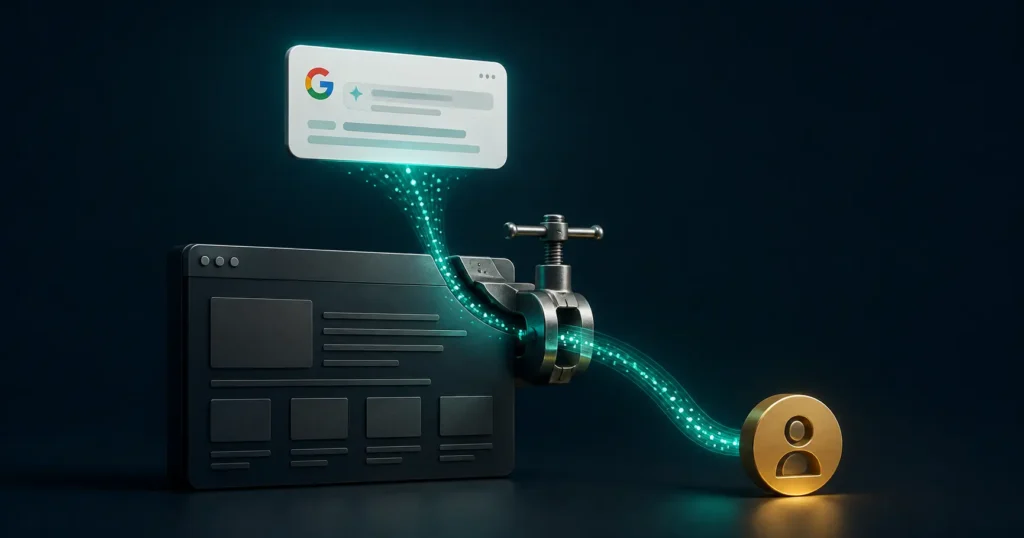
Google AI Overviews Are Eating Your Firm’s Traffic. Here’s the Fix
If your firm’s blog traffic fell off a cliff this year, Google AI Overviews are the likely culprit, and the fix is not what most panic articles suggest. When an AI Overview answers a question at the top of the results, far fewer people click through.
The Pew Research Center data found users click a traditional result about 8% of the time when an AI summary is present, versus roughly 15% when it is not, and only about 1% click a link inside the Overview itself.
This guide is for professional-services firms in the United States, law, accounting, financial advisory, consulting, and agencies, whose informational articles stopped pulling clicks. The good news is that firms are unusually well positioned to recover, because AI Overviews reward exactly the deep expertise firms already have.
The fix is a shift in strategy, not a scramble for some secret tag. Our team at Intelitune helps firms trade a shrinking pool of informational clicks for citations and higher-intent leads that AI Overviews touch far less.
Why Are AI Overviews Taking Your Firm’s Traffic?
AI Overviews take your traffic because they answer the informational questions your blog used to answer, so the reader never needs to click. For firms, the hardest-hit pages are the broad explainer posts, the “what is” and “how does” articles written to attract top-of-funnel visitors. Those are precisely the queries Google now resolves on the results page.
The scale is why this stings. Google has said AI Overviews reach well over a billion people, and SparkToro zero-click research shows fewer than a third of searches now end in a click to the open web. So a ranking that once sent hundreds of visitors a month can still rank first and send a fraction of that. The traffic did not move to a competitor; it evaporated into an answer. Understanding that is what separates a smart recovery from a wasted one.
The reflex for most firms is to try to claw those informational clicks back with more informational content, which is the trap. You cannot out-publish a summary that answers the question before anyone scrolls.
The durable response is to become the source that summary cites, which is the whole point of answer engine optimization, and to move real effort toward the queries a summary cannot satisfy. A reader deciding whether to hire a tax attorney is not served by a paragraph; they still click, compare, and call.
Quick verdict: Stop trying to win back informational clicks that AI Overviews now absorb. Instead, get cited inside the Overview, cover the fan-out sub-questions with real expertise, and shift your effort toward branded, local, and consultation queries where firms still earn the click and the lead.
Which Firm Pages Lose the Most to AI Overviews?
The pages that lose most are broad, informational articles with no transactional intent, the exact content firms mass-produced for years to build topical authority. A general “how does a trust work” post gets summarized away, while a booking page or a specific local service page barely feels it. Knowing which pages bled traffic tells you where to stop investing and where to double down.
High-intent pages hold up far better. Someone searching your firm by name, looking for a local practitioner, or ready to book a consultation still clicks through, because an AI summary cannot replace hiring you.
Gartner’s search-volume forecast predicted a 25% drop in traditional search volume by 2026, but that decline is not evenly spread. It falls hardest on the informational middle, and lightest on the branded and transactional queries that actually feed a firm’s pipeline.
Run the audit page by page and the pattern becomes obvious. Pull your top pages that lost traffic and sort them by intent. You will usually find a cluster of broad explainers hemorrhaging sessions while your practice-area and location pages barely moved.
That split is a gift, because it tells you precisely where to stop spending and where your remaining search value actually lives. A firm that reacts to the total traffic number panics; a firm that reads the intent breakdown acts with precision.
The Fix Is Not a Magic Tag: How Firms Actually Appear in AI Overviews
There is no special AI markup, and any vendor selling you one is selling snake oil. According to Google’s own Google AI features documentation, there are no additional requirements, files, or schema needed to appear in AI Overviews or AI Mode.
A page only needs to be indexed and eligible to be shown in Google Search with a snippet. That is the whole eligibility bar. The same Gemini SEO fundamentals that help you rank are what put you in the Overview.
What changes is which content gets pulled. AI Overviews use a technique Google calls query fan-out, issuing several related searches and assembling an answer from a diverse set of sources.
So the firms that appear are the ones whose content cleanly answers not just the headline question but the cluster of sub-questions around it.
Cover the Fan-Out: Answer the Sub-Questions
Map the sub-questions a reader actually has and answer each one in a clean, self-contained passage. If the topic is “how a revocable trust works,” the fan-out includes cost, tax treatment, revocability, and how it differs from a will, and the page that covers all of them is the one an Overview draws from. Answer each sub-question under its own clear heading, in a sentence a summary could lift without any surrounding context.
Structured data will not force you into an AI Overview, since Google is explicit that no special schema is required. That said, marking up your FAQs, services, and location with Schema.org structured data still earns rich results and helps machines parse your answers, so it remains worth doing for reasons beyond the Overview.
Lead With Your Firm’s Expertise
Genuine expertise is a firm’s biggest advantage, because AI Overviews favor content that demonstrates experience, authority, and trust. Google’s Google helpful content guidance rewards people-first content from credible sources, and a licensed attorney or CPA writing from real casework clears that bar in a way a generic content mill never will. Put the author’s credentials, real examples, and firsthand judgment front and center.
This is where firms beat pure publishers. On money and legal topics, the systems are cautious about who they cite, and a named, qualified professional is a safer source than an anonymous blog. Make your expertise unmistakable and you become the citation, not the casualty.
Practically, that means fixing the bylines and bios most firms treat as an afterthought. Attach every article to a real, credentialed author with a detailed bio, link that author to their bar or license record where appropriate, and let the writing show judgment rather than reciting definitions anyone could copy.
Firms that publish faceless, generic explainers throw away their single biggest edge. The whole reason a legal or financial topic falls under Google’s stricter scrutiny is the same reason your licensed professionals are the safest possible source to cite.
Shift From Informational Clicks to High-Intent Leads
The strategic fix is to rebalance away from informational content toward the queries that still convert, because those are the ones AI Overviews barely touch. Branded searches, local intent, comparison of providers, and “hire” or “consultation” queries all still send clicks and leads. This is where generative engine optimization and firm growth actually intersect.
Reallocate real budget here. Strengthen your service pages, your local presence, and your consultation funnels, and treat top-of-funnel explainers as citation bait rather than traffic drivers.
A firm that stops mourning informational sessions and starts optimizing for booked calls usually finds its pipeline is healthier than the traffic chart suggests, because the visitors it loses were rarely the ones who were going to hire it anyway.
Worried your firm’s pipeline is shrinking with your traffic? Book a strategy call and we will map which queries still convert for your firm and how to win them.
Should You Block AI Overviews With nosnippet?
You can block your content from AI Overviews with the nosnippet tag, but for most firms it is the wrong move. Google confirms that preview controls like nosnippet, data-nosnippet, max-snippet, and noindex manage whether your content appears in AI features.
The catch is that nosnippet also removes your traditional featured snippets and rich previews, so you often lose more visibility than you protect.
Blocking makes sense only in narrow cases, such as gated proprietary content you never want summarized. For the informational content most firms publish, being cited inside an Overview still builds authority and brand recognition even without the click.
Check the tradeoff before you touch it; a quick AI visibility diagnostic shows whether you are being cited or ignored, which should drive the decision.
Rebuild Your Measurement: Track Leads, Not Just Sessions
The fastest way to panic needlessly is to keep judging success by raw sessions. If your dashboard only tracks traffic, an AI Overviews drop looks like a catastrophe even when your consultations are steady. Firms live on qualified leads, not pageviews, so your reporting has to follow the money.
Shift your primary metrics to consultation requests, form fills, calls, and assisted conversions, then segment traffic by intent so informational declines do not mask healthy transactional performance. When you measure what actually feeds the firm, you can tell the difference between a real problem and a vanity-metric scare, and you invest accordingly.
Add one more layer: brand and citation tracking. A reader who saw your firm named inside an AI Overview may not click that day, but they may search your firm directly a week later or arrive through a referral.
If you only credit last-click traffic, that influence is invisible, and you will underinvest in the exact content that is quietly building your reputation. Watch branded search volume and direct traffic alongside leads, because in an answer-first world those are often where the value of a citation finally shows up.
Common Mistakes Firms Make After an AI Overviews Drop
The most damaging mistake is deleting or gutting content that lost traffic, because that content may still earn citations and support your topical authority. Ripping it out to chase a bounce-back removes the very pages AI Overviews draw from. Refresh and deepen instead of deleting.
Other errors compound the loss. Firms chase a phantom AI markup, ignore the branded and local queries that still convert, keep reporting on sessions alone, and neglect broader AI visibility work like ChatGPT SEO and Perplexity SEO even as buyers research firms across every assistant.
Panic-driven decisions almost always cost more than the traffic did, because they trade durable authority for a short-term traffic number that is not coming back in its old form.
Your 90-Day AI Overviews Recovery Plan for Firms
Start by segmenting your pages by intent and identifying which losses actually matter. Informational drops with no lead impact are noise; declines on pages that fed consultations are the priority. Confirm your key pages are indexed and snippet-eligible, then rebuild your highest-value explainers to cover the full fan-out with clear, credentialed answers.
Next, reallocate effort to the queries that still convert, tighten your service and local pages, and rebuild your reporting around leads. Track results the way we do in our case studies, and tailor the plan to your practice area, since the mix varies widely across the industries we serve.
Ninety days of disciplined work on eligibility, fan-out depth, expertise signals, and lead tracking turns an AI Overviews scare into a leaner, higher-converting search presence.
Your firm’s traffic chart and your firm’s pipeline are no longer the same story, and that is the real lesson of AI Overviews. Stop optimizing for a click that a summary now absorbs, and start optimizing to be the trusted source that summary cites and the firm that reader eventually hires.
Do that, and the drop becomes an advantage over every competitor still panicking about sessions instead of quietly rebuilding around the leads that actually pay the firm.
Frequently Asked Questions
Can I stop Google AI Overviews from using my firm’s content?
Yes, using preview controls like the nosnippet or data-nosnippet tags, but it usually backfires. Those tags also remove your featured snippets and rich previews, so you often lose more visibility than you protect. For most firms, being cited inside an AI Overview still builds authority, so blocking makes sense only for gated or proprietary content you never want summarized.
Do I need special schema to appear in AI Overviews?
No. Google states there are no special requirements, files, or schema needed to appear in AI Overviews or AI Mode. A page only needs to be indexed and eligible to show in Search with a snippet. Structured data still helps you earn rich results and helps machines parse your content, but it is not a requirement for appearing in AI features.
Why did my firm’s blog traffic drop but leads stayed steady?
Because AI Overviews absorb informational clicks, not transactional ones. Your explainer articles lost visits when Google started answering those questions directly, but branded, local, and consultation queries still send clicks and leads. If your consultations held steady while sessions fell, your pipeline is intact and your reporting simply needs to track leads rather than raw traffic.
Should firms stop writing informational blog content?
No, but treat it differently. Informational content still builds topical authority and earns citations inside AI Overviews, which supports brand recognition even without the click. The shift is to write it to be cited and to answer the full fan-out of sub-questions, while investing more heavily in the service, local, and consultation pages that still convert readers into clients.
How long does it take firms to recover from an AI Overviews drop?
Most firms see a clearer picture within about 90 days once they re-segment by intent and rebuild reporting around leads. Recovering citation visibility and strengthening high-intent pages takes a quarter of focused work. The traffic number may never fully return to its old shape, but qualified leads and pipeline often recover or improve faster than raw sessions.
Resources & Further Reading
The following authoritative sources were used to inform and validate this article:
- Google AI Features Documentation – Google’s official guidance on how sites appear in AI Overviews and AI Mode
- Pew Research Center – data on falling click rates when an AI summary appears in search results
- Google Search Central – helpful content and E-E-A-T guidance for credible sources
- Gartner Press Release – prediction that search volume will drop 25% by 2026
- SparkToro – research on zero click search and the shrinking share of clicks to the open web
- Schema.org – structured data vocabulary for rich results and machine-readable content

Arqam Bashir
Founder & Head of AI SEO
Arqam Bashir is the Founder & Head of AI SEO at Intelitune, helping brands grow visibility across ChatGPT, Google AI Overviews, Gemini, Perplexity, and Search through AI SEO, AEO, GEO, technical SEO, and entity optimization.
- Previous
- Next
- Real client results
What you can expect to gain
- AI Visibility Diagnostic