
- Answer Engine Optimization
Answer Engine Optimization (AEO): get cited inside AI answers.
When buyers ask AI a question, AEO structures your content so ChatGPT, Perplexity, Gemini, Claude, and Google AI Overviews quote your brand as the answer, not a competitor.
How a cooking school hit 96.6% ChatGPT visibility in 30 days.
Free diagnostic · 3 business days · No sales call
Surfaces we optimize for:


ChatGPT

Gemini

Claude

Microsoft Copiltot

ChatGPT · answer
Prompt
“Best cookery schools for hands-on classes?”
Response
A few highly-rated options stand out for hands-on instruction:

Your brand, small-group classes across cuisines, instructor-led, cited with sources.
Other options include Leiths and Divertimenti…
Citation earned
via AEO
- The visibility gap
Why your content isn't getting cited.
Five structural failures block your content from being cited across answer engines.
You’re showing up in Google. The traffic looks fine. But when a buyer asks ChatGPT about your category, your name doesn’t come up.
That’s not a ranking problem. It’s a citation problem.
AI systems decide what to cite based on different signals than the ones that earn rankings. Entity clarity. Schema density. Whether your content can be extracted as a clean, standalone answer. Most B2B sites were built for the first job. Almost none were built for the second.
Here’s what we usually find when we audit:
Google · 10 blue links
agency-one.com › services
directory.com › research
competitor.io › about
review-site.com › b2b
You rank. The buyer scans. Maybe clicks.
→ Competitor cited
One brand named. The rest never enter the conversation.
Content structure
isn’t built for direct answers, with no Q&A blocks and no comparison structures
Entity clarity
is missing, so AI can’t disambiguate your brand from competitors
Semantic coverage
is weak, with topical authority gaps where peers earn citation
AI retrieval
isn’t optimized, with schema markup partial and llms.txt misconfigured against the major crawlers
Indexation
has gaps, with important pages excluded and unimportant pages bloating the index
Your competitors get named in the answer. You get the rankings. They get the pipeline.
- The citation layer
What is Answer Engine Optimization?
Key takeaways
- AEO is content optimization for AI answer engines, not traditional Google search results.
- It earns citations across ChatGPT, Perplexity, Gemini, Claude, Microsoft Copilot, and Google AI Overviews.
- Schema markup is necessary but not sufficient, content patterns and passage quality matter more.
- Documented case studies show 30–90 day citation timelines.
Answer Engine Optimization (AEO) is the practice of structuring content so AI answer engines extract it, quote it, and cite your brand as the source. Featured Snippets were the predecessor, AEO is the AI-era evolution covering ChatGPT, Perplexity, Gemini, Claude, Microsoft Copilot, and Google AI Overviews.
Search Engine Land documents the rise of zero-click queries as the new search reality. AEO earns the citation. The methodology covers passage quality, structured data, entity clarity, trustworthiness, and topical authority as core ranking signals.
How a citation actually happens
Query
Buyer asks AI
Retrieval
Sources fetched
Extraction
Answer parsed
Citation
Brand named
Query
Buyer asks AI
Retrieval
Sources fetched
Extraction
Answer parsed
Citation
Brand named
Three disciplines run together, and each one has a distinct job:
AEO
earns the citation. Your brand quoted, named, or surfaced in the answer itself.
GEO
earns the recommendation. Your brand suggested when buyers ask AI which vendor to choose.
LLM SEO
earns the technical inclusion. Your site readable, indexable, and trusted by AI crawlers.
Some agencies treat AEO and GEO as the same thing. We don’t.
They share infrastructure but solve different problems. Citation is about being extractable. Recommendation is about being preferred. The work for each compounds when run together, and falls apart when treated as one.
This page is about the citation layer specifically.
- The behavior shift
Why AEO is critical in AI search.
Behavior shift
Many queries resolve zero-click now.
The user reads the AI answer and never visits a website. AI answers compress the click-through path, buyers shortlist via AI before they ever open Google. If you’re not cited, you’re not in the consideration set.
Volume
Ask-first
Buyers put the full question to AI and act on the answer, not ten blue links.
Trajectory
Climbing
AI-referred sessions keep climbing across the engagements we track.
That’s a behavior shift, not a hype cycle.
Disqualification used to happen on your website.
Before
01
Buyer lands on your homepage.
02
Reads your content.
03
Decides whether to book a demo.
now
01
Buyer asks ChatGPT.
02
Gets three vendor names.
03
Shortlists whichever was named most clearly. Never visits your site.
AEO is the discipline that earns citation eligibility, and Featured Snippets, voice search, and AI Overviews all reward the same structural signals.
That window won’t stay open.
- How we work
Our 4-step AEO methodology.
Intelitune’s 4-step AEO methodology, the same framework behind our documented engagements.
01 / Answer structuring
Restructure content for direct answer extraction first.
We rewrite the load-bearing pages around the formats AI systems actually extract.
- Q&A blocks at 100–200 word answer block length per question.
- Comparison structures (table-format Q&A) for category comparison queries.
- Definition frameworks, under 25 word definition plus 3-bullet supporting set.
- List-based answers inside passage quality blocks.
- Pruning thin Q&A blocks that no one searches for.
First decisions are usually pruning decisions.
02 / Entity optimization
Entity clarity is the single highest-leverage AEO factor for premium brands.
We tune entity signals to disambiguate your brand from the competitive set.
- Organization schema defining the brand as a distinct, resolvable entity.
- sameAs links to authority sources (Wikipedia, Crunchbase, LinkedIn Company).
- Direct answer alignment across every entity reference.
03 / Schema & structured data
Carry the AEO content into machine-readable form.
Schema markup and structured data make the answer extractable.
- FAQPage and HowTo schema where Q&A or step content lives.
- Article schema for evergreen long-form citation-eligible pages.
- Freshness signals so AI knows the page is current.
- Topical clusters reinforcing each direct answer.
04 / Citation targeting
Citation eligibility tracking, freshness loop, and measurement against the competitive set.
The final layer is measurement.
- Passage quality scored against AI extraction patterns.
- Citation rate measured against competitive set.
- Mention rate tracked monthly across answer engines.
- AI Visibility Diagnostic
See if your content gets cited.
Written diagnostic covering the AEO layer of your site. Three business days. No sales call. Routed to your inbox.
Written diagnostic. 3 business days. Complimentary. No sales call.
- The building blocks
What we optimize.
Four components carry the AEO work. Each one earns citation differently. Each one has to be in place for the rest to compound.
01 /Content structure
Q&A blocks, comparison structures, definition frameworks.
The patterns AI extracts.
02 /Schema and entities
FAQ schema, HowTo schema, Organization schema, sameAs links.
Entity disambiguation across the site.
03 /Answer targeting
Direct answer, passage quality, 100–200 word block per query.
The dimensions AI weighs.
04 /Topical authority
Topical clusters plus entity signals plus freshness.
Cumulative weight Google and AI measure.
Each layer compounds the others. Schema without entity clarity gets misread. Entity clarity without crawl access never gets surfaced. Extraction signals without authority signals get cited inconsistently. The work is integrated by design.
- How AI extracts
Proven content patterns that get cited.
Five content patterns dominate AI citation. Q&A blocks are the most extracted, clear question, 100–200 word answer block, structured for citation extraction. Comparison structures pull from side-by-side tables answering “X vs Y”.
Definition frameworks open with a 25-word definition followed by three supporting bullets, doubling citation rate against unstructured paragraphs.
List-based answers nested inside passage quality blocks pick up voice search queries especially well. Information gain markers, specific data, dates, and named entities, get quoted where generic explanation gets paraphrased.
01
Question-led H2s with answer-first paragraphs.
What it is
An H2 phrased as a buyer’s actual question, immediately followed by a single sentence that answers the question completely.
Why it works
AI systems lift the first sentence after a question heading. If that sentence answers the question on its own, the citation is clean.
What breaks it
Opening with “There are several factors to consider…” or any setup language breaks it. The setup gets cited instead of the answer, and the answer gets paraphrased into something less specific.
Extraction preview
“What is answer engine optimization? AEO is the practice of structuring content so AI systems can extract and cite it as a direct source.”
02
Standalone definition blocks.
What it is
Term, standalone definition, context, in that order.
Why it works
AI systems extract definitions disproportionately when generating answers to “what is X” queries. Self-contained definitions outperform context-dependent ones in every retrieval test we’ve run.
What breaks it
Defining a term using another undefined term, or burying the definition mid-paragraph, breaks it. The buyer reads it; the AI system can’t extract it cleanly.
Extraction preview
“Schema density: the count and quality of structured data types applied across a site, weighted by retrieval relevance.”
03
Parallel comparison structures.
What it is
Side-by-side construction with consistent terminology. “X is faster than Y. Y is more accurate than X.” Same terms used the same way across the comparison.
Why it works
AI systems handle clean parallel structure cleanly. The comparison can be lifted as a single unit.
What breaks it
Hedging language breaks it. “While X excels in some areas, Y has its own advantages” creates ambiguity that breaks extraction. The system can’t tell what the comparison actually concluded.
Extraction preview
“Perplexity cites 3–4 sources per answer. ChatGPT cites 1–2. Claude cites fewer than either.”
04
Structured lists and tables for shortlist queries.
What it is
Numbered lists for ranked recommendations. Tables for feature comparisons. Each item parallel in length and format.
Why it works
Buyers ask AI systems for shortlists (“best CRM for B2B SaaS,” “alternatives to Salesforce”). Pages structured as shortlists get cited as shortlists.
What breaks it
Mixing list items with prose explanations between them breaks it. The list structure breaks; the citation goes elsewhere.
Extraction preview
“Top 3 AEO platforms to track: 1. ChatGPT 2. Perplexity 3. Google AI Overviews.”
05
Information gain markers.
What it is
Specific data, dates, named entities, original research embedded inside otherwise standard content.
Why it works
AI systems trained on trust signals weight content that introduces new, citable facts. Generic explanation gets paraphrased. Specific data gets quoted.
What breaks it
Stats without sources, dates without context, named entities without disambiguation break it. AI systems flag unverifiable claims and cite something else.
Extraction preview
“Intelitune drove £2,262 in ChatGPT-attributed revenue for a culinary-education brand over 30 days.”
The pattern matters less than the substance under it. A question-led H2 with a vague answer is worse than a declarative H2 with a specific answer. We start with the patterns, then make the substance earn the structure.
- The engagement
How we run AEO engagements.
01 / Audit content
We audit existing content against a citation eligibility rubric.
- Diagnostic across content, schema, entities, llms.txt, and crawler access.
- Competitive set mapping, pages already cited by AI for your queries.
- Documented findings ranked by impact.
02 / Restructure for answers
Existing pages get restructured for direct answer extraction before any new content is written.
- Q&A blocks added where queries already rank.
- Comparison tables for category-level shortlisting.
- Pruning thin content that competes with itself.
03 / Add information gain
Net-new pages only where peers already rank and the gap is real.
- Information gain above peer pages on the same query.
- Topical authority built through topical clusters.
- Documented sources where claims need evidence.
04 / Optimize for citation
Schema, freshness, and entity signals tune the page for AEO citation.
- FAQPage, HowTo, and Article schema where the content pattern fits, benchmark the schema against top citation pages.
- Freshness loop, quarterly content refresh on top citation pages.
- Pipeline reporting on citation rate, mention rate, and qualified leads attribution.
Senior team
Intelitune’s senior team leads strategy on every engagement. Specialists execute. The senior team reviews the work and stays in every decision that matters. Most engagements run 3 months minimum. Most clients stay over a year.
The methodology is not the differentiator. The measurement is.
Visibility isn’t the win. Behavior is. Pipeline is the proof.
- Answer engines
Optimized for leading AI platforms.
Five answer engines drive citation share for premium service brands. AEO mechanics adapt to each one, and the foundation underneath stays the same.
ChatGPT SEO
Open ai
AEO content patterns weighted for ChatGPT Search and citation extraction.
Perplexity SEO
Perplexity weighs freshness heavier, so the content refresh cycle is tuned accordingly.
Gemini SEO
Gemini and Google AI Overviews share signals, so schema and topical authority compound here.
Claude SEO
Claude prefers structured Q&A and passage quality blocks for citation.
Microsoft Copilot SEO
Copilot pulls from the Bing index, so FAQPage schema and structured data carry the answer.
Meta AI SEO
The mechanics differ. The foundation underneath them, entity clarity, schema density, extractable content, crawl access, stays the same.
- Best fit
Where AEO works best.
AEO mechanics aren’t industry-agnostic. The signals that earn citation in luxury travel are not the signals that earn citation in market research.
We’ve documented results across four verticals. Different mechanics. Same foundation underneath.
Professional Services
Buyers ask AI which firm to trust. AEO lands you in Google AI Overviews and ChatGPT.
B2B SaaS & Technology
Buyers ask AI for software before they reach your site. AEO structures pages for citation.
B2B Market Research
Procurement teams shortlist research vendors via AI. AEO drives qualified leads.
Digital Marketing Agencies
Prospects ask AI which agency to hire. AEO gets your agency named in the answer.
Luxury Travel & Hospitality
Affluent travelers ask AI where to stay. AEO gets you cited beside Belmond and Virtuoso.
- Every vertical
Don’t see your industry?
If your buyers ask AI before they shortlist, AEO applies. The citation mechanics don’t care about your category, they care about your signals. A diagnostic shows exactly where you stand across the answer engines.
Different verticals, different mechanics. The foundation underneath, schema, entity clarity, extractable content, crawl access, stays consistent.
- The proof
Real results from AEO.
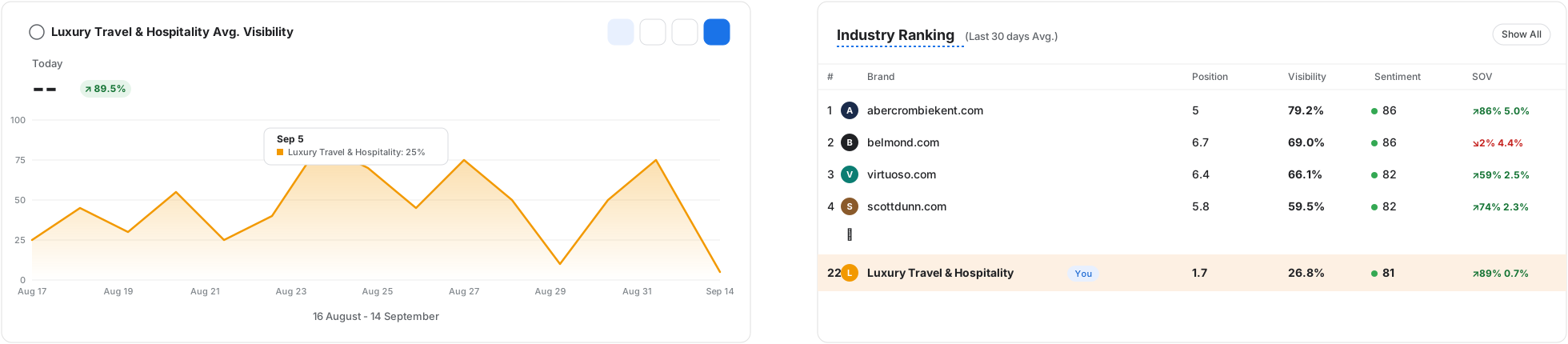
Luxury Travel Brand · 60 days
From #22 to #9 against category leaders.
Vertical: Luxury Travel Timeline: 60 days
60-day AEO engagement. This luxury travel brand is now cited beside Belmond, Virtuoso, and Abercrombie & Kent inside ChatGPT and Perplexity answer engines, with 100% AI visibility across both platforms with 58.3% share of voice documented over the engagement window.
- Related services
Part of our AI SEO system.
AEO (Answer Engine Optimization) is one of three disciplines under Intelitune’s AI SEO system, the answer-engine campaign layer for the citation outcome.

Parent system
AI SEO Hub.
The parent system. AEO + GEO + LLM SEO under one methodology.
Recommendation layer
GEO (Generative Engine Optimization).
GEO earns the recommendation. The compounding layer above AEO citation.
Different signals. Compounds with AEO and LLM SEO.
Technical layer
LLM SEO.
If LLM SEO is broken, AEO and GEO can’t earn what they’re supposed to earn.
The disciplines compound. AEO gets you cited. GEO gets you recommended. LLM SEO makes you reachable. None work alone.
- Good to know
Frequently asked about AEO.
What is answer engine optimization (AEO)?
Answer engine optimization (AEO) is the practice of structuring content so AI answer engines extract it, quote it, and cite your brand as the source. Instead of chasing a blue-link ranking, AEO earns the citation inside answers from ChatGPT, Perplexity, Gemini, Claude, and Google AI Overviews, where buyers increasingly get their information.
What is the difference between AEO and SEO?
SEO earns rankings and clicks on Google; AEO earns the citation inside an AI answer. They share a foundation of quality content and clean technical health, but AEO adds answer-first structure, entity clarity, and schema so an engine can lift your passage and name you. Most brands now need both.
What is the difference between AEO and GEO?
AEO and GEO solve different halves of AI visibility. AEO is citation: structuring passages so an engine quotes you as the answer. GEO, generative engine optimization, is recommendation: building the entity and authority signals that make AI name your brand when someone asks for options. A strong AI presence usually needs both.
How does AEO get your content cited by AI?
By making your answer the easiest one to lift. We structure answer-first passages, mark them up with FAQ, HowTo, and Organization schema, disambiguate your brand as an entity with sameAs links, and build topical authority. When a passage is clean, accurate, and clearly attributed, engines quote it and cite the source.
How long does AEO take to work?
Technical, schema, and entity fixes can shift AI answers within weeks; consistent citations usually build over about 60 days. In one documented culinary-education engagement, ChatGPT visibility reached 96.6% in 30 days, though timelines vary with your starting authority, competition, and content. Every engagement reports against a baseline from day one.
Do you guarantee an AI citation?
No, and no honest operator can guarantee a brand mention inside ChatGPT or any AI answer. Those engines decide what to quote, and they change constantly. What we guarantee is the methodology, transparent reporting against your baseline, and a senior team leading the work, so you always see what moved and why.
How do you measure AEO success?
Three ways: citation rate, whether engines quote and name you for priority questions; share of voice, your brand mentions versus competitors; and revenue attribution, leads and sales from AI-driven traffic in GA4 and Google Search Console. Everything is tracked against a documented baseline, so results are proven in your analytics.
Who is AEO for?
AEO fits premium service brands and scaling B2B SaaS, typically $2M to $50M in revenue, across professional services, technology, market research, agencies, and luxury travel. Intelitune is remote-first and works with clients worldwide, so location is not a barrier. It works best when being cited in AI answers can drive real revenue.
- 3 business days · No sales call
Get cited inside AI answers.




All four clients began with this exact audit. Documented outcomes inside the case study library.