





Key Takeaways
A 2026 guide to ranking in Microsoft Copilot answers, built on how Copilot grounds in Bing and the Microsoft report that makes AI visibility measurable.
- Copilot grounds its answers in Bing’s web index and cites sources, so your Bing visibility is the foundation of Microsoft Copilot SEO.
- Copilot SEO is uniquely measurable: Bing Webmaster Tools now shows your Citation Share in AI answers, a report Google does not offer.
- The neglected win is Bing itself, since most brands optimize for Google and leave the engine Copilot actually reads underinvested.
- The biggest mistake is treating Copilot as a niche channel when it runs across Windows, Edge, Bing, and Microsoft 365 for a billion-plus users.
- Consistent entity signals and clean, quotable content are what turn a Bing ranking into a Copilot citation.
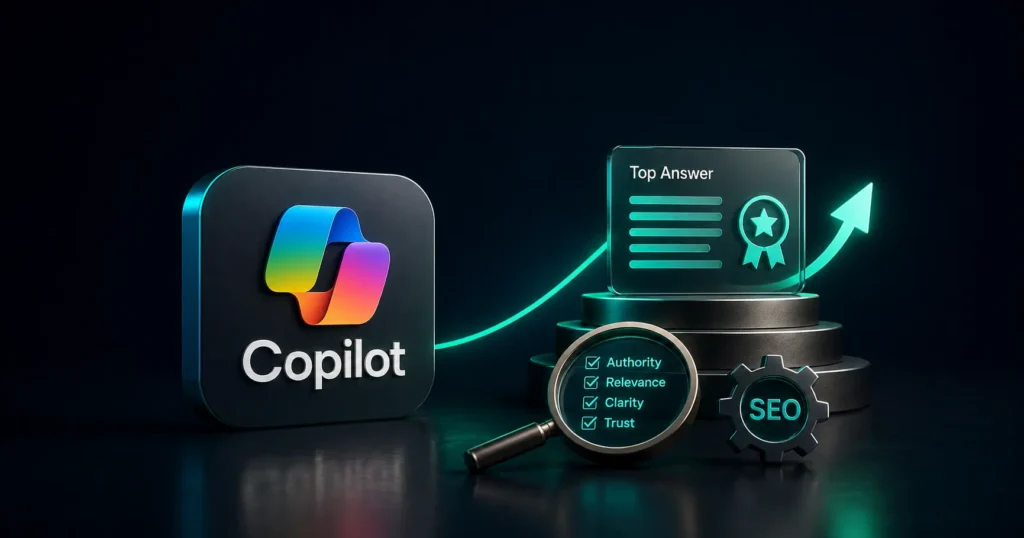
Microsoft Copilot SEO: How to Rank in Copilot Answers
Microsoft Copilot SEO comes down to one mechanic most guides miss: Copilot grounds its answers in Bing’s web index and cites the sources it uses. That means ranking in Copilot answers is not a separate mystery. It is largely downstream of your Bing visibility, combined with content clean enough for Copilot to quote and attribute.
This guide is for marketers, founders, and SEO teams in the United States who want their brand cited when someone asks Copilot inside Windows, Edge, Bing, or Microsoft 365. Two facts make this worth your time.
First, Copilot reaches an enormous audience across Microsoft’s ecosystem. Second, and unusually, Microsoft lets you measure your progress, because Bing Webmaster Tools now reports your Citation Share in AI answers.
According to Pew Research Center data, people click far fewer traditional links once an AI answer appears, so being the cited source inside Copilot now matters more than a raw ranking. Our team at Intelitune treats Copilot as the most measurable AI-search opportunity available today.
What Is Microsoft Copilot, and Where Does It Get Answers?
Microsoft Copilot is Microsoft’s AI assistant, and it gets real-time answers by grounding in Bing’s web index, then citing the sources it draws from. It runs across Windows, Edge, Bing, Microsoft 365 apps like Word and Teams, and the standalone Copilot app, so it answers questions right inside the tools people already work in. Getting cited by it is a core part of answer engine optimization.
That grounding step is the whole game. When Copilot answers a question, it runs searches against Bing, synthesizes the results, and attaches citations to the specific claims those sources support.
If your site is not visible in Bing, Copilot has nothing to ground against and no reason to cite you. The reach makes this consequential: Copilot is embedded in the operating system and productivity suite of well over a billion people, so a citation there reaches buyers in the middle of their workday.
Quick verdict: Copilot cites what Bing can surface and what Copilot can cleanly quote. Win real Bing visibility, structure your pages so a factual passage is easy to lift, then use the Bing Webmaster Tools AI report to measure your Citation Share and improve it. Skip Bing and you stay out of the answer.
How Do You Rank in Microsoft Copilot Answers?
You rank in Copilot answers by being visible in Bing for the query and offering a clean, quotable passage Copilot can attribute. There is no separate Copilot submission or ranking dial; you influence it through Bing visibility and content clarity. This is where generative engine optimization and classic search work converge.
The practical implication is that Copilot rewards the same fundamentals Bing does, plus extractability. A page that ranks in Bing but buries its answer in a dense paragraph gives Copilot nothing tidy to cite, so it grounds against a competitor who wrote a crisp, standalone sentence instead.
Copilot Grounds in Bing, So Bing Visibility Comes First
Bing visibility is the single biggest lever in Copilot SEO, because grounding pulls from Bing’s index. Most brands pour everything into Google and treat Bing as an afterthought, which quietly hands Copilot answers to whoever bothered to rank there.
SparkToro zero-click research shows fewer than a third of searches now end in a click, so the citation, not the click, is increasingly the prize, and in Copilot that citation is decided in Bing.
Because so few competitors take Bing seriously, its results are often less contested than Google’s. A page that struggles on Google can rank well on Bing, which puts you into Copilot answers you would never win otherwise.
Where Copilot Shows Up: Windows, Edge, and Microsoft 365
Copilot appears inside the surfaces people already use all day, not on a separate destination they have to seek out. It sits in Windows, the Edge sidebar, Bing search, and Microsoft 365 apps, and answers through the Copilot app on the web and mobile. Each surface is a place a buyer might ask for a recommendation mid-task.
That placement changes behavior. Someone researching a purchase inside Edge or drafting a document in Word can get a cited answer without ever opening a fresh search, so the brand Copilot names captures attention you never see in a traditional analytics report.
Measure Your Copilot Citations With Bing Webmaster Tools
Here is the advantage no other major engine gives you: Microsoft shows you your Copilot citation performance. The Bing AI Performance report in Bing Webmaster Tools reveals how your content appears in AI-generated answers across Microsoft Copilot, Bing, and partner AI platforms. You can finally see whether the model is citing you or ignoring you.
The report includes several metrics worth knowing. Citations track when your content is referenced in an AI answer. Citation Share shows the percentage of citations attributed to your site out of all citations for that grounding query, so you see relative visibility, not just raw counts.
Intents classify the queries by type, such as Informational, Commercial, or Local, and Topics group them into thematic clusters. A Compare view shows how your citation activity changes over time. Microsoft is explicit that Citation Share is an observational metric, not a ranking system, so treat it as a feedback loop rather than a scoreboard.
Even so, it is the closest thing to a Copilot analytics dashboard in existence, and using it puts you ahead of competitors flying blind.
The strategic value is in the loop it creates. For the first time, you can change a page, wait, and watch whether your Citation Share for a topic moves, instead of guessing whether an AI edit worked.
The Intents and Topics views are especially useful, because they show which kinds of questions you already win and which you are absent from, so you can point your content at the exact gaps.
I treat this report the way a paid-search team treats a campaign dashboard: check it on a schedule, watch the trend line, and let the data decide where the next piece of content goes rather than optimizing on hunches.
Win Bing: The Foundation of Copilot SEO
Winning Bing is the durable core of Copilot SEO, and it starts with the fundamentals most teams skip because they only think about Google. Verify your site and submit your sitemap in Bing Webmaster Tools, confirm your key pages are indexed, and check how you actually rank in Bing, which is often different from Google.
From there, follow Bing’s own quality guidance. The Bing Webmaster Guidelines emphasize clear, credible, well-structured content and sound technical health, and content that satisfies them is content Copilot can ground against.
Because Bing can weigh exact-match relevance and page clarity a little differently than Google, a page that ranks well on Google may still need attention to surface on Bing. Audit both engines, and close the gap on the one you have been neglecting, because for Copilot that gap is the whole opportunity.
Two Bing-specific habits pay off quickly. First, submit new and updated URLs through IndexNow so Bing crawls your changes fast, which matters because Copilot can only cite what Bing has indexed recently.
Second, watch your Bing crawl and index coverage separately from Google Search Console, since a page Google indexed cleanly can still be missing or stale in Bing. Teams that assume Bing mirrors Google are often surprised to find whole sections of their site underrepresented in the exact index Copilot reads.
Build the Entity and Content Signals Copilot Trusts
Entity clarity tells Copilot who you are and which category you belong in, independent of any single page. A model that sees one coherent description of your brand cites you with confidence; one that sees conflicting details hedges and picks someone clearer. Consistency is the quiet foundation under every citation.
Make your identity uniform across your site, your profiles, and third-party mentions, covering your brand name, description, and category. Add Schema.org structured data with Organization markup and a complete sameAs list so machines can connect your website to the rest of your footprint.
Structured data will not force you into a Copilot answer, but it helps engines parse and trust your content, which supports both ranking and citation.
Want to see whether Copilot and other assistants currently cite your brand? Run a free AI visibility diagnostic and benchmark against your competitors.
Structure Content So Copilot Can Cite It
Structure is what turns a ranking page into a cited one. Lead each important section with a direct, factual answer, then support it, so Copilot has a clean line to quote rather than a slow build it must summarize. Assistants reward pages that make the answer obvious.
Use plain sentences near the top of each section, put numbers and specifics in their own clauses, and break dense blocks into short paragraphs under descriptive headings. The same discipline that earns Copilot citations also helps you in Claude SEO, because every major assistant prefers self-contained, verifiable passages.
Write each answer as though it will be quoted on its own, because in an AI answer it will be, stripped of the paragraph around it and shown next to a link back to you.
How Is Copilot SEO Different from ChatGPT and Google?
The core difference is the index and the measurement. Copilot grounds primarily in Bing and, uniquely, lets you measure your citation share, while Google keeps its AI Overviews performance opaque. That makes Bing strength and the AI Performance report central to Copilot in a way they are not for ChatGPT SEO, which uses its own retrieval stack.
The fundamentals still travel. Clean entities, quotable structure, and demonstrated expertise help across every assistant, including Gemini SEO, which leans on Google instead. The tuning is what changes. For Copilot, weight your effort toward Bing visibility and lean hard on the citation data Microsoft hands you, because that feedback loop is a genuine competitive edge.
Common Microsoft Copilot SEO Mistakes
The most common mistake is optimizing only for Google and assuming it covers Copilot. Because Copilot grounds in Bing, a Google-only strategy leaves you invisible for the queries Copilot answers from Bing, and you never see it happen. Close the Bing gap first, then verify progress in the AI Performance report.
Other errors compound the loss. Brands ignore the Citation Share data Microsoft gives them, publish inconsistent descriptions that confuse entity resolution, bury key facts in long paragraphs, and neglect broader work like Perplexity SEO that shares the same fundamentals.
Many also dismiss Copilot because they underrate Bing, forgetting that Copilot’s reach runs through Windows and Microsoft 365 rather than a standalone search box. Assuming a channel does not matter because you never measured it is exactly how competitors take the citation.
Your 2026 Microsoft Copilot SEO Checklist
Start with the engine you have been ignoring. Verify your site in Bing Webmaster Tools, confirm indexation, and benchmark your Bing rankings against Google for your priority queries, because that gap is usually where the fastest Copilot gains hide. Then open the AI Performance report and record your baseline Citation Share.
Next, tighten your entity signals, unify your brand description everywhere, and ship Organization schema with a full sameAs list. Rebuild your highest-intent pages around clean, quotable answers, and date anything time-sensitive.
Track results the way we do in our case studies, and tailor the plan to your vertical, since buyer behavior varies widely across the industries we serve. Ninety days of steady work on Bing visibility, entity clarity, and extractable content, measured against your Citation Share, moves a brand from absent to routinely cited in Copilot.
The brands Copilot recommends in 2026 are the ones visible in Bing and clear enough to quote without hesitation. Win Bing first, make your identity unmistakable everywhere, and let Microsoft’s own report tell you whether it is working.
Do that consistently, review the AI Performance report each month, and Copilot SEO becomes the rare AI channel where you can actually see the scoreboard and play to it.
Frequently Asked Questions
How does Microsoft Copilot decide which sources to cite?
Copilot grounds its answers in Bing’s web index, runs searches for the question, synthesizes the results, and attaches citations to the specific claims those sources support. It favors pages that rank in Bing and offer clean, quotable passages. Being visible in Bing and easy to quote is what gets your content cited inside a Copilot answer.
Can I track my visibility in Copilot answers?
Yes. Bing Webmaster Tools includes an AI Performance report that shows how your content appears in AI answers across Microsoft Copilot, Bing, and partner platforms. It reports Citations, your Citation Share for grounding queries, query intents, topics, and changes over time. Microsoft calls Citation Share an observational metric, so use it as a feedback loop, not a ranking score.
Is Microsoft Copilot SEO different from Google SEO?
Yes, in emphasis. Copilot grounds primarily in Bing, so Bing visibility matters far more than for Google-focused work, and Microsoft uniquely lets you measure your AI citation share. The fundamentals overlap, since clean structure and strong content help on both, but Copilot SEO puts unusual weight on Bing and on the AI Performance report Google does not provide.
Do I need to be on Bing to appear in Copilot?
Effectively, yes. Copilot grounds its answers in Bing’s index, so if Bing has not crawled and indexed your pages, Copilot has nothing to cite. Verify your site in Bing Webmaster Tools, submit your sitemap, and confirm your key pages are indexed. Bing visibility is the prerequisite for showing up in Copilot answers.
Which businesses benefit most from Copilot SEO?
Brands whose buyers use Windows, Edge, or Microsoft 365 benefit most, which covers most B2B and enterprise-facing companies. Because Copilot is embedded in workplace tools, professional and business audiences encounter it constantly. Any brand already investing in AI visibility should include Copilot, especially since it is the one channel where Microsoft lets you measure your citation share directly.
Resources & Further Reading
The following authoritative sources were used to inform and validate this article:
- Bing AI Performance Report – Microsoft’s official overview of AI visibility and Citation Share in Bing Webmaster Tools
- Bing Webmaster Tools – Microsoft’s tool to index your site and check Bing visibility
- Bing Webmaster Guidelines – Microsoft’s official guidance on content quality and technical health
- Schema.org – the structured data vocabulary that defines your brand as an entity
- Pew Research Center – data on falling click rates when AI answers appear in results
- SparkToro – research on zero click search and the shrinking share of clicks to the open web

Arqam Bashir
Founder & Head of AI SEO
Arqam Bashir is the Founder & Head of AI SEO at Intelitune, helping brands grow visibility across ChatGPT, Google AI Overviews, Gemini, Perplexity, and Search through AI SEO, AEO, GEO, technical SEO, and entity optimization.
- Previous
- Next
- Real client results
What you can expect to gain
- AI Visibility Diagnostic