





Key Takeaways
A 2026 engine-by-engine playbook for cybersecurity brands that want ChatGPT, Perplexity, and Copilot to cite them when CISOs research vendors.
- CISOs now start vendor research inside AI assistants, and G2 found half of B2B software buyers begin with an AI chatbot, so citations decide your shortlist.
- The three engines cite differently: ChatGPT and Perplexity lean on web reputation and sources, while Copilot grounds in Bing, so no single tactic covers all three.
- Cybersecurity brands hold a citation advantage in deep technical content, threat research, and third-party analyst validation that AI engines trust.
- The biggest mistake is treating AI visibility as one channel instead of tuning for each engine’s distinct retrieval and citation behavior.
- A cross-engine playbook built on Bing visibility, sourced technical depth, and entity clarity turns a cyber brand from invisible to routinely cited.
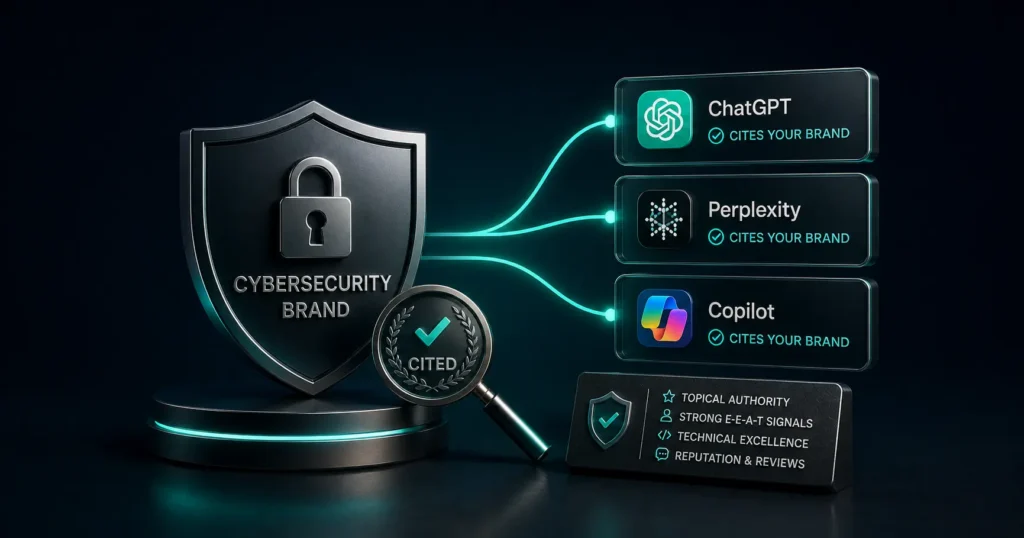
How Cybersecurity Brands Get Cited by ChatGPT, Perplexity, and Copilot
The security buyer’s journey now starts inside an AI assistant, and how cybersecurity brands get cited there decides whether they make the shortlist. When a CISO asks ChatGPT for the best EDR platforms, or Perplexity to compare SIEM vendors, or Copilot inside Microsoft 365 for a threat explanation, the brands named in the answer win the first look. The ones absent from it never get evaluated.
This playbook is for cybersecurity vendor marketers, CMOs, and founders in the United States whose buyers research with AI before they ever fill out a form. The stakes are concrete. According to the G2 Answer Economy report, half of B2B software buyers now start their research with AI chatbots, and security software is squarely in that shift.
The catch most brands miss is that ChatGPT, Perplexity, and Copilot each retrieve and cite sources differently, so one generic approach leaves gaps. Our team at Intelitune tunes cyber brands for each engine rather than hoping a single tactic covers all three.
Why Do Cybersecurity Brands Need to Get Cited by AI?
Cybersecurity brands need AI citations because the recommendation now happens inside the answer, before any click reaches your site. A CISO who gets a synthesized list of vendors from an assistant rarely visits ten websites afterward; they act on the shortlist the model gave them. If you are not cited, you are not in consideration. This is the core of answer engine optimization for security vendors.
The traffic math makes it urgent. The Pew Research Center data shows people click far fewer results once an AI answer appears, so the citation, not the ranking, is increasingly the prize. For high-consideration purchases like security tooling, where trust is everything, being the vendor an assistant names and sources carries real weight with a skeptical technical buyer.
Quick verdict: Win the citation on all three engines, but tune for each. Build web reputation and third-party validation for ChatGPT and Perplexity, win Bing visibility for Copilot, and back every claim with sourced technical depth. Cyber brands that treat AI as one channel lose citations on the engines they ignored.
How Cybersecurity Brands Get Cited: The Three Engines at a Glance
The three engines share fundamentals but differ in where they look and what they trust. Here is how they compare on the factors that decide a cybersecurity citation, so you can see where your effort should go. Understanding these differences is the heart of practical generative engine optimization.
| Factor | ChatGPT | Perplexity | Microsoft Copilot |
| Primary retrieval | Web search plus model memory | Web search, source-first | Bing web index |
| Citation style | Linked sources when browsing | Prominent numbered citations | Cited sources, Bing-grounded |
| What earns the citation | Broad web reputation, authority | Fresh, well-sourced, data-rich pages | Bing ranking plus clean structure |
| Best content for it | Widely referenced expertise | Technical depth with real sources | Indexed, quotable Bing content |
| Measurement | Limited direct visibility | Limited direct visibility | Bing Webmaster AI Performance |
| Biggest lever for cyber | Analyst and press validation | Original research and data | Bing visibility, often neglected |
The pattern is clear: reputation and sources win ChatGPT and Perplexity, while Bing visibility wins Copilot. A cyber brand needs all three.
How Do You Get Cited by Each Engine?
Getting cited on each engine means matching your effort to how that engine retrieves and trusts sources. The fundamentals of expertise and clean structure carry across all three, but the emphasis shifts, and the brands that win tune for those shifts instead of hoping one approach lands everywhere. Here is what earns the citation on each.
How Do You Get Cited by ChatGPT?
You get cited by ChatGPT by being a widely referenced, authoritative source that its web search and training both recognize. ChatGPT blends what it learned in training with live web results, and when it browses it can attach linked sources, so brands referenced consistently across the web get surfaced more often. This is where ChatGPT SEO meets cyber marketing.
For security vendors, the strongest lever is third-party validation. OpenAI’s ChatGPT search draws on the open web, so analyst recognition, respected security publications, and independent test results do more for you than any amount of self-published marketing copy.
Earn mentions in the sources ChatGPT already trusts, publish genuinely expert threat research, and make your brand the name that keeps appearing when the topic is your category.
Consistency matters more than any single placement here, because ChatGPT rewards the brand that is referenced repeatedly across many credible sources rather than one that appears loudly in a single place. Think in terms of becoming the default answer to a category question, not winning one article.
How Do You Get Cited by Perplexity?
You get cited by Perplexity by publishing fresh, well-sourced, data-rich content it can quote and attribute cleanly. Perplexity is retrieval-first and shows prominent numbered citations, so it favors pages that read like credible references rather than sales pages. The Perplexity answer engine rewards clear sourcing, which security brands are well positioned to provide.
Original research is your edge here, and Perplexity SEO for cyber rewards it directly. Publish your own threat data, benchmark results, and technical breakdowns with clear citations and dates.
A page that states a specific finding, backs it with a methodology, and reads like something a researcher would cite gets pulled into Perplexity answers far more often than a glossy product page with no evidence behind it.
Freshness is a real factor too, since Perplexity leans on current results, so a dated threat report loses ground to a competitor who updated theirs this quarter. Security is a fast-moving field, and keeping your research current is itself a citation strategy.
How Do You Get Cited by Microsoft Copilot?
You get cited by Copilot by winning Bing visibility, because Copilot grounds its answers in Bing’s web index. Most security brands optimize only for Google and quietly ignore Bing, which hands Copilot citations to whoever bothered to rank there. Fixing Bing is often the fastest citation win a cyber brand has available.
Copilot is also the one engine where you can measure progress. The Bing AI Performance report in Bing Webmaster Tools shows your Citation Share in AI answers across Copilot and Bing, so you can see whether the model is citing you or a competitor.
Verify your site in Bing Webmaster Tools, confirm indexation, and use that report as a feedback loop. Because Copilot lives inside Windows and Microsoft 365, its reach into enterprise security buyers is enormous.
The measurement advantage is worth dwelling on, because it is unique among the three engines. With ChatGPT and Perplexity you largely optimize and hope, watching brand mentions and referral patterns for indirect signals.
With Copilot you can change a page, wait, and watch your Citation Share move for a given topic, which turns AI visibility from guesswork into something you can manage like any other channel.
For a security marketing team that has to justify budget, that measurable feedback loop is a reason to start with Copilot even though the others may have larger audiences.
The Cybersecurity Citation Advantage: Technical Depth and Third-Party Trust
Cybersecurity brands hold an unusual advantage in AI citations, because the content that earns them is exactly what good security teams already produce. AI engines favor depth, evidence, and credibility, and a vendor with real threat research, published data, and analyst recognition clears that bar in a way a generic publisher never can. Your technical substance is your moat.
The research backs this. The arXiv GEO research paper found that adding citations, statistics, and quotations measurably lifts a page’s visibility in generative engines, and security content is naturally full of exactly those elements.
Lead with your data, cite your sources, and let your genuine expertise carry the page. That is what convinces a cautious model to name a security vendor in a high-stakes answer.
There is a trust dimension here that other industries do not share. A CISO evaluating your product is professionally skeptical, and so, in effect, are the models answering their questions on high-stakes security topics.
Both are looking for evidence, not enthusiasm. A vendor that publishes a rigorous breakdown of a threat, names its methodology, and links to primary sources signals the kind of credibility that gets quoted, while one that leans on adjectives gets passed over. The same discipline that earns a security buyer’s trust is what earns the citation, which means your best technical marketing and your best AI-visibility work are the same work.
Want to see which engines already cite your cybersecurity brand and which ignore it? Book a strategy call and we will map your citation gaps across ChatGPT, Perplexity, and Copilot.
Build the Entity Signals AI Engines Trust
Entity clarity tells every engine who you are, what you secure, and which category you compete in, independent of any single page. A model that sees one coherent description of your brand cites you confidently; one that sees conflicting details hedges and names a clearer competitor. For security vendors with complex product lines, this consistency matters even more.
Make your brand name, product names, and category descriptors identical across your site, your profiles, analyst listings, and review platforms. Keep your positioning unambiguous, because a vendor that describes itself three different ways teaches the model to trust none of them.
Reinforce that identity with structured data and accurate, matching listings on the analyst and review platforms security buyers already trust, since those third-party sources are often what an engine cross-checks before it commits to naming you.
A quick AI visibility diagnostic shows how each engine currently understands and places your brand, which is where any serious citation effort should start.
Common Mistakes Cybersecurity Brands Make
The most common mistake is treating AI visibility as a single channel and applying one tactic everywhere. Because the three engines retrieve and cite differently, a Google-only, self-published strategy leaves you absent from Copilot, thin on Perplexity, and forgettable to ChatGPT. Tune for each engine or lose the ones you neglected.
Other errors compound the loss. Security brands publish marketing fluff instead of citable research, ignore Bing and the AI Performance data Microsoft gives them, let their entity signals drift inconsistent across analyst and review sites, and forget engines like Gemini that share the same fundamentals, which is why broader Gemini SEO work still pays off.
The deepest mistake is underestimating how much a skeptical technical buyer weighs the sources an assistant cites, and then giving those assistants nothing credible to quote. Another quiet failure is publishing strong research but never earning the third-party coverage that ChatGPT and Perplexity lean on, so the work exists but the wider web never amplifies it.
Your Cross-Engine Citation Playbook for Cyber Brands
Start by fixing the engine you have been ignoring, which for almost every cyber brand is Bing. Verify your site in Bing Webmaster Tools, confirm indexation, and record your baseline Citation Share so Copilot has clean content to ground against. Then unify your entity signals across every single place your brand appears online.
Next, invest in the content that earns citations on all three engines: original threat research, sourced data, and clear technical answers, plus the third-party validation that ChatGPT and Perplexity weight so heavily.
Track outcomes the way we do in our case studies, and tailor the plan to your segment, since buying behavior differs across the industries and security sub-categories we serve. Ninety days of disciplined, engine-aware work moves a cybersecurity brand from absent to routinely cited exactly where its buyers now decide.
This playbook does not fit everyone. If your brand has almost no published expertise, no analyst presence, and no research to share, fix that foundation before chasing citations, because AI engines cannot cite substance you have not created.
For the security vendors that do the technical work, though, AI citation is a rare place where genuine depth wins over marketing budget, and the brands that lean into it will own the answers their competitors never show up in.
Frequently Asked Questions
How do AI engines decide which cybersecurity vendors to cite?
They cite vendors that are visible in their retrieval source and backed by credible evidence. ChatGPT and Perplexity lean on web reputation and clear sources, while Copilot grounds in Bing’s index. Across all three, technical depth, third-party validation, and clean, quotable content decide which security brands get named and which are left out of the answer.
Is getting cited by Copilot different from ChatGPT or Perplexity?
Yes. Copilot grounds its answers in Bing, so Bing visibility is the deciding factor, and Microsoft even reports your Citation Share in Bing Webmaster Tools. ChatGPT and Perplexity rely more on broad web reputation and clearly sourced content. The fundamentals overlap, but Copilot rewards Bing presence while the others reward references and evidence across the wider web.
What content gets cybersecurity brands cited by AI?
Original threat research, published data, benchmark results, and clear technical explanations with real sources. AI engines favor content rich in statistics, citations, and quotable facts, which strong security teams already produce. Marketing copy with no evidence behind it rarely gets cited, while a well-sourced research page on your category is exactly what an assistant wants to quote.
Does Bing visibility really matter for cybersecurity AI citations?
Yes, more than most vendors realize. Microsoft Copilot grounds its answers in Bing, and Copilot is embedded in Windows and Microsoft 365 where enterprise security buyers work. Because most cyber brands optimize only for Google, Bing is often the fastest citation win available, and its AI Performance report is the only place you can measure your AI citation share directly.
How long does it take a cybersecurity brand to get cited by AI?
Expect meaningful movement within about 90 days of engine-aware work. Fixing Bing visibility and entity signals resolves relatively quickly, while building the web reputation and research depth that ChatGPT and Perplexity reward compounds over a longer horizon. Pages built around sourced data and clean structure can start earning citations within weeks once they surface in each engine.
Resources & Further Reading
The following authoritative sources were used to inform and validate this article:
- G2 Answer Economy Report – G2 research that half of B2B software buyers now start research with AI chatbots
- OpenAI ChatGPT Search – OpenAI’s overview of how ChatGPT searches the web and cites sources
- Perplexity – the answer engine that surfaces prominent numbered citations for its sources
- Bing AI Performance Report – Microsoft’s report on Citation Share in Copilot and Bing AI answers
- GEO Research Paper (arXiv) – study showing citations, statistics, and quotations lift visibility in generative engines
- Pew Research Center – data on falling click rates when an AI answer appears in

Arqam Bashir
Founder & Head of AI SEO
Arqam Bashir is the Founder & Head of AI SEO at Intelitune, helping brands grow visibility across ChatGPT, Google AI Overviews, Gemini, Perplexity, and Search through AI SEO, AEO, GEO, technical SEO, and entity optimization.
- Previous
- Next
- Real client results
What you can expect to gain
- AI Visibility Diagnostic