





Key Takeaways
A plain-English comparison of SEO, AEO, GEO, and AIO for marketers deciding where to invest their search and AI visibility budget in 2026 and beyond.
- SEO, AEO, GEO, and AIO are not competing choices; they are layers of one strategy, so the real question is emphasis, not either-or.
- SEO is the foundation, AEO wins the direct answer, GEO wins the generative citation, and AIO is the umbrella term for optimizing across all AI surfaces.
- AIO is the most confused acronym: most use it for AI Optimization broadly, while some mean AI Overview Optimization specifically.
- The biggest mistake is treating these as rival disciplines and chasing the newest acronym instead of building on a healthy SEO base.
- In 2026 the center of gravity is shifting from ranking links toward earning citations, so budget should follow that shift, not abandon SEO.
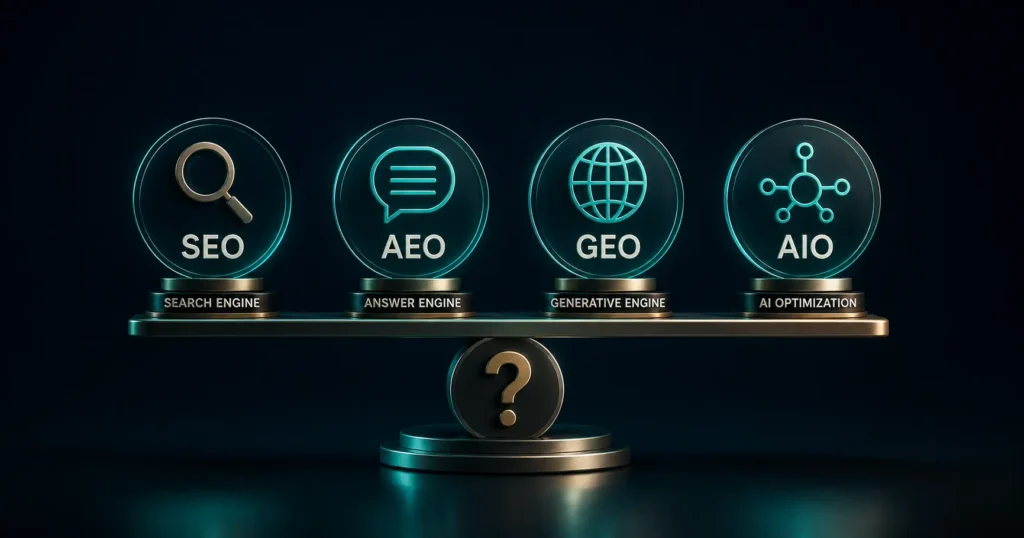
SEO vs AEO vs GEO vs AIO: Which One Matters in 2026?
If you have watched the acronyms pile up and wondered whether SEO is dead, AEO is next, or GEO is the future, here is the honest answer to SEO vs AEO vs GEO vs AIO: all four matter, because they are layers of one discipline, not rival strategies you must choose between. SEO is the foundation everything else stands on. AEO and GEO are what you add to win in answers and AI responses. AIO is just the umbrella label for the whole effort.
This comparison is for marketers, founders, and SEO teams in the United States who are tired of the alphabet soup and want to know where their budget should actually go. The shift underneath the jargon is real.
According to Pew Research Center data, people click far fewer links once an AI answer appears, which is why the newer acronyms exist at all. Our team at Intelitune treats these as one connected system, and below we define each clearly, compare them head to head, and show you which deserves the most attention in 2026.
SEO vs AEO vs GEO vs AIO at a Glance
Here is the fastest way to see how the four relate. They differ in what they optimize for, but they share the same underlying goal of being found and trusted. Gartner’s search-volume forecast predicted a 25% drop in traditional search volume by 2026, which is exactly why the answer-focused layers now matter.
| Discipline | Full Name | Optimizes For | Primary Target | Relationship |
| SEO | Search Engine Optimization | Ranking in search results | Google and Bing organic links | The foundation |
| AEO | Answer Engine Optimization | Being the direct, cited answer | Snippets, AI Overviews, assistants | A layer on SEO |
| GEO | Generative Engine Optimization | Being cited in AI responses | ChatGPT, Perplexity, Gemini, Claude | A layer for generative engines |
| AIO | AI Optimization | Visibility across all AI surfaces | Every AI search experience | The umbrella |
The pattern is simple: SEO gets you found, AEO gets you answered, GEO gets you cited, and AIO is the name for doing all three well as one coordinated program rather than four disconnected projects.
Quick verdict: Do not pick one. Keep a strong SEO foundation, add AEO to win direct answers, add GEO to earn citations in generative engines, and treat AIO as the umbrella that ties them together. The only wrong move in 2026 is chasing a shiny new acronym while your existing fundamentals quietly rot.
What Do SEO, AEO, GEO, and AIO Mean?
Each acronym describes a different slice of getting found, and the differences are real even though the work overlaps. Here is what each one actually means, without the hype.
SEO: Search Engine Optimization
SEO is the practice of optimizing your site to rank in search engine results like Google and Bing. It rests on three pillars: technical health so engines can crawl you, on-page relevance so they understand you, and authority from links and mentions so they trust you.
SEO is decades old, well understood, and still the foundation every other discipline builds on. Ship Schema.org structured data and it feeds all four.
When people ask whether SEO still matters, they usually mean “do rankings still send traffic,” and the answer is yes for branded, local, and transactional queries, even as informational clicks erode. Nothing the newer acronyms do removes the need for a crawlable, credible, well-organized site underneath.
AEO: Answer Engine Optimization
AEO is the practice of optimizing to be the direct, cited answer in answer engines and features like featured snippets and AI Overviews. It rewards clear, structured, factual content that a system can lift and attribute.
Where SEO wants a ranking, answer engine optimization wants the answer box itself, which is a different and increasingly valuable target. The practical difference shows up in how you write.
AEO rewards leading a section with a direct, self-contained answer, using clear question-style headings, and stating facts a system can lift without editing. A page can rank in the classic sense yet lose the answer, and in an answer-first world losing the answer means losing the visitor.
GEO: Generative Engine Optimization
GEO is the practice of optimizing to be surfaced and cited inside generative AI responses. The term comes from a 2023 arXiv GEO research paper by Aggarwal and colleagues, who found that adding citations, statistics, and quotations measurably lifts a page’s visibility in generative engines.
In practice, generative engine optimization leans on entities, sourced data, and quotable content. GEO is where the newest work lives, because generative engines compose an answer from many sources rather than pointing to one, and they decide what to quote based on which passage is clearest, best sourced, and easiest to trust.
That is why original research and specific, defensible claims outperform polished marketing copy when the goal is a citation.
AIO: AI Optimization
AIO is the most confused acronym of the four, so it deserves a clear definition. Most practitioners use AIO to mean AI Optimization, the umbrella term for optimizing across every AI surface, which effectively contains AEO and GEO. Some use it to mean AI Overview Optimization specifically, focused on Google’s AI Overviews.
Google’s Google AI features documentation governs that narrower AI Overview case, but when someone says AIO, ask which meaning they intend before you assume. The ambiguity is not just pedantic. If a vendor sells you AIO meaning the narrow AI Overview work, you may still have no plan for ChatGPT, Perplexity, or Claude.
If they mean the umbrella, you need to confirm it actually includes the generative engines and is not just SEO wearing a newer badge. Clarity on this one word saves real money.
How Are They Different, and Where Do They Overlap?
The differences are about target and emphasis; the overlap is about fundamentals. SEO targets a ranking, AEO targets the answer, and GEO targets the citation, but all three depend on the same base: crawlable, credible, well-structured content. That shared base is the reason why doing any one of them well quietly helps all the others.
The overlap is larger than the marketing suggests. SparkToro zero-click research shows fewer than a third of searches now end in a click, which pushes every discipline toward the same conclusion: being the cited answer matters more than the raw ranking.
The honest read is that these acronyms are largely overlapping labels for one evolving practice, and the boundaries between them blur more every quarter.
Where they genuinely diverge is worth knowing. SEO still owns the technical and link-building foundation that nothing else replaces. AEO adds the discipline of answer-first structure and snippet formatting.
GEO adds entity work, original data, and the sourcing that generative engines reward. AIO is the coordination layer that keeps those efforts pointed at the same goal. Think of them as concentric, not competing: each newer acronym wraps around the one before it rather than replacing it, which is why a brand strong in SEO has a real head start in all the rest.
Not sure where your brand stands across search and AI engines? Run a free AI visibility diagnostic and see which layer needs the most work.
Which One Matters Most in 2026?
All four matter, but the center of gravity has shifted toward the answer-focused layers, so if you are choosing where to add effort, AEO and GEO are where the growth is. That does not mean SEO is dead. It means SEO is now the price of entry rather than the whole game, because you cannot be cited by an answer engine that cannot first find and trust your content.
The right emphasis depends on where your buyers are. If your audience still searches and clicks, SEO and AEO carry most of the value. If they research inside assistants, GEO earns you the citations that shape their shortlist, which is why platform-specific work like ChatGPT SEO and Gemini SEO now sits alongside classic ranking work.
For most brands in 2026, the honest answer is a healthy SEO base plus a deliberate, growing investment in AEO and GEO.
A useful way to decide the split is to look at your own funnel. If most of your qualified leads still describe finding you through a search and a click, keep weighting SEO and AEO, because that behavior is intact for now.
If new customers increasingly say they asked an assistant or acted on an AI summary, move budget toward GEO faster, because your buyers have already crossed over. Most teams land on a blend that shifts a few points toward the answer-focused layers each quarter rather than a dramatic overnight reallocation. The mistake is standing still while the behavior underneath you changes.
How Should You Invest Across All Four?
Invest in the order the layers depend on each other: fix SEO fundamentals first, then add AEO and GEO, and treat AIO as the umbrella that keeps them coordinated. A brand with broken crawlability or thin content cannot skip ahead to citations, because the newer engines read the same signals search does. Fundamentals first is not old-fashioned advice; it is a technical prerequisite.
From there, weight your effort toward answers. Rebuild high-intent pages around clear, quotable answers, ship structured data, and earn the sourced, entity-rich content that generative engines cite, an approach that pays off across Perplexity SEO and Claude SEO alike. Let where your buyers actually research decide how fast you move budget from links to citations.
A simple sequence works for most teams. Spend the first month fixing technical SEO and content gaps, so nothing is blocking discovery. Spend the next on AEO, restructuring your most important pages to lead with clean, extractable answers under clear headings.
Then layer in GEO, publishing the sourced data and entity signals that generative engines reward, and set up measurement for citations, not just rankings. This is not four separate budgets; it is one budget that shifts its center of gravity from links toward answers as you go.
The teams that treat it as a sequence, rather than a menu of competing options, move faster and waste less.
Common Mistakes and Misconceptions
The biggest misconception is that these are rival disciplines you must choose between, when they are layers of one strategy. Teams waste real money chasing the newest acronym, rebrand their existing SEO work as GEO, or abandon a healthy foundation to bet everything on assistants. The alphabet soup is mostly marketing; the underlying work is more connected than the labels imply.
Two other mistakes recur. Brands treat AIO as a magic new channel rather than an umbrella, expecting a separate playbook that does not exist. And they measure only rankings while ignoring whether AI engines cite them, so they never see the gap between being found and being recommended.
Track outcomes the way we do in our case studies, across rankings and citations both, and the confusion clears fast.
There is also a vocabulary trap worth naming. Because the acronyms are new and undefined, vendors use them loosely to sound cutting-edge, and buyers end up paying a premium for GEO or AIO that is really just competent SEO plus structured content.
Ask any provider to define exactly what they do differently under each label, and the real work becomes clear fast. The right balance also shifts by sector, which is why we calibrate the mix across the industries we serve rather than selling the same acronym to everyone.
Substance matters more than the label on the invoice.
The takeaway on SEO vs AEO vs GEO vs AIO is not which acronym wins. It is that all four describe one shift: from ranking links toward earning trusted citations. Build a strong SEO foundation, layer AEO and GEO on top, use AIO as the umbrella, and stop letting the jargon distract you from the work.
The brands that win in 2026 are the ones that treat search and AI visibility as a single, connected system rather than a race to adopt whatever acronym is trending this quarter.
Frequently Asked Questions
Is SEO dead because of AEO and GEO?
No. SEO is the foundation AEO and GEO build on, because AI answer engines still read the same crawlability, relevance, and authority signals that search does. What has changed is that SEO is now the price of entry rather than the whole game. You need a healthy SEO base before AEO and GEO can earn you answers and citations.
What is the difference between AEO and GEO?
AEO, Answer Engine Optimization, focuses on becoming the direct, cited answer in features like featured snippets and AI Overviews. GEO, Generative Engine Optimization, focuses on being cited inside generative responses from ChatGPT, Perplexity, Gemini, and Claude. They overlap heavily and both reward clear, sourced, quotable content, but AEO targets the answer box while GEO targets the assistant’s synthesized reply.
What does AIO mean in marketing?
AIO usually means AI Optimization, the umbrella term for optimizing across every AI surface, which effectively includes AEO and GEO. Some marketers use AIO to mean AI Overview Optimization specifically, focused on Google’s AI Overviews. Because the acronym is used both ways, confirm which meaning someone intends before assuming, since the scope of work differs a lot between them.
Which should I invest in first, SEO, AEO, or GEO?
Invest in SEO fundamentals first, then layer AEO and GEO on top. AI answer engines cannot cite content they cannot crawl or trust, so a healthy SEO base is a technical prerequisite, not optional. Once the foundation is solid, weight new effort toward AEO and GEO, since that is where visibility is growing fastest in 2026.
Are SEO, AEO, GEO, and AIO just marketing buzzwords?
Partly. The acronyms describe real differences in target, but the underlying work overlaps so much that the boundaries are mostly marketing labels. Rather than obsessing over which term applies, focus on the three things all four reward: being retrievable so engines can find you, being citable so they can quote you, and being ranked so you show up at all.
Resources & Further Reading
The following authoritative sources were used to inform and validate this article:
- GEO Research Paper (arXiv) – the paper that introduced Generative Engine Optimization and its ranking signals
- Google AI Features Documentation – Google’s official guidance on AI Overviews and AI Mode
- Pew Research Center – data on falling click rates when AI answers appear in results
- SparkToro – research on zero click search and the shrinking share of clicks to the open web
- Gartner Press Release – prediction that search volume will drop 25% by 2026
- Schema.org – the structured data vocabulary that supports every optimization layer

Arqam Bashir
Founder & Head of AI SEO
Arqam Bashir is the Founder & Head of AI SEO at Intelitune, helping brands grow visibility across ChatGPT, Google AI Overviews, Gemini, Perplexity, and Search through AI SEO, AEO, GEO, technical SEO, and entity optimization.
- Previous
- Next
- Real client results
What you can expect to gain
- AI Visibility Diagnostic