





Key Takeaways
A 2026 guide to the difference between AEO and SEO, whether answer engine optimization replaces classic SEO, and how to win at both across AI search.
- SEO optimizes to rank a page and win the click; AEO optimizes to make that page the answer a search engine or AI system extracts and shows.
- AEO does not replace SEO; it is built on top of it, because a page that is not indexed and ranking cannot be pulled into a snippet or AI answer.
- The “SEO is dead” claim is wrong again: answer engines and AI Overviews run on the same search index that SEO has always served.
- AEO shifts what you measure, from rankings and clicks alone to answer ownership: snippet share, People Also Ask presence, and AI citations.
- The winning approach treats AEO and SEO as one connected effort, optimizing the same pages to both rank and become the answer.
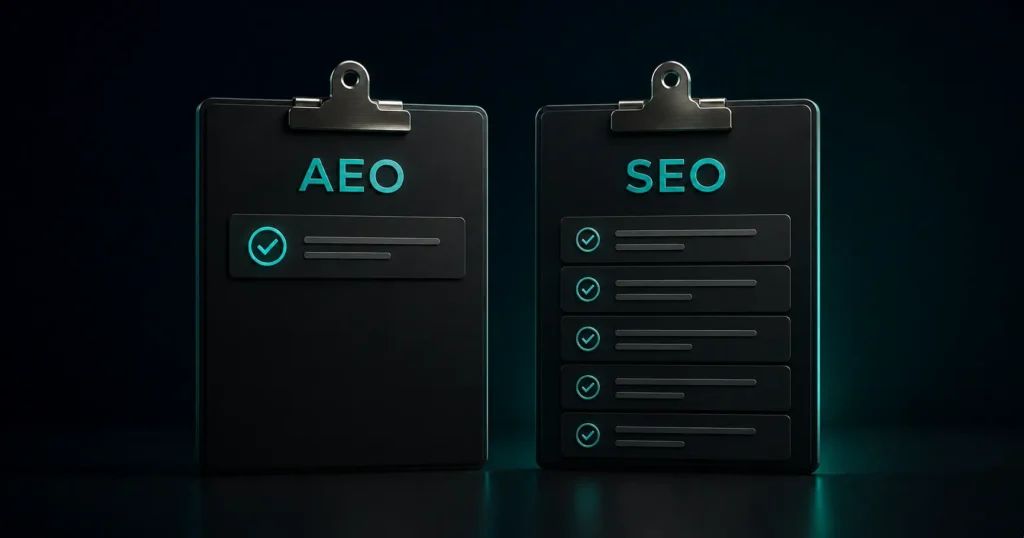
AEO vs SEO: The Difference and Why It Matters in 2026
AEO and SEO are not rivals: SEO gets your page ranked and eligible, and answer engine optimization gets that page chosen as the answer.
The confusion is understandable, because both compete inside the same search results, but they win in different ways. SEO earns the ranking; AEO earns the extracted answer that increasingly sits above those rankings.
This guide is for US marketers, founders, and content teams who keep hearing that AEO is the future and SEO is dead, and want a clear, honest read on how the two actually relate in 2026. The stakes are rising fast.
Gartner’s search-volume forecast predicted traditional search volume would fall 25 percent by 2026 as AI answers absorb queries, which changes where visibility comes from but not the fundamentals underneath it.
At Intelitune, we treat AEO as an extension of strong SEO, never a replacement for it.
What Is the Difference Between AEO and SEO?
The difference is the goal: SEO optimizes to rank a page and win the click, while AEO optimizes to make that page the answer a search or AI system extracts and displays.
SEO competes for position; AEO competes for the answer box that often sits above position one. One gets you listed, the other gets you quoted.
Traditional SEO is the mature discipline of earning rankings through relevant content, keywords, backlinks, and a crawlable, well-structured site.
Layered on top of it, answer engine optimization targets the surfaces that deliver a direct answer: featured snippets, People Also Ask, voice results, and AI Overviews. AEO also connects to its newer cousin, generative engine optimization, which extends the same answer-first thinking into fully generated responses.
Here is how AEO and SEO compare directly.
| Dimension | Traditional SEO | Answer Engine Optimization (AEO) |
| Optimizes for | Ranking in results and winning the click | Being the extracted answer, not just a link |
| Primary surfaces | Blue-link results, organic listings | Featured snippets, People Also Ask, voice, AI Overviews |
| Success metric | Rankings, organic traffic, clicks | Answer share, snippet ownership, AI citations |
| Core signals | Keywords, backlinks, crawlable structure | Direct answers, clean formatting, structured data |
| Content shape | Comprehensive pages that rank | Concise, self-contained answer blocks |
| Relationship | The foundation everything rests on | A layer built on top of SEO |
Quick verdict: AEO does not replace SEO; it depends on it. You cannot win a featured snippet or an AI answer for a page that is not indexed and ranking in the first place.
Treat SEO as the foundation that earns eligibility and AEO as the layer that turns eligibility into the answer. Firms that pit one against the other lose ground to those that do both.
SEO and Answer Engine Optimization, Defined
SEO is the practice of earning organic rankings; AEO is the practice of earning the direct answer those rankings make possible. The two share most of their machinery and differ mainly in what they optimize the final output to do.
The shift is not hypothetical. SparkToro zero-click research found fewer than a third of searches now end in a click, which is exactly why owning the answer, not just the ranking, has become its own discipline.
Understanding each on its own terms is what makes the relationship click, so here is what each actually optimizes for.
The overlap is worth stating plainly, because it is where most of the confusion lives. Most of what earns a ranking also helps you win the answer: relevance, clarity, authority, and a crawlable page a system can read.
What separates the two disciplines is the final mile. SEO leans harder on breadth, links, and out-competing other pages, while AEO leans on precision, formatting, and directly answering the exact question a user typed.
Same foundation, different finish, which is why the smartest teams build once and optimize twice.
What Traditional SEO Optimizes For
Traditional SEO optimizes to be found and ranked: it makes your pages crawlable, indexable, relevant, and authoritative enough to appear high in organic results.
The work spans keyword research, on-page optimization, technical health, and backlinks, all aimed at earning position for the queries that matter to your business.
None of that goes away in the AI era, because ranking is still the entry ticket.
A page that cannot rank cannot be pulled into a snippet or cited by an assistant, so the same fundamentals that win organic position also make you eligible for every newer surface, from AI Overviews to Gemini SEO visibility.
SEO is the base layer nothing else works without.
What Answer Engine Optimization Adds
AEO adds a focus on being the single, cleanly extractable answer rather than one of ten ranked links.
It optimizes the shape of your content so a system can lift a direct response: a concise definition, a clear list, a table, or a 40-to-60-word paragraph that answers the exact question asked.
Two things drive it. Formatting and clarity make extraction easy, and Schema.org structured data helps engines understand what your content means.
Notably, you cannot buy or mark your way into a featured snippet; per Google’s featured snippets guide, Google’s systems decide whether a page makes a good answer and elevate it automatically.
AEO is how you earn that decision, by being the clearest, best-structured answer on a page that already ranks.
Is AEO Replacing SEO?
No. AEO is not replacing SEO; it is changing what winning at SEO looks like.
The claim that “SEO is dead” resurfaces with every shift in search, and it is wrong again here, because answer engines are built directly on the search index SEO has always served.
Kill SEO and you leave nothing for AEO to optimize.
Google itself makes the dependency explicit. Its AI features documentation states that to appear in AI Overviews a page simply needs to be indexed and eligible to show with a snippet, with no separate AI markup required.
In other words, the ranking and snippet work SEO already does is the same work that earns AI visibility. What changes is the finish line: instead of stopping at a ranking, you optimize the page to become the answer, which is why ChatGPT SEO and classic SEO increasingly describe one connected effort rather than two.
It helps to be precise about what actually changed. What is fading is not SEO but one specific reward: the guaranteed click from a high ranking. For years, ranking and traffic were nearly the same thing, so teams treated position as the goal itself.
Answer engines broke that link, letting a user get the answer without ever visiting the page, which feels like SEO dying only if you defined SEO as clicks.
Redefine it as earning visibility wherever search happens, and SEO is not dying at all; it is expanding into the answer layer that AEO exists to optimize.
Why Does AEO vs SEO Matter in 2026?
It matters because the payoff of ranking is shrinking while the payoff of being the answer is growing.
When a search returns an AI answer or a snippet that satisfies the user, the click you used to earn from position one may never happen, so ranking without owning the answer increasingly means invisible traffic.
The data is stark. Pew Research Center data shows people click far fewer traditional results once an AI-generated answer appears, and only a small fraction click the sources inside it.
That reshapes strategy: a page ranked third that owns the snippet or gets cited in the AI answer can now beat the page ranked first that does not.
The same pressure spans assistants, which is why work like Claude SEO matters alongside Google, since the answer layer now appears everywhere your audience asks questions.
Picture a concrete case. A software company ranks first for a comparison query, but a competitor ranked fourth wrote a crisp, well-structured answer that Google lifted into the featured snippet and an AI Overview then cites.
The searcher reads the answer, sees the competitor’s name, and never scrolls to the first result. The higher-ranked page won the position and lost the customer.
Multiply that across a category and the firm optimizing only for rank watches qualified traffic quietly migrate to the firm optimizing to be the answer, often long before any ranking report shows a problem.
How Do You Do AEO and SEO Together?
You do them together by building one strong foundation, then optimizing its output to be the answer. Start with SEO fundamentals: crawlable architecture, relevant content, internal links, and authority, so your pages can rank at all. Without that base, AEO has nothing to work with.
Then layer AEO on top. Lead sections with a direct, quotable answer, structure content with clear headings and lists, add FAQ blocks and structured data, and target the specific questions your audience asks.
The elegant part is that this is mostly the same content investment optimized twice: once to rank and once to be extracted. Tracking whether you actually own answers, not just rankings, is where Perplexity SEO and answer-focused measurement come in.
A simple workflow keeps both aligned. For each priority page, first confirm it can rank at all: intent match, real depth, internal links, and enough authority to compete.
Then add the answer layer, a direct opening answer, a scannable structure, an FAQ, and schema, so the same page is eligible for the ranking and the snippet at once. Finally, verify the outcome by checking whether you actually hold the answer for the target query, not just the position.
Done this way, AEO adds only a little effort to content you were already producing, while opening a second, faster-growing source of visibility.
Want to see whether you own the answers or just the rankings? Run a free AI visibility diagnostic and find out where AEO can lift your existing SEO.
What Changes When You Measure AEO, Not Just SEO
The biggest practical shift is measurement: AEO forces you to track answer ownership, not just position and clicks.
A team that only watches rankings and organic traffic will miss the moment a competitor starts winning the snippet or the AI citation for its best keywords, because those losses do not always show up as a ranking drop.
New metrics move to the center. Instead of position and sessions alone, you track snippet ownership, presence in People Also Ask, appearance in AI Overviews, and whether assistants name you at all.
We build both views into our case studies, because a page can hold its ranking while quietly losing the answer, and only answer-level measurement catches it.
The teams that adapt their reporting first are the ones that see the shift coming instead of explaining it after traffic falls.
Setting this up is more practical than it sounds. Pull your top queries, then check each one live to see who owns the snippet, what appears in People Also Ask, and whether an AI Overview names a source.
Repeat the highest-value questions inside ChatGPT, Gemini, and Perplexity to see which brands they surface and why. None of this requires exotic tooling; it requires deciding that answer ownership is a metric worth watching.
The firms that treat it as seriously as they treat rankings are the ones that catch erosion while it is still cheap to fix.
Common AEO and SEO Mistakes to Avoid
The most damaging mistake is treating AEO and SEO as either-or, either ignoring the answer layer or abandoning the SEO fundamentals that make it possible.
Chasing snippets on unranked pages fails, and ranking pages that answer nothing cleanly get skipped by every answer engine. You need both, on the same pages.
Other errors are common. Teams bury the answer halfway down a page instead of leading with it, skip structured data, write for keywords instead of the actual questions people ask, and never check whether they own the answer boxes for their terms.
The deepest mistake is believing the hype that SEO is finished; the fundamentals still decide who is even eligible to be the answer, and buying behavior differs enough across the industries we serve that the right AEO and SEO balance should always follow where your audience actually searches.
Frequently Asked Questions
What is the difference between AEO and SEO?
SEO optimizes your pages to rank in search results and earn clicks, using keywords, backlinks, and technical health. AEO (answer engine optimization) optimizes those pages to be the extracted answer in featured snippets, voice results, and AI Overviews. SEO wins the ranking; AEO wins the direct answer that increasingly appears above the rankings. AEO builds on SEO rather than replacing it.
Is AEO replacing SEO?
No. AEO is not replacing SEO; it extends it. Answer engines and AI Overviews are built on the same search index that SEO serves, so a page must still be indexed and ranked before it can become an answer. Google confirms AI visibility needs no special markup beyond normal indexing and snippet eligibility. SEO remains the foundation AEO depends on.
Do I still need SEO in 2026?
Yes. SEO is the entry ticket: a page that cannot rank cannot be pulled into a snippet, cited in an AI answer, or read aloud by a voice assistant. AEO changes what you optimize toward, being the answer rather than just a link, but it runs on SEO fundamentals like crawlability, relevance, and authority. Dropping SEO would remove the base AEO needs.
How do I optimize for answer engines?
Lead each page with a direct, concise answer to the exact question, then support it. Use clear headings, lists, and tables, add FAQ sections, and apply structured data so engines understand your content. Target real questions people ask, not just keywords. Because Google selects snippets automatically, your job is to be the clearest, best-structured answer on a page that already ranks.
Which matters more, AEO or SEO?
Neither alone; they matter at different stages. SEO decides whether you are eligible to appear at all, and AEO decides whether you become the answer users actually see. In 2026, a lower-ranked page that owns the snippet or AI citation can outperform a higher-ranked page that does not. The winning approach treats them as one connected effort, not a choice.
Resources & Further Reading
The following authoritative sources were used to inform and validate this article:
- Google Featured Snippets Guide – Google’s explanation that featured snippets are selected automatically and cannot be marked up or bought
- Google AI Features Documentation – Google’s guidance that AI Overview eligibility rests on normal indexing and snippet signals
- Gartner Search Forecast – forecast that AI chatbots will cut traditional search volume 25 percent by 2026
- Pew Research Center – data on falling click rates when an AI answer appears in search results
- SparkToro Zero-Click Research – research showing fewer than a third of searches now end in a click to the open web
- Schema.org – the structured data vocabulary that helps engines extract and understand page content

Arqam Bashir
Founder & Head of AI SEO
Arqam Bashir is the Founder & Head of AI SEO at Intelitune, helping brands grow visibility across ChatGPT, Google AI Overviews, Gemini, Perplexity, and Search through AI SEO, AEO, GEO, technical SEO, and entity optimization.
- Previous
- Next
- Real client results
What you can expect to gain
- AI Visibility Diagnostic