





Key Takeaways
A clear guide to what an answer engine is, the main types from featured snippets to ChatGPT, and how these systems actually pick the answers they show.
- An answer engine returns one direct answer instead of a list of links, spanning featured snippets, voice assistants, and AI tools like ChatGPT and Perplexity.
- The three types are extractive engines that lift an answer from one page, generative engines that synthesize from many, and hybrids like Google AI Overviews.
- Extractive engines pick answers by ranking pages and lifting the clearest passage; generative engines synthesize and cite sources they can corroborate.
- Answer engines increasingly satisfy the user without a click, so being the source they choose now matters as much as ranking on the page.
- You cannot buy or force an answer, but you can earn it with clear structure, strong authority, and quotable, well-sourced content.
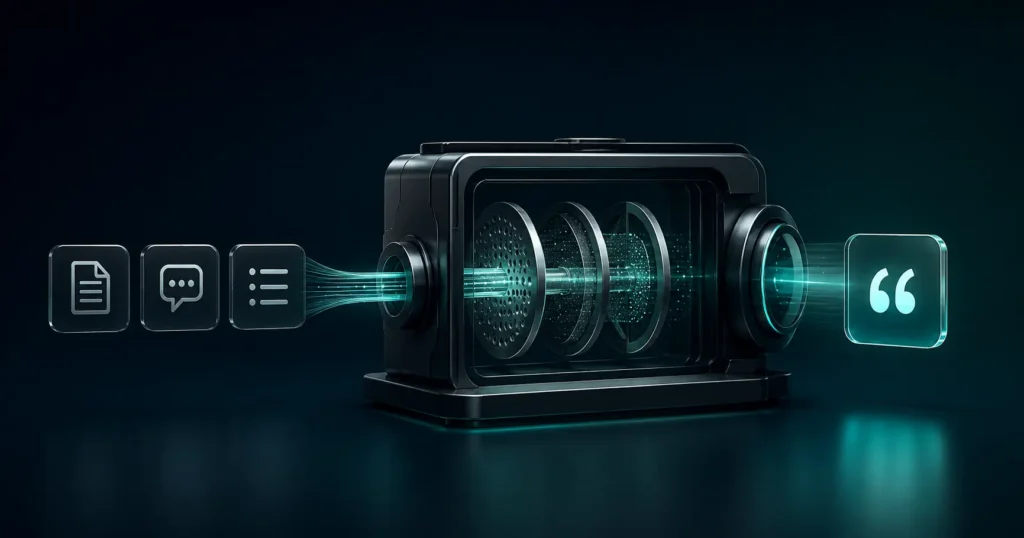
What Is an Answer Engine? Types and How They Pick Answers
An answer engine is any system that responds to a question with a direct answer instead of a list of links, and you already use several every day. Ask Google a question and read the box at the top, talk to a voice assistant, or type a query into ChatGPT, and an answer engine is deciding what to tell you. Understanding what they are, the types that exist, and how they pick answers is the foundation of getting your brand into those answers.
This guide is for marketers, founders, and anyone trying to make sense of a search world that increasingly answers instead of links. The shift is real and measurable. SparkToro zero-click research found fewer than a third of searches now end in a click, because answer engines satisfy the question on the spot. At Intelitune, we help brands understand exactly how these systems choose, so they can become the answer rather than the link no one clicks.
What Is an Answer Engine?
An answer engine is a system that interprets a question and returns a single, direct answer rather than a ranked list of pages to visit. Where a traditional search engine hands you ten links to evaluate, an answer engine does the evaluating and gives you the response, whether as a snippet, a spoken reply, or a generated paragraph. The goal is to end the query, not start a browsing session.
The term describes a function, not a single product. An answer engine can be a feature bolted onto a search engine, like Google’s snippet box, or a standalone product built to answer, like Perplexity. What unites them is intent: they are designed to resolve your question in place rather than send you elsewhere to find it yourself.
That is why the category now includes everything from a smart speaker on your counter to a chatbot in a browser tab, tools that once seemed unrelated but now compete for the same job of answering you directly.
That definition spans more tools than most people expect. A Google featured snippet, Siri reading a fact aloud, and ChatGPT writing a summary are all answer engines, differing mainly in how they source and deliver the answer. Optimizing to appear in them is answer engine optimization, the discipline built around this exact shift. Here are the main types at a glance.
| Answer Engine Type | Examples | How It Answers |
| Extractive (snippet) | Google featured snippets, People Also Ask | Lifts a direct answer from one ranked page |
| Voice assistants | Google Assistant, Siri, Alexa | Reads one concise answer aloud |
| Generative AI | ChatGPT, Perplexity, Claude | Synthesizes an answer from many sources |
| Hybrid | Google AI Overviews, Bing Copilot | Blends generated text with cited links |
Quick verdict: An answer engine returns a direct answer instead of a link list. The main types are extractive engines (featured snippets, voice) that lift an answer from one page, generative engines (ChatGPT, Perplexity, Claude) that synthesize from many, and hybrids like Google AI Overviews that do both.
They pick answers by retrieving, ranking, and trusting sources, so clear, authoritative, well-structured content is what gets chosen.
How Do Answer Engines Differ From Search Engines?
The core difference is the output: a search engine returns a list of results to choose from, while an answer engine returns the answer itself. A search engine points; an answer engine tells. That single shift changes how visibility works, because there is often only one answer slot instead of ten blue links to compete for.
The line blurs in practice, since the same company often runs both. Google is a search engine that increasingly behaves like an answer engine, showing a featured snippet or AI Overview above the traditional results.
Per Google’s featured snippets guide, those answers are selected automatically from pages that already rank well, which is why answer engines sit on top of search rather than replacing it. Work like ChatGPT SEO exists precisely because the answer layer now decides who gets seen.
The Main Types of Answer Engines
Answer engines fall into three broad types: extractive, generative, and hybrid. Extractive engines lift an existing answer from a single page, generative engines write a new answer from many sources, and hybrids combine both.
Knowing which type you are dealing with tells you how to earn its answer, since each sources content differently. Strong generative engine optimization starts with knowing which engine you are optimizing for.
The hybrid type deserves special attention, because it is where most people now meet answer engines. Google AI Overviews and Microsoft’s Copilot in Bing generate a written answer and attach cited links, blending the extractive habit of pointing to sources with the generative habit of composing a response.
For a brand, hybrids are the highest-stakes surface, since they sit directly above traditional results and can satisfy the query while still crediting a source, but only if you are the source they choose to credit.
Extractive Answer Engines: Snippets and Voice
Extractive answer engines pull a ready-made answer directly from a web page and display or speak it. Google’s featured snippets and People Also Ask boxes are the classic examples, along with voice assistants like Google Assistant, Siri, and Alexa that read a single result aloud. The engine is not writing anything; it is choosing the clearest existing passage and presenting it as the answer.
Because extraction depends on machine-readable clarity, structure wins here. Marking content with Schema.org structured data and leading with a concise, direct answer makes a passage easy to lift, and the same signals feed Google’s other surfaces, which is why extractive optimization and Gemini SEO overlap so much. The page that answers the question cleanest, on a site the engine already trusts, wins the slot.
Generative AI Answer Engines
Generative answer engines compose an original answer by synthesizing information from many sources at once. ChatGPT, Perplexity, and Claude are the leading examples, writing a fresh response rather than quoting one page, often with citations you can click. This is a fundamentally different act from extraction: the engine is reasoning across sources, not selecting a single one.
That changes what earns a mention. A generative engine names the brands it can corroborate across multiple trusted sources, so scattered or unsupported claims rarely surface.
Understanding how each model reasons is why Perplexity SEO and Claude SEO have become distinct practices, even though both reward the same underlying qualities: authority, consistency, and quotable evidence.
How Do Answer Engines Pick Answers?
Answer engines pick answers through a pipeline of retrieval, ranking, and trust: they find candidate sources, judge which are most relevant and credible, then extract or synthesize the response.
The details differ by type, but the throughline is that only content an engine can find, parse, and trust ever makes it into an answer. Per the Google AI features documentation, even AI answers start from pages that are simply indexed and eligible to show with a snippet, no special markup required.
Think of it as three gates every answer must pass. First, retrieval: the engine has to find and crawl your content, so anything blocked or unindexed is invisible from the start. Second, relevance and ranking: your page has to be judged a strong match for the question, not merely present in the index.
Third, trust: the engine has to be confident enough in your content to represent it, which is where authority and clear sourcing decide the outcome. Fail any one gate and you are absent from the answer, no matter how good the page looks to a human reader.
Curious how answer engines pick, and whether they currently pick your brand? Run a free AI visibility diagnostic to see how ChatGPT, Gemini, and Google answers represent you today.
How Extractive Engines Select an Answer
Extractive engines select by ranking pages, then choosing the one whose content best and most cleanly answers the specific question.
Google, for instance, identifies pages that already rank for a query, then evaluates which contains a passage that directly and concisely answers it, and elevates that passage into a snippet. Ranking is the entry ticket; clean formatting is the tiebreaker.
This is why you cannot buy or force a snippet. The engine is making an automated judgment about which existing answer is clearest and most trustworthy, so your only real lever is to be that answer: a direct response near the top of a well-structured, authoritative page. Miss on ranking or clarity and a competitor’s passage gets read aloud or boxed instead of yours.
Format is doing quiet, heavy work here. Engines favor passages that stand alone, so a direct definition, a short numbered list, or a clean table is far easier to lift than the same information buried in a long paragraph.
Matching the phrasing of the question helps too, since the engine is looking for the passage that most obviously responds to what was asked. This is why two pages with identical facts can get very different results: the one that presents the answer in an extractable shape wins the slot, and the one that makes the engine work for it loses.
How Generative Engines Choose What to Cite
Generative engines choose what to cite by weighing which sources are most authoritative, corroborated, and quotable for the point they are making. Rather than lifting one passage, the model assembles an answer and pulls in sources it trusts to support specific claims, favoring content with clear evidence.
The arXiv GEO research paper by Aggarwal and colleagues found that adding citations, statistics, and quotations measurably raises how often a source is included in generative answers.
The practical takeaway is that generative engines reward provable specifics. A page with original data, clear attribution, and consistent facts gives a model safe material to synthesize and cite, while vague marketing language gives it nothing to hold.
Consistency across the web matters too, because a model trusts a brand it can verify in more than one place far more than one it sees only once.
Why Do Answer Engines Matter in 2026?
Answer engines matter because they increasingly stand between your content and your audience, deciding what people see before they ever reach your site. When the answer appears on the results page or inside a chatbot, the click you used to earn may never happen, so being the chosen answer is now the visibility that counts. Pew Research Center data shows people click far fewer traditional results once an AI answer appears, and only a small share click the sources within it.
For brands, this reframes the goal from ranking to being represented. If an answer engine names a competitor when a buyer asks for a recommendation, you lost that moment invisibly, with no ranking report to flag it. The brands that treat answer engines as a channel, and measure whether they actually appear, are the ones that adapt before their traffic quietly erodes.
There is an upside worth naming. Answer engines reward being genuinely useful and clearly sourced, which is exactly what good content teams already want to produce.
Unlike an ad auction, you cannot outspend your way into an answer, so a smaller brand with sharper, better-sourced content can win the answer over a larger competitor with a bigger budget. That levels a field paid search tilts toward whoever pays most. The catch is that you have to earn it deliberately, because being invisible in answers produces no signal at all until the traffic is already gone.
Common Misconceptions About Answer Engines
The biggest misconception is that answer engines need special AI markup or a separate strategy from search. They do not; they run on the same indexed, ranked, well-structured content classic SEO produces, then add a layer of selection and synthesis on top. Another myth is that you can pay or trick your way into an answer, when in reality the engine makes an automated judgment about clarity and trust.
A subtler error is assuming answer engines only pull from the top result. Extractive engines often lift the snippet from a page ranked below number one, and generative engines cite sources far down the results if they are the most quotable and corroborated.
We see this constantly in our case studies: the brand that wins the answer is rarely the one shouting loudest, and it is usually the one that is clearest, most consistent, and best sourced. Because the questions buyers ask differ across the industries we serve, the winning answer content looks different in each, but the mechanics of how engines pick never really change.
Frequently Asked Questions
What is an answer engine?
An answer engine is a system that responds to a question with a direct answer instead of a list of links. Examples include Google featured snippets, voice assistants like Siri and Alexa, and generative AI tools like ChatGPT and Perplexity. Some extract an answer from one page, while others synthesize a response from many sources and cite them.
What is the difference between an answer engine and a search engine?
A search engine returns a ranked list of links for you to evaluate, while an answer engine returns the answer itself. Search engines point you to sources; answer engines do the evaluating and give a direct response. In practice they overlap, since Google shows featured snippets and AI Overviews, acting as an answer engine layered on top of its search results.
What are the main types of answer engines?
There are three main types: extractive engines that lift an answer from a single page (featured snippets, voice assistants), generative engines that synthesize an answer from many sources (ChatGPT, Perplexity, Claude), and hybrids that combine both (Google AI Overviews, Bing Copilot). Each sources and delivers answers differently, so earning a place in them requires different tactics.
How do answer engines pick which answer to show?
Answer engines pick answers through retrieval, ranking, and trust. They find candidate sources, judge which are most relevant and credible, then extract a passage or synthesize a response. Extractive engines lift the clearest answer from a ranking page; generative engines cite sources they can corroborate. Only content an engine can find, parse, and trust appears in an answer.
Can you optimize for answer engines?
Yes. Optimizing to appear in answer engines is called answer engine optimization (AEO). It combines solid SEO fundamentals with clear, direct answers, structured data, and strong authority signals so engines can find, parse, and trust your content. You cannot force an answer, but you can make your page the clearest, most credible option an engine chooses to show.
Resources & Further Reading
The following authoritative sources were used to inform and validate this article:
- Google Featured Snippets Guide – Google’s explanation of how featured snippets are automatically selected from ranking pages
- Google AI Features Documentation – Google’s guidance that AI answers draw on normally indexed, snippet-eligible pages
- GEO Research Paper (arXiv) – study on how generative engines value citations, statistics, and quotations when choosing sources
- Schema.org – the structured data vocabulary that helps engines understand and extract page content
- Pew Research Center – data on falling click rates when an AI answer appears in search results
- SparkToro Zero-Click Research – research showing fewer than a third of searches now end in a click to the open web

Arqam Bashir
Founder & Head of AI SEO
Arqam Bashir is the Founder & Head of AI SEO at Intelitune, helping brands grow visibility across ChatGPT, Google AI Overviews, Gemini, Perplexity, and Search through AI SEO, AEO, GEO, technical SEO, and entity optimization.
- Previous
- Next
- Real client results
What you can expect to gain
- AI Visibility Diagnostic



