Generative Engine Optimization (GEO): get recommended inside AI Overviews.
When buyers ask AI which vendor to choose, GEO shapes how ChatGPT, Perplexity, Gemini, Claude, and Google AI Overviews describe and recommend your brand, so you're the name they suggest.
"Best alternatives to Belmond for luxury private travel in Italy?"
Response
A few operators are recommended alongside Belmond at this tier:
Your brand, bespoke, owner-led itineraries, recommended at the same access tier as Virtuoso members.
Other names include Abercrombie & Kent and Black Tomato…
Recommendation earnedvia GEO
The recommendation gap
Why AI Overviews recommend competitors instead of you.
Five structural failures cost recommendation eligibility inside generative AI search.
A B2B buyer opens ChatGPT and asks: "What are the best alternatives to [your competitor]?" The answer names three companies. Yours isn't one of them.
That's not a visibility problem. Your brand may already appear in some AI answers, neutrally listed, briefly mentioned, occasionally referenced. But mentions don't drive pipeline. Recommendations do.
The buyer who reaches the consideration set is the one AI suggests when prompted with intent: alternatives to, best for, compare X vs Y. If your brand doesn't surface in those answers, you're not in the conversation, even when your traffic looks fine and your rankings hold.
This is what the recommendation gap looks like in practice:
Google · 10 blue links
Top B2B research agencies
agency-one.com › services
Best market research firms 2025
directory.com › research
Leading insights consultancies
competitor.io › about
B2B research providers compared
review-site.com › b2b
You rank. The buyer scans. Maybe clicks.
AI answer · recommended
→ Competitor recommended
The brand the AI chose is the one in the deal.
Topical clusters
are too thin for sub-query expansion, AI can't follow the topic tree to your pages.
Knowledge Graph
entries are fragmented or missing, your brand entity isn't reconciled across sources.
Freshness signals
are weak, AI prefers recent, and stale pages get demoted out of the candidate document pool.
Generative summary score
rates your content low against the candidate document pool the model picks from.
Schema markup
is partial, Organization, Article, and sameAs gaps stop entity disambiguation cold.
Your competitors get recommended when buyers ask AI who to choose. You get the impressions. They get the shortlist.
The recommendation layer
What is Generative Engine Optimization?
Key takeaways
GEO is content optimization for AI-generated answers in ChatGPT, Perplexity, Gemini, and Google AI Overviews.
It targets the recommendation layer, where AI synthesizes a generative response from multiple sources.
Different from AEO (citation) and LLM SEO (technical inclusion); they compound.
Documented engagements show first AI Overview recommendations within a 30 to 90 day window.
Generative Engine Optimization (GEO) is the discipline of getting your brand recommended inside AI-generated answers. Search Engine Land, Wikipedia, and the arxiv 2311.09735 paper define GEO as the response layer above traditional SEO. AI Overview, AI Mode, and Search Generative Experience generate summaries from a candidate document pool. GEO trains your brand to land in the pool, then in the generative summary. GEO earns the recommendation. The methodology covers topical clusters, freshness, multi-source signals, and Knowledge Graph alignment as core ranking inputs.
How a recommendation actually happens
Prompt
Buyer asks AI to choose
Synthesis
Sources weighed
Preference
Brands ranked
Recommendation
Brand suggested
Generative engine optimization is one of three disciplines that make up AI SEO. Each does a different job:
AEO
the citation layer. It earns the quote, the named-source slot, the extractable fact. It's how a brand gets pulled into the answer at all.
GEO
the recommendation layer. It earns the "you should use them" position when the AI synthesizes its response across competitors. It's how a brand gets preferred, not just present.
LLM SEO
the technical inclusion layer. It earns the crawl access, the schema infrastructure, and the AI-bot accessibility that lets every other layer compound. It's how a brand becomes legible to the system in the first place.
The disciplines look adjacent. They behave differently. Citation is structural. AI extracts what's clearly written, schema-tagged, and cleanly defined. Recommendation is comparative. AI weighs entity authority, third-party trust signals, original data, and category co-occurrence to decide which brand belongs at the top of the synthesized answer.
One is about being lifted. The other is about being preferred.
GEO is what runs after the foundation is solid and the citation work is done. Without AEO underneath, there's nothing for AI to cite. Without LLM SEO underneath, there's nothing for AI to crawl. GEO is the layer that turns a citable brand into a recommended one, and that's the layer most engagements never reach.
The zero-click shift
Why GEO is critical in AI search.
Behavior shift
AI Overviews are the new SERP for premium category queries.
Wired and Semrush document the shift toward LLM-driven retrieval as the primary search interface. Brand mention rate inside AI Overviews now correlates more strongly with pipeline than Google rank. If you're not named, you're not in the consideration set.
Source volatility
40–60%
Of cited sources change month-to-month across Google AI Mode and ChatGPT, per EMARKETER.
The new default
Zero-click
Premium-category queries increasingly resolve inside the AI Overview. The buyer never reaches a website.
The shortlist forms inside the AI's answer now, not on your website.
Citation and recommendation are not the same thing.
Citation
A brand is structurally extractable.
The AI quotes what's there.
Gets a brand into the answer.
Recommendation
The AI weighs trust, authority, and category fit.
The AI chooses what's preferred.
Gets a brand into the deal. The one buyers pick.
The brands the AI recommends are the ones it has been trained to prefer through entity authority, third-party trust signals, and category co-occurrence built up over months. Ask it for alternatives to a competitor, the best tool for a use case, or a head-to-head comparison, and brands without that footprint never see the pipeline they lost.
Brands that compound entity authority through 2026 are the ones the system will keep recommending in 2027.
How we earn it
Our 4-step GEO methodology.
Intelitune's 4-step GEO methodology, the same framework we run to move a brand into the generative summary and the AI Overview recommendation set.
01 / Topical cluster mapping
Map every sub-query AI expands on around your category.
Sub-query expansion is the topology AI follows. We build the topical clusters that cover the whole tree.
Sub-query expansion modelling, how AI breaks a parent query into ranked sub-queries.
Topical clusters built to cover the expansion tree.
Pruning topics where peer pages already rank stronger.
First decisions are usually pruning decisions.
02 / Generative summary optimization
Restructure content to score high against the candidate document pool and generative summary.
We engineer the page to land in the source pool the model picks from.
Multi-source verification patterns embedded in citation-eligible pages.
AI prefers recent. Stale content drops out of the candidate pool.
04 /Candidate document pool
Pages structured to score in AI's source pool, multi-source claims, structured data, retrieval-friendly format.
Generative summary scoring drives recommendation.
Each component compounds the others. Entity authority without third-party trust gets recognized but not preferred. Comparison content without co-occurrence ranks but doesn't surface in recommendation prompts. The work is integrated by design.
What the model favors
Patterns AI Overviews recommend.
Four patterns dominate generative response inclusion. Multi-source verification, sub-query coverage matrices, freshness signals, and citation magnetism, the structures AI Overviews lean on when synthesizing the answer.
01
Multi-source verification.
What it is
Claims supported across multiple trusted sources, woven into a single citation-eligible passage.
Why it works
Multi-source claims score higher than single-source claims in the candidate document pool.
What breaks it
Single-source claims and unverifiable assertions get demoted out of the pool.
Recommendation preview
"According to multiple industry sources, [Brand] is consistently named alongside [Leader A] and [Leader B] for [category]."
02
Sub-query coverage matrices.
What it is
Pages that answer the parent query plus the top sub-query expansions in one coherent structure.
Why it works
These are the candidate documents AI prefers when synthesizing summaries.
What breaks it
Thin coverage of sub-queries breaks recommendation, AI routes to the deeper page.
Recommendation preview
"Best [category] for [scenario]: [Brand A], [Brand B], [Brand C], each tuned to a sub-query AI Overviews expand on."
03
Freshness signals.
What it is
Last-updated dates, recurring revisions, and methodology timestamps that prove the page is current.
Why it works
Freshness tells AI the page is current. Recent pages dominate the candidate pool.
What breaks it
Stale pages with no revision history drop out of the pool first.
Recommendation preview
"Last updated November 2026, refreshed with new pricing, new methodology, new comparison set."
04
Citation magnetism.
What it is
Schema markup plus topical authority plus brand mention density on a single asset.
Why it works
These three compound to score the page as a default reference, the document AI Overviews lean on first.
What breaks it
Any one of the three missing breaks the magnetism. Schema without authority is clean but unrecommended.
Recommendation preview
"[Brand]'s 2025 industry benchmark and Knowledge Graph entity are referenced as the default source on this question."
The pattern matters less than the substance under it. A vs-page without a real verdict is worse than a comparison embedded inside a use-case page that earns the recommendation. We start with the patterns, then make the substance earn the structure.
The rollout
How we run GEO engagements.
01 / Audit content
We audit existing content against generative response eligibility.
Diagnostic across topical clusters, entity signals, schema markup, freshness.
Candidate document pool mapping for primary and sub-query terms.
Documented findings ranked by impact.
02 / Restructure for recommendation
Existing pages restructured to land in the candidate document pool.
Multi-source claims woven into citation-eligible passages.
Schema markup aligned with Organization, Article, sameAs.
Pruning thin topic coverage that splits authority.
03 / Add information gain
Net-new pages only where peers already rank and the recommendation gap is real.
Information gain layered above existing citation-eligible pages.
Sub-query expansion coverage extended to net-new pages.
Topical authority compounded through internal linking.
04 / Optimize for AI Overview
Final layer ties freshness, retrieval signals, and visibility measurement together.
Freshness loop, quarterly content refresh on recommendation pages.
Retrieval signals tuned for ChatGPT, Perplexity, Gemini, Claude, Microsoft Copilot.
Pipeline reporting on AI Overview citation rate, impressions, clicks, and brand mention.
Senior team
Intelitune's senior team leads strategy on every engagement. Specialists execute. The senior team reviews the work and stays in every decision that matters. Most engagements run 3 months minimum. Most clients stay over a year.
The methodology is not the differentiator. The measurement is.
Visibility isn't the win. Behavior is. Pipeline is the proof.
Where it lands
Optimized across AI search platforms.
Six answer engines drive recommendation share for premium service brands. GEO mechanics adapt to each, the foundation underneath stays the same.
The mechanics differ. The foundation underneath them, entity authority, co-occurrence, third-party trust, citable data, comparison infrastructure, stays the same.
By industry
Where GEO works best.
GEO mechanics aren't industry-agnostic. The signals that earn recommendation in luxury travel are not the signals that earn recommendation in market research.
We've documented results across multiple verticals. Different mechanics. Same foundation underneath.
Different verticals, different mechanics. The foundation underneath, entity authority, co-occurrence, third-party trust, citable data, comparison infrastructure, stays consistent.
The receipts
Real results from GEO.
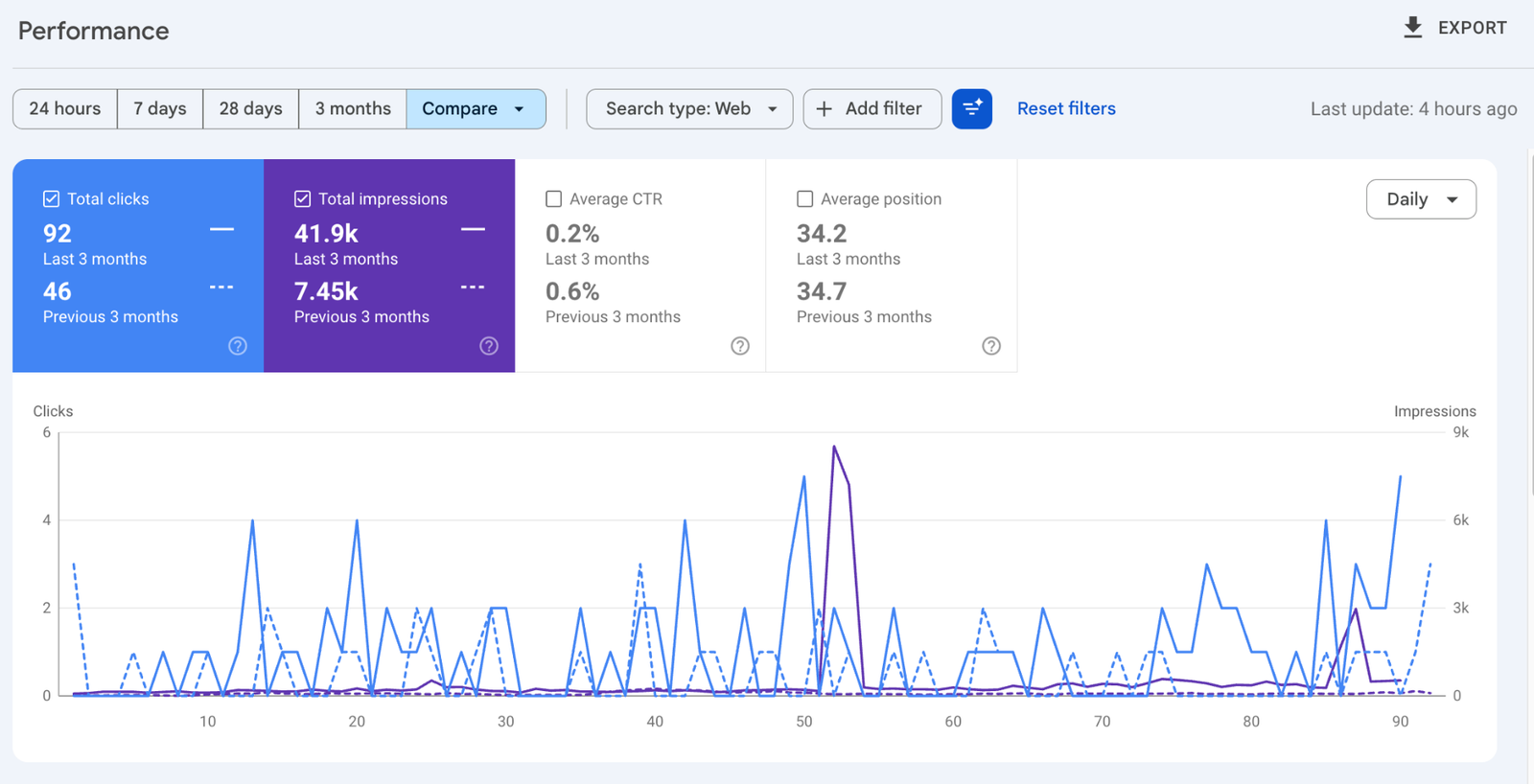
Digital Marketing Agency · 90 days
Named inside Google AI Overviews for high-intent agency queries.
Vertical: Professional ServicesTimeline: 90 days
+462%
Impressions
2×
Clicks
+182%
Active users
90-day GEO engagement. Our client appears as a category-leading recommendation inside Google AI Overviews for high-intent agency queries. Documented in Google Search Console with AI visibility benchmark tracking. Named in answer surfaces across the core query set.
Most engagements start with one discipline and grow into all three. The page you're on is the recommendation layer. The system underneath it is what makes recommendation translate into pipeline.
Questions we get
Frequently asked.
ChatGPT SEO vs. using ChatGPT for SEO?
Different things. ChatGPT SEO is optimization to appear inside ChatGPT answers. Using ChatGPT for SEO is using the tool to write content. We do the first.
How long until I see ChatGPT visibility?
In a documented culinary-education engagement, ChatGPT visibility reached 96.6% in 30 days. Most engagements show first citations inside 60 days.
Do you guarantee a ChatGPT citation?
No honest operator can guarantee a brand mention inside ChatGPT. Intelitune guarantees methodology, reporting, and senior team ownership.
Which AI crawlers should I configure?
GPTBot for OpenAI training crawl. OAI-SearchBot for live ChatGPT Search retrieval. ChatGPT-User when ChatGPT browses on a user’s behalf. Bingbot for the Bing index ChatGPT pulls from.
Does ChatGPT use Bing for results?
Yes. ChatGPT Search results show 73% Bing similarity per seo.com’s documented testing. Bing footprint feeds ChatGPT visibility indirectly.
What schema types matter for ChatGPT?
FAQPage and HowTo schema for Q&A and step-by-step content. Organization schema and sameAs links anchor entity signals. JSON-LD structured data drives citation eligibility.
Different from Neil Patel or Backlinko guides?
Those guides cover ChatGPT for SEO, using the tool. Some publish 7-strategy framework lists. Intelitune is the service that gets your brand cited inside ChatGPT.
What if I have FAQ schema but no citations?
Schema is necessary but not sufficient. ChatGPT citation eligibility requires passage quality, entity signals, Bing footprint, and brand authority working together.
How do you measure ChatGPT SEO success?
Three measurements: AI search citation rate inside ChatGPT, ChatGPT Search, and adjacent Perplexity surfaces; brand mention rate against the competitive set; revenue attribution from ChatGPT-source traffic feeding pipeline. Documented quarterly.
What industries does ChatGPT SEO work in?
Premium service brands and scaling B2B SaaS at $2M–$50M revenue. Documented case studies in luxury travel, culinary education, UK market research, and digital marketing.
3 business days · No sales call
Get recommended when buyers ask AI.
Written diagnostic in 3 business days. Complimentary. No sales call.

 Google
 ChatGPT
 Gemini
 Claude
 Microsoft Copilot