




Key Takeaways
The 12 AI search engines and assistants worth optimizing for in 2026, why each matters, how to prioritize them, and how to win across all of them.
- AI search is no longer just Google. A dozen engines now answer questions and recommend brands.
- ChatGPT and Google’s AI surfaces have the most reach, but Perplexity, Claude, and Copilot matter by audience.
- The same foundations win almost everywhere: clear answers, trusted sources, and consistent facts.
- Each engine has its own biases, so a smart strategy is shared foundations plus per-platform tuning.
- You cannot improve what you do not measure, so track your visibility across engines, not just one.
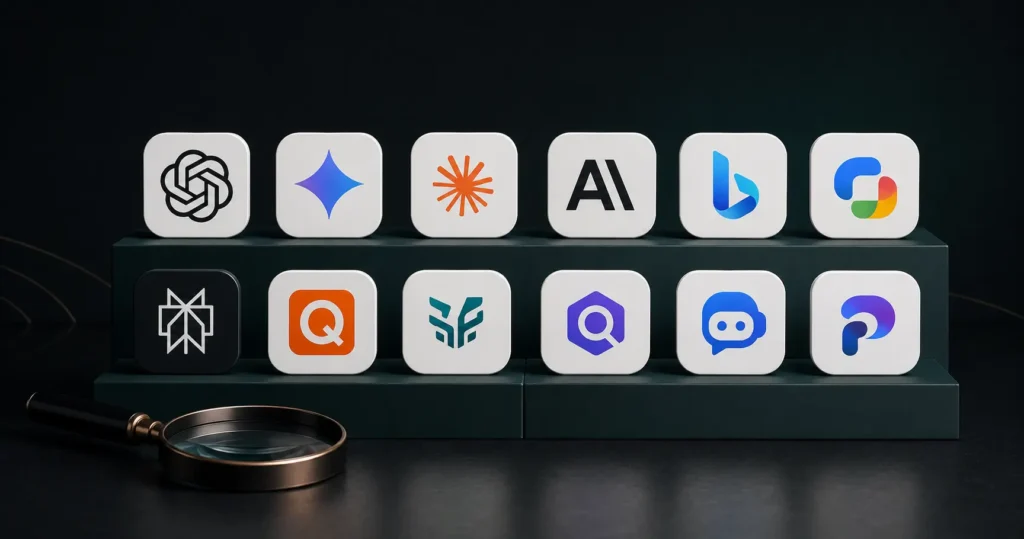
Search is no longer a single destination. Your customers now ask questions across a dozen different AI engines, from Google’s AI Overviews to ChatGPT, Perplexity, and a wave of fast-rising challengers. Each one answers directly and recommends brands, and being visible in one does not mean being visible in the others. This is the list of AI search engines that actually matter in 2026, and how to think about optimizing for them.
This guide is written for marketers and business owners who know AI search is fragmenting and want a clear map: which platforms to care about, why each matters, how to prioritize, and how to win visibility across all of them without chasing every shiny new tool.
Think of it less as a dozen separate problems and more as one shifting landscape. The names and rankings will change, but the underlying question stays the same: when an AI answers on your topic, is your brand in it? This list is the map, and the rest of the guide is how to read it.
What counts as an AI search engine
An AI search engine is any system that answers a query with a generated response instead of a list of links, usually citing a few sources. That definition now spans traditional search with AI layered on top, standalone AI assistants, and AI features built into browsers, phones, and apps.
The common thread is that they all read the web, synthesize an answer, and decide which brands to name, drawing on large language models to do it. Winning visibility across them is the work of LLM SEO: making your brand the clear, trusted source these systems reach for, wherever the question is asked. It is worth being clear about what is not on this list.
Pure image or code tools, closed enterprise copilots with no web access, and niche experiments do not move the needle for most brands. The engines that matter are the ones your customers actually use to ask questions and get recommendations, and those are the twelve below.
Quick verdict: AI search has fragmented across a dozen engines, and each recommends brands in its own answers. ChatGPT and Google’s AI surfaces lead on reach, while Perplexity, Claude, and Copilot matter by audience. Optimize the shared foundations that work everywhere, tune for the platforms your buyers actually use, and measure your visibility across all of them.
The 12 AI search engines to optimize for in 2026
These are the AI engines and assistants worth your attention this year, roughly in order of reach and relevance for most businesses.
1. Google AI Overviews and Gemini
Google’s AI surfaces still reach the most people. AI Overviews and the conversational AI Mode sit on top of Search, powered by Gemini, and answer a large share of queries directly. Because they inherit Google’s scale, appearing in Google Gemini answers and Overviews is the single biggest AI visibility opportunity for most brands, and Google’s AI features documentation confirms it relies on the same helpful, trustworthy content foundations.
The practical move is to answer the specific questions in your niche clearly and earn the trust signals Google already rewards in Search.
2. ChatGPT
ChatGPT is the largest standalone AI assistant, with around 800 million weekly users, and its search feature browses the live web and cites sources. It is where a huge share of research, comparison, and recommendation now happens. Optimizing to be cited in ChatGPT means writing clear, answer-first content and earning the third-party trust that OpenAI’s ChatGPT search relies on.
Because ChatGPT weights broad web consensus and Wikipedia-grade sources, being consistently described across many reputable places matters more than any single page.
3. Perplexity
Perplexity is the AI answer engine built for search, and it shows its sources prominently on every answer. It leans heavily on community and review content, so being present and well-regarded on sites like Reddit and G2 matters.
Winning Perplexity answers rewards content that reads like a citable reference and is corroborated elsewhere. If your category lives on Reddit and review sites, Perplexity is often where that presence pays off first.
4. Microsoft Copilot
Copilot is Microsoft’s assistant, built into Windows, Microsoft 365, and Bing, which makes it especially important for B2B and enterprise audiences who live in those tools all day. It draws on the Bing index and cites sources. Appearing in Microsoft Copilot answers rewards clear content plus solid Bing visibility, an often-overlooked advantage.
For B2B brands, a little attention to Bing and Microsoft’s ecosystem can unlock visibility that competitors ignore entirely.
5. Claude
Claude, from Anthropic, is favored by professional, technical, and enterprise users for its depth and careful reasoning, and it browses and cites web sources. It rewards thorough, well-structured, credible content over thin pages.
Getting recommended by Claude is about demonstrated expertise, which is exactly what Anthropic’s Claude is designed to reward. Detailed, well-sourced pages that hold up to scrutiny are what earn a mention here.
6. Meta AI
Meta AI is embedded across WhatsApp, Instagram, and Facebook, putting an assistant in front of billions of consumers inside apps they already use daily. For consumer and local brands especially, this reach is hard to ignore. Optimizing for Meta AI means clear entity signals and a strong, consistent presence across the web it draws from. For local and consumer brands, consistent listings and reviews are the foundation Meta AI leans on.
7 to 12. The fast-rising challengers
Beyond the leaders, six more are gaining fast and worth watching. Grok, built into X, pulls heavily on real-time and social conversation. DeepSeek has become a serious open model with growing global reach. Amazon’s Rufus and Alexa+ shape shopping and voice answers. Apple Intelligence and Siri now blend on-device AI with ChatGPT for hundreds of millions of iPhone users.
And a new class of AI browsers, including Perplexity’s Comet and other agentic tools, is starting to search and act on the user’s behalf. None dominate yet, but the brands that stay consistent and trustworthy tend to appear across all of them. The right posture toward these is attention without obsession.
You do not need a dedicated program for Grok or a new AI browser today, but you should watch which ones your audience adopts, because a challenger can go from novelty to necessity in a single product cycle. The brands that keep their fundamentals strong are ready when any of them breaks through.
Which AI search engines should you prioritize?
You prioritize by where your buyers actually are, not by which tool is trending. Reach is not the same as relevance, so start from your audience and work backward to the engines they use.
For most businesses, Google’s AI surfaces and ChatGPT are non-negotiable because of sheer reach. B2B and enterprise brands should add Copilot and Claude, since their buyers live in Microsoft tools and value depth. Consumer and local brands should weight Meta AI and Google, while ecommerce brands cannot ignore Amazon’s Rufus.
The good news is that you do not have to choose as much as it seems, because the foundational work carries across all of them. There is a simple way to decide: look at where your buyers already spend attention, then weight your effort toward the two or three engines that match.
It matters because the click is scarce everywhere, and zero-click search data from SparkToro shows less than a third of searches now send a click, so being the cited answer on the engines your audience uses is worth more than thin coverage across all twelve.
Not sure where your brand shows up across AI engines? Run a free AI visibility audit to see which platforms cite you and which name a competitor instead.
How to optimize across all of them
You optimize across engines by getting the shared foundations right first, then tuning for the platforms that matter most to your audience. The overlap is larger than the differences.
Universal foundations that work everywhere
Almost every engine rewards the same core work. Lead with clear, direct answers, back claims with data and sources, keep your facts consistent across the web, earn genuine third-party mentions, and make your content crawlable and well-structured.
This is the heart of generative engine optimization, and doing it well lifts your visibility everywhere at once, because you are building the credibility all of these systems look for. A useful way to picture it: these foundations are the eighty percent of the work that pays off on almost every engine.
If you only had time for one thing, it would be making your content the clearest, best-sourced answer in your category, because that single quality is what nearly every AI system is optimizing to find.
Where the platforms differ
The tuning is in the details. ChatGPT leans on Wikipedia and broad web trust, Perplexity and Google AI weight Reddit and reviews, Copilot rewards Bing presence, and Claude favors depth. Knowing these biases lets you prioritize the right third-party sources for the engines your buyers use, rather than spreading effort evenly and thin.
The foundations are shared, but the finishing touches are platform-specific. Treat the differences as a prioritization guide, not a reason to fragment. Knowing Perplexity loves Reddit tells you where to invest first if Perplexity matters to your buyers, not that you need a wholly separate strategy. The bias tells you the order of operations, while the foundation stays the same.
Do you need a different strategy for each platform?
No, you need one strategy with platform-specific adjustments. Building a separate program for every engine is wasteful and unnecessary, because the same trusted, clearly structured content earns visibility across most of them.
The smarter model is a shared core plus targeted tuning. Get your entity signals, answer-first content, and third-party trust right once, then adjust which platforms and sources you emphasize based on where your audience concentrates. A brand strong on the fundamentals will show up across many engines with far less effort than one chasing each platform separately with a different playbook.
There is also a cost to over-fragmenting. Teams that build a bespoke plan per engine spread themselves thin, ship less, and end up weaker everywhere. A single strong core, updated as the engines evolve, is more resilient than a dozen half-finished platform strategies, and far easier to maintain as new engines appear and old ones fade.
How to track visibility across AI engines
You track it by testing the real questions your buyers ask across multiple engines and logging where you appear. Rankings tell you nothing here, so the metrics that matter are mention rate, citation rate, and share of voice against competitors, measured per platform.
Start with a baseline across the engines your audience uses, then re-test on a regular cadence, because AI answers shift often. Our AI SEO case studies track these cross-platform gains rather than traffic alone, since a brand can be strong in one engine and invisible in another.
Watching all of them at once is the only way to see the full picture and fix the gaps. Prioritize by intent, not just presence. Being named for a high-intent buying question on the engine your customers use is worth far more than a mention on a fringe platform, so weight your tracking and your fixes toward the answers that actually move revenue. That focus keeps a multi-platform program from becoming an unmanageable sprawl.
A quick multi-platform AI search checklist
Use this as a fast starting point for winning visibility across AI engines.
- List the engines your buyers actually use, and prioritize the top three.
- Baseline how each names or cites your brand for ten real buyer questions.
- Lead your key pages with clear, direct answers backed by data and sources.
- Keep your brand facts identical across your site, profiles, and directories.
- Earn genuine reviews and mentions on the third-party sources each engine trusts.
- Add clear structure and schema so every engine can parse your content.
- Track mention rate, citation rate, and share of voice per platform, monthly.
Building for the whole AI search landscape
AI search will keep fragmenting, and no single engine will win everything. That is why the goal is not to chase one platform but to build the durable foundations that make your brand a trusted answer wherever the question is asked. The leaders will shift, but clear, credible, consistent brands travel well across all of them.
Start by mapping which engines your buyers use, get the shared foundations right, then tune for the platforms that matter most and measure your presence across the board. Do that, and you future-proof your visibility against whatever the AI search landscape looks like next.
The specific twelve on this list will look different in a year. Some will consolidate, others will surge, and new ones will appear. Brands built on genuine clarity, trust, and consistency are the ones that keep showing up regardless. At Intelitune, that is the outcome we build toward on every engagement.
Frequently Asked Questions
What are the main AI search engines in 2026?
The main ones are Google AI Overviews and AI Mode, ChatGPT, Perplexity, Google Gemini, Microsoft Copilot, and Claude, followed by Meta AI, Grok, DeepSeek, Amazon’s Rufus, Apple Intelligence, and emerging AI browsers. Google’s surfaces and ChatGPT have the widest reach, while the others matter depending on your audience.
Which AI search engine has the most users?
ChatGPT is the largest standalone assistant, with around 800 million weekly users, but Google’s AI Overviews reach even more people because they appear on top of standard Google Search. For total reach, Google’s AI surfaces and ChatGPT lead, with Gemini and Perplexity growing quickly behind them.
Do I need to optimize for every AI search engine?
No. Optimize the shared foundations that work across all engines, then prioritize the two or three platforms your buyers actually use. Because clear, trusted, well-structured content earns visibility almost everywhere, a strong core plus light per-platform tuning beats building a separate program for each engine.
How is optimizing for AI search engines different from Google SEO?
Classic SEO aims to rank a page and earn a click. AI search optimization aims to be cited and recommended inside a generated answer, often with no click. It relies more on third-party trust, clear answers, and consistent facts than on backlinks and keyword rankings, though strong SEO still helps.
How do I know if AI engines recommend my brand?
Test the real questions your buyers ask across ChatGPT, Perplexity, Gemini, Copilot, and Claude, and record whether you are named or cited and which competitors appear instead. Tracking mention rate and share of voice per platform, ideally with an AI visibility audit, shows exactly where you win and where you are missing.
Resources & Further Reading
The following authoritative sources were used to inform and validate this article:
- Google Search Central explains Google’s AI features and how content appears in AI Overviews and AI Mode.
- OpenAI documents ChatGPT search and how it browses the web and cites sources.
- Anthropic is the maker of Claude, an AI assistant used widely by professional and technical audiences.
- Wikipedia provides a reference explainer on the large language models behind AI search engines.
- SparkToro published 2026 data showing less than a third of Google searches send a click.

Arqam Bashir
Founder & Head of AI SEO
Arqam Bashir is the Founder & Head of AI SEO at Intelitune, helping brands grow visibility across ChatGPT, Google AI Overviews, Gemini, Perplexity, and Search through AI SEO, AEO, GEO, technical SEO, and entity optimization.
- Previous
- Next
- Real client results
What you can expect to gain
- AI Visibility Diagnostic