



Key Takeaways
A 2026 guide to getting your brand cited when users ask Meta AI across WhatsApp, Instagram, Facebook, and Messenger, built on how Meta AI works.
- Meta AI pulls real-time results from both Google and Bing, so optimizing for Meta AI means winning in two search engines, not one.
- Meta AI reaches close to a billion monthly users inside apps people already live in, which makes its recommendations high-stakes for brands.
- Bing visibility is the neglected half of Meta AI SEO, since most brands optimize for Google and quietly ignore the engine Meta AI also reads.
- The biggest mistake is treating Meta AI like a niche channel when it sits inside WhatsApp, Instagram, and Messenger for everyday questions.
- Consistent entity signals across the web and your Meta profiles help Meta AI recognize and recommend you with confidence.
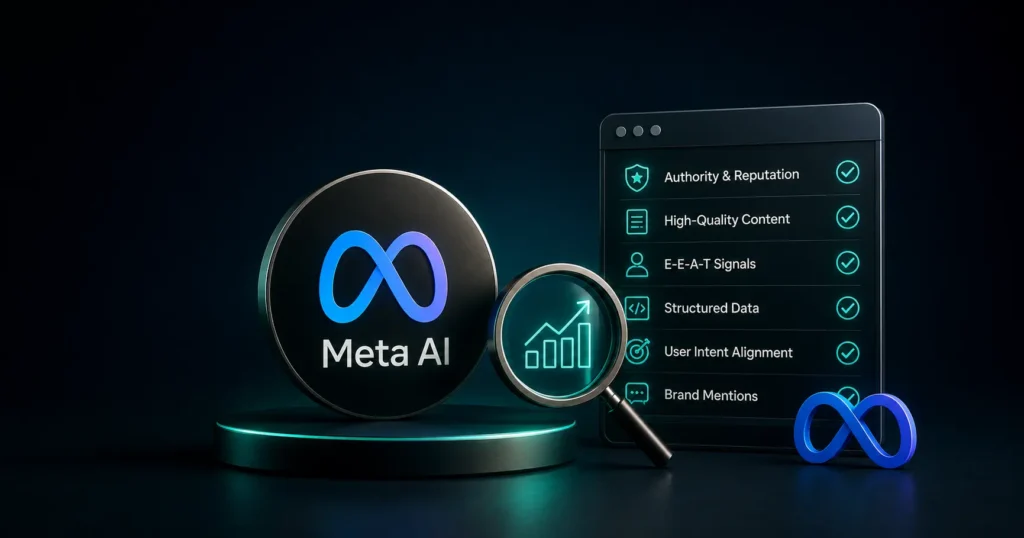
Meta AI SEO: How to Optimize for Meta AI in 2026
Learning how to optimize for Meta AI starts with a fact that reshapes the whole strategy: Meta AI reads both Google and Bing. It is not grounded in a single search index.
Meta’s assistant pulls real-time results from Google or Bing depending on the query, which means Meta AI SEO is really about winning visibility in two engines at once, plus being clear enough as a brand that the model trusts and quotes you.
This guide is for marketers, founders, and SEO teams in the United States who want to be recommended when someone asks Meta AI inside WhatsApp, Instagram, Facebook, or Messenger.
The reach is hard to ignore. Meta has reported that Meta AI serves close to a billion people a month, embedded in the apps they already open dozens of times a day. That distribution is the opportunity.
According to Pew Research Center data, people click far fewer traditional links once an AI answer appears, so being the cited source inside Meta AI now matters more than a raw ranking. Our team at Intelitune treats Meta AI as a two-engine problem most brands are only half solving.
What Is Meta AI, and Where Does It Get Its Answers?
Meta AI is Meta’s assistant, built on its Llama models, and it gets real-time answers from Google and Bing. It runs inside Facebook, Instagram, WhatsApp, and Messenger, on the meta.ai website, and on Meta’s smart glasses, so it answers questions right where people already spend their time. Getting recommended by it is a core part of generative engine optimization.
Per Meta’s own Meta AI announcement, the assistant is woven into the search boxes and feeds of Meta’s apps and can respond to posts directly. That placement changes buyer behavior.
Someone comparing products in an Instagram DM or asking a question in WhatsApp can get a synthesized answer without ever opening a browser. If your brand is not visible in the engines Meta AI reads, you are simply absent from that moment, no matter how strong your website is.
Quick verdict: Meta AI answers from both Google and Bing, so treat it as a two-engine problem and win visibility in each. Tighten your entity signals so the model trusts who you are, and write passages it can quote in a single line. Optimize only for Google and you vanish from every answer Meta AI builds from Bing.
How Does Meta AI Find and Surface Sources?
Meta AI decides whether a question needs live information, then pulls current results from Google or Bing and synthesizes them into an answer. That means your path to being surfaced runs through classic search visibility in both engines, combined with content clean enough to quote. This is the practical core of answer engine optimization for Meta’s ecosystem.
The key implication is that you cannot optimize for Meta AI directly. There is no Meta AI submission form or ranking dashboard. You influence it indirectly, by being the result its underlying engines return and the passage its model finds easiest to trust.
Meta AI Reads Both Google and Bing
Meta AI selects between Google and Bing depending on the query, so visibility in either engine can put you in an answer. As Search Engine Journal reporting documented, Meta’s assistant incorporates real-time results from both, intelligently choosing which to display.
The exact logic for when it favors one over the other is not public, which is precisely why you cannot afford to be strong in only one.
That dual sourcing is the single biggest difference between Meta AI and an assistant like Gemini. Betting everything on Google leaves half the door closed.
Where Meta AI Shows Up: WhatsApp, Instagram, and More
Meta AI appears inside the surfaces people use daily, not on a separate destination they have to seek out. It sits in the search bars of WhatsApp, Instagram, Facebook, and Messenger, answers in feeds, continues conversations on meta.ai, and speaks through Meta’s smart glasses. Each surface is a place a buyer might ask for a recommendation.
That ubiquity raises the stakes. A question you would never see in a search console is now being asked and answered inside a private WhatsApp thread, and the brand named there wins attention you never get to measure directly.
Why Bing Visibility Is the Hidden Half of Meta AI SEO
Bing visibility is the most overlooked lever in Meta AI SEO, because most brands pour everything into Google and treat Bing as an afterthought. Since Meta AI also pulls from Bing, that neglect quietly hands answers to competitors who happen to rank there. Fixing your Bing presence is often the fastest Meta AI win available.
Start with the basics most teams skip. Submit your site and sitemap in Bing Webmaster Tools, confirm your key pages are indexed, and check how you rank in Bing for the queries that matter, which is frequently different from Google.
Bing also powers other assistants and Copilot experiences, so the work compounds beyond Meta AI. The brands that treat Bing as a real channel, not a rounding error, show up in Meta AI answers their Google-only competitors miss.
There is a competitive reason this matters more than the raw traffic suggests. Because so few brands seriously optimize for Bing, its results are often less contested than Google’s for the same query.
A page that struggles to crack the Google top ten can land far higher on Bing, which means a modest Bing effort can put you into Meta AI answers you would never win through Google alone. In practice, the fastest Meta AI gains I see come from teams that simply stop ignoring the engine half their competitors forgot exists.
Win Google and Bing Together
The durable strategy is to earn strong, trustworthy visibility in Google and Bing at the same time, because Meta AI can reach for either. Most fundamentals overlap, so this is less about doubling the work and more about not ignoring one engine. Fix crawlability, earn quality links, and publish genuinely helpful content, and both engines reward you.
Lean on demonstrated expertise. Google’s Google Search Central guidance rewards experience, expertise, and trust, and Bing weighs similar quality signals, so content that satisfies one tends to satisfy the other.
Where they diverge is worth knowing: Bing can favor exact-match and older signals more than Google, so a page that ranks well on Google may still need attention to surface on Bing. Audit both, and close the gap on whichever engine you have been neglecting.
A practical way to run this is to keep one prioritized query list and track your position on both engines side by side. When a page ranks on Google but not Bing, the fix is usually straightforward: confirm Bing has indexed it, check for crawl or canonical issues, and make sure the exact phrasing buyers use appears in your headings.
When it ranks on Bing but not Google, the gap is often authority and links. Treating the two engines as one dashboard, rather than two separate projects, keeps the Meta AI opportunity in view instead of buried in a tool most teams check once a year.
Build the Entity Signals Meta AI Can Trust
Entity clarity tells Meta AI who you are and which category you belong in, independent of any single page or engine. A model that sees one coherent description of your brand across the web recommends you with confidence; one that sees conflicting details hedges. This is the backbone of being recognized rather than guessed at.
Make your identity consistent everywhere it appears. Your brand name, description, and category should read the same on your site, your profiles, and third-party mentions, including your Facebook and Instagram business profiles, which are part of how you present a coherent entity.
Add Schema.org structured data with Organization markup and a complete sameAs list so machines can connect your website to the rest of your footprint. Consistency here is not cosmetic; it is what lets an assistant place you correctly.
Curious where Meta AI, ChatGPT, and Gemini currently place your brand? Run a free AI visibility diagnostic and see how you compare against competitors.
Structure Content So Meta AI Can Extract It
Structure is what turns a ranking page into a quotable one. Lead each important section with a direct, factual answer, then support it, so the model has a clean line to lift rather than a slow build it has to summarize. Assistants reward pages that make the answer obvious.
Use plain sentences near the top of each section, put numbers and specifics in their own clauses, and break dense blocks into short paragraphs with descriptive headings.
The same discipline that earns citations in Meta AI also helps you in Claude SEO, because every major assistant prefers self-contained, verifiable passages. Write the answer as though it will be quoted alone, because increasingly it will be.
Meta AI adds one more reason to keep answers tight: many of its interactions happen on mobile, inside a messaging thread where the response is short. A model composing a two-line reply in WhatsApp has room to quote one clean sentence, not a rambling paragraph.
Pages that front-load the answer in a single, specific line give Meta AI exactly what fits that format. Long preambles, marketing throat-clearing, and answers that only make sense after three paragraphs of setup get skipped in favor of a competitor who simply said the thing.
How Is Optimizing for Meta AI Different from ChatGPT and Gemini?
The core difference is the source of truth: Meta AI reads both Google and Bing, while Gemini grounds mainly in Google and other assistants use their own retrieval. That makes Bing visibility unusually important for Meta AI compared with, say, Gemini SEO, where Google strength carries most of the weight.
The distribution differs too. Meta AI lives inside social and messaging apps rather than a standalone chat destination, so it captures casual, in-the-moment questions that a tool like ChatGPT SEO targets in a different context.
The shared fundamentals of entity clarity and quotable content carry across all of them, but for Meta AI you should weight extra effort toward Bing and toward a consistent presence on Meta’s own platforms.
Common Meta AI SEO Mistakes
The most common mistake is optimizing only for Google and assuming that covers every assistant. Because Meta AI also reads Bing, a Google-only strategy leaves you invisible for any query Meta AI answers from Bing, and you will never see it happen in your analytics. Close the Bing gap first.
Other frequent errors compound the problem. Brands ignore Meta AI entirely as a channel, publish inconsistent descriptions that confuse entity resolution, bury key facts in long paragraphs, and neglect platform-specific work like Perplexity SEO that shares the same fundamentals.
Many also forget that Meta AI reaches people in private messages, so they underestimate how much brand discovery now happens somewhere they cannot track. Assuming a channel does not matter because you cannot measure it is how competitors quietly take the recommendation.
Your 2026 Meta AI Optimization Checklist
Start by fixing the engine you have been ignoring. Verify your site in Bing Webmaster Tools, confirm indexation, and benchmark your Bing rankings against Google for your priority queries, because that gap is usually where the fastest Meta AI gains hide. Then shore up Google visibility so both engines are covered.
Next, tighten your entity signals: unify your brand description across the web and your Meta profiles, ship Organization schema with a full sameAs list, and make sure your category is unmistakable. Rebuild your highest-intent pages around clean, quotable answers, and date anything time-sensitive.
Track results the way we do in our case studies, and tailor the approach to your vertical, since buyer behavior varies widely across the industries we serve.
Ninety days of steady work across both engines, entity clarity, and extractable content moves a brand from absent to routinely cited in Meta AI.
The brands Meta AI recommends in 2026 are the ones visible in both engines it reads and clear enough to quote without hesitation. Cover Google and Bing together, make your identity unambiguous everywhere, and give the model a clean answer worth repeating.
Do that consistently, review your position on both engines each quarter, and you stop guessing whether Meta AI mentions you and start expecting it.
Frequently Asked Questions
Can you optimize for Meta AI directly?
Not directly. Meta AI has no submission form or ranking dashboard. It pulls real-time results from Google and Bing and synthesizes them, so you influence it indirectly by winning visibility in both engines and publishing clean, quotable content. Strong search presence plus consistent entity signals is how you get surfaced inside Meta AI answers.
Does Meta AI use Google or Bing for search results?
Both. Meta AI incorporates real-time results from Google and Bing, selecting between them depending on the query, according to reporting on Meta’s integration. The exact logic for when it favors one engine is not public. That is why optimizing for only Google leaves you invisible for the queries Meta AI answers using Bing instead.
Where does Meta AI appear?
Meta AI runs inside Facebook, Instagram, WhatsApp, and Messenger, in their search boxes and feeds, plus the meta.ai website and Meta’s smart glasses. That places it inside apps people already use constantly, so buyers can get recommendations in a private message or DM without ever opening a browser or visiting a search engine.
How is Meta AI SEO different from regular SEO?
Regular SEO aims to rank a page and win a click. Meta AI SEO aims to be the source Meta AI cites inside an answer, which depends on visibility in both Google and Bing plus quotable, well-structured content. The two overlap heavily, but Meta AI SEO puts unusual weight on Bing and on consistent entity signals across platforms.
Does my Facebook or Instagram presence affect Meta AI?
Consistent business profiles help by reinforcing a coherent entity, but follower counts are not a proven direct ranking signal for Meta AI answers. Meta AI grounds its answers in Google and Bing web results, so your search visibility matters most. Keep your Meta profiles accurate and on-brand so every source tells the same story about your company.
Resources & Further Reading
The following authoritative sources were used to inform and validate this article:
- Meta AI Announcement – Meta’s official overview of Meta AI, built on Llama and across its apps
- Search Engine Journal – reporting that Meta AI integrates real-time Google and Bing results
- Bing Webmaster Tools – Microsoft’s tool to index and check visibility in Bing
- Google Search Central – helpful content and EEAT guidance for Google visibility
- Schema.org – the structured data vocabulary that defines your brand as an entity
- Pew Research Center – data on falling click rates when AI answers appear in results

Arqam Bashir
Founder & Head of AI SEO
Arqam Bashir is the Founder & Head of AI SEO at Intelitune, helping brands grow visibility across ChatGPT, Google AI Overviews, Gemini, Perplexity, and Search through AI SEO, AEO, GEO, technical SEO, and entity optimization.
- Previous
- Next
- Real client results
What you can expect to gain
- AI Visibility Diagnostic