
 ChatGPT SEO
 Perplexity SEO
 Gemini SEO
 Claude SEO
 Microsoft Copilot SEO
 Meta AI SEO


What 40 AI answers, 10 Google searches and 130 firm websites show about who gets the first call after an arrest.
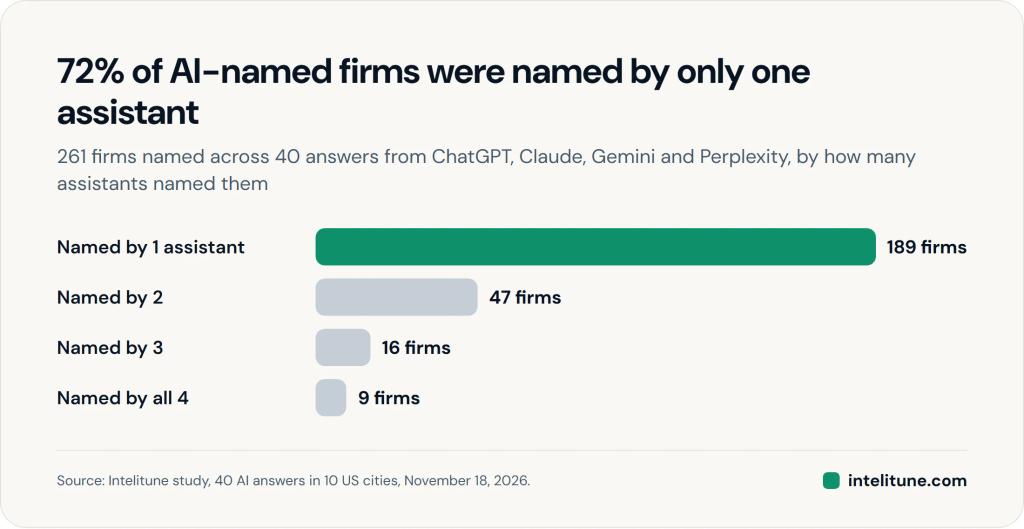
- There is no single AI ranking. 189 of the 261 firms the assistants named (72%) were named by only one of them. Just 9 were named by all four.
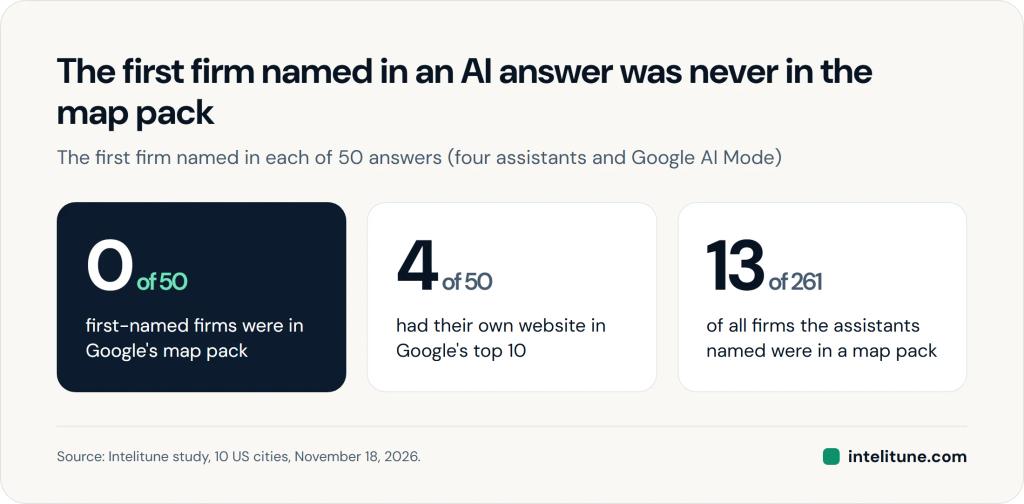
- The map pack and the AI shortlist are different lists. None of the 50 firms named first in an AI answer was in Google's map pack.
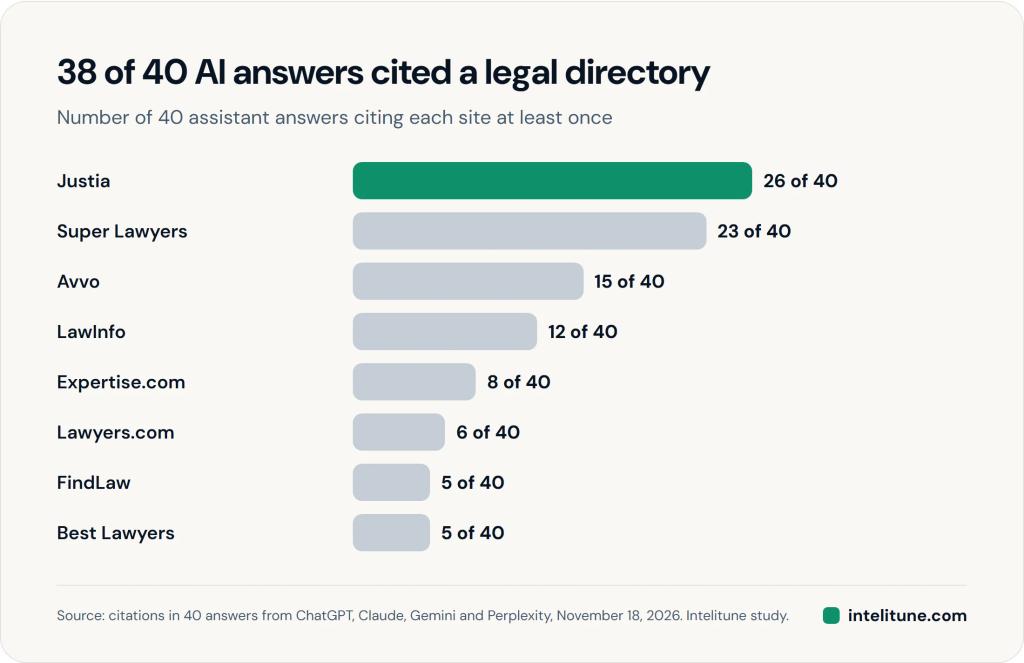
- Directories are the common source. 38 of 40 assistant answers cited Justia, Super Lawyers, Avvo or another legal directory, and directories held 57% of Google's top 10 results.
- Match the charge. 78% of firm mentions tied the firm to DUI or DWI work for a DUI question, so every charge you defend needs its own page.
- Make the call one tap. 27 of 130 firm sites had no tap-to-call link on the first phone screen.
- It works without ads. A criminal defence firm logged 35 call taps and 13 forms in 28 days after 90 days of charge pages, answers and tracking.
Ask four AI assistants the same question and you get four different lawyers.
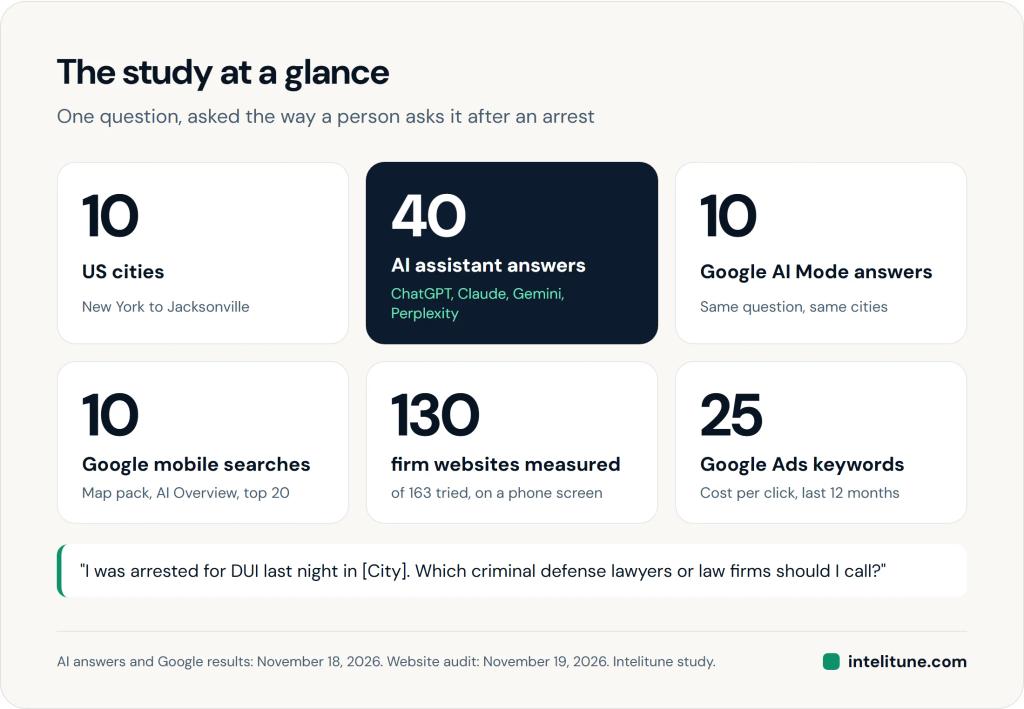
We checked. On November 18, 2026 we typed one sentence into ChatGPT, Claude, Gemini and Perplexity: "I was arrested for DUI last night in Houston, TX. Which criminal defense lawyers or law firms should I call?" Then we did the same for nine more US cities. Same words, every time.
The four assistants named 261 different firms. 189 of them were named by only one assistant. Just 9 were named by all four.
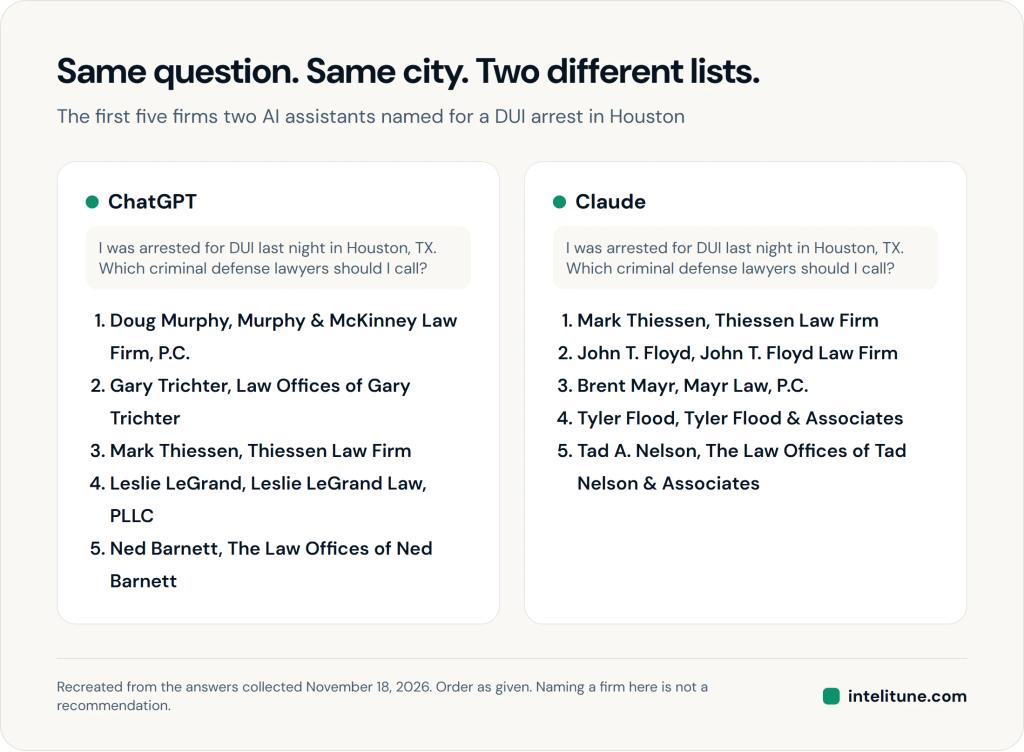
That is the new problem in criminal lawyer marketing. There is no single "first" to rank for. There are five shortlists (four assistants and Google), and they rarely match.
Our guide to AI SEO for law firms covers the basics across every practice area. This one is about criminal defense, where the client calls within hours of an arrest.
This guide shows how firms get onto those shortlists. What the assistants cite. What Google shows on a phone. What the websites of the firms they picked have in common. Then a real case: a criminal defence firm that went from referrals only to 35 call taps in 28 days, with no ads.
(The map pack result surprised us most.)
How we tested
We ran one realistic question through four AI assistants and Google in ten big US cities, then opened 130 firm websites on a phone-sized screen.
- 40 AI answers: ChatGPT, Claude, Gemini and Perplexity, all with web search on, one answer per city.
- 10 Google AI Mode answers to the same question.
- 10 Google searches on mobile for "criminal defense lawyer [city]": the map pack, the AI Overview and the top 20 results.
- 130 firm websites opened at 390 × 844 pixels, the size of a common phone. We checked the first screen, the call button, charge pages, reviews, structured data and AI crawler rules.
- Google Ads costs for 25 criminal defense and DUI searches.
The cities: New York, Los Angeles, Chicago, Houston, Phoenix, Philadelphia, San Antonio, San Diego, Dallas and Jacksonville. The full method and its limits are at the end.
How people find a criminal lawyer after an arrest
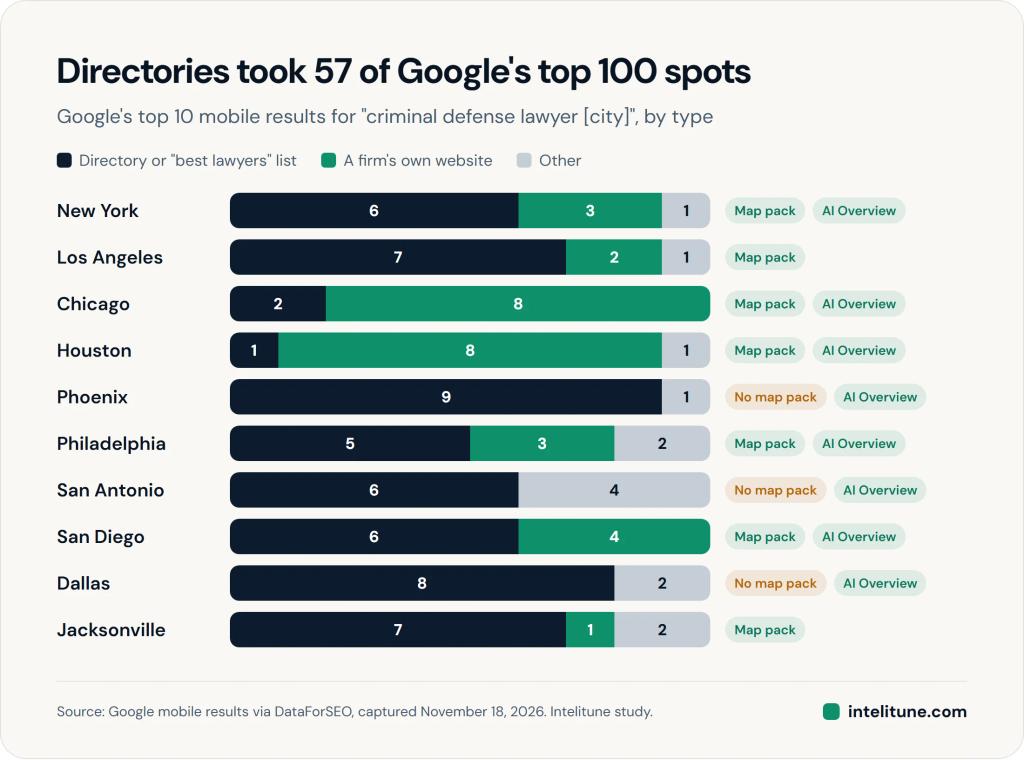
After an arrest, people search on a phone, in a hurry, and most of what they see first is not a law firm's website. Directories held 57% of Google's top 10 results in our ten cities.
Picture the person. Released at 3 a.m., or calling for a son who wasn't. Court date on a sheet of paper. They grab a phone and type "criminal defense lawyer" and the city.
Here is what Google showed them on mobile:
- An AI Overview on 8 of the 10 searches.
- A map pack on 7 of 10. In Phoenix, San Antonio and Dallas there was no map pack at all, only the AI Overview and the results under it.
- In the top 10 results, 57 of 100 places went to directories and "best lawyers" lists. 29 went to firms' own websites.
- In 3 cities, not one firm's own website made the top 10.
So the first thing a scared person sees is often a directory profile, a Business Profile card or an AI answer. Your website gets its turn later, if at all.
And an AI summary changes what people click. In a Pew Research Center study of 900 US adults, people clicked a regular search result on 8% of visits when an AI summary appeared, against 15% when none did.
More and more of them skip the list and ask AI directly. That's where it gets messy.
The AI assistants don't agree on who to call
The four assistants named 261 firms for the same ten questions, and 72% of those firms were named by only one assistant. Being named by one AI is common. Being named by most of them is rare.
The lists didn't even have the same length. The Claude answers named 13.0 firms each on average. Gemini named 6.1.
On average, two assistants shared only 16% of the firms they named between them. The closest pair, Perplexity and Gemini, shared 19%. ChatGPT and Perplexity shared 12%. In 2 of the cities, no firm was named by all four.
This isn't a glitch in our test. Each assistant runs its own web searches, reads different pages and builds its own shortlist, every time someone asks.
If your firm shows up in none of them, look at what keeps a firm invisible to ChatGPT. Usually it's thin profiles, vague practice pages and facts that don't match across sites.
Do this: stop asking "do we rank in ChatGPT?" Pick 20 questions your clients really ask. Run them through ChatGPT, Claude, Gemini, Perplexity and Google AI Mode once a month, and count how often your firm is named. That count moving is the number that matters. One screenshot isn't.
So what do the firms that keep getting named have in common? Not the thing most firms invest in first.
The map pack and the AI shortlist are different lists
None of the 50 firms named first in an AI answer was in Google's map pack. The map and the AI shortlist are built from different signals, so a firm needs both.
We expected overlap. The map pack is where Google puts the firms it trusts most for a local search. Surely the AI answers would start there.
They didn't:
- Across the 7 cities with a map pack, 25 firms appeared in it (4 of those spots were ads). 13 of them were named by at least one assistant.
- Of the 261 firms the assistants named, only 13 (5%) were in a map pack.
- Of the 50 firms named first in an answer, 0 were in the map pack and only 4 had their own website in Google's top 10.
Google's own AI sits in between. Google says there are no additional requirements to appear in AI Overviews or AI Mode beyond its normal search guidance. The AI Mode answers came back as Business Profile cards with star ratings. 9 of AI Mode's 52 picks were in the map pack, and 14 were in the firm list of the AI Overview on the same search.
Reviews still count. Where Google showed a rating, the firms the assistants named had a median of 218 Google reviews. Firms that only showed up on Google had 130. Firms in the free map pack spots had 258. Small samples (44 and 18 firms), but the direction is clear.
Google says the same about its own map. Local results rest mainly on relevance, distance and prominence, and more reviews and positive ratings can help a business rank locally.
That gives a criminal defense firm two jobs, not one:
- For Google's map pack and Google's AI: a complete Google Business Profile, the right primary category, real recent reviews, and answers to the questions people ask there.
- For the AI assistants: profiles and mentions on the sites they read, and a website that confirms the same facts.
Which sites do they read? We counted.
Reviews, directories and the signals AI trusts
The assistants leaned on legal directories more than any other source: 38 of 40 answers cited at least one.
Justia was cited in 26 of the 40 answers. Super Lawyers in 23. Avvo in 15. LawInfo in 12. Every assistant cited firms' own websites too, but the directories were the common thread.
Perplexity leaned on them hardest. Perplexity cites Justia in all 10 of its answers, and 75 of its 100 citations went to directories.
The Gemini answers were the exception. They cited firms' own websites 42 times and directories 20 times. For Gemini, your own site is the source.
Do this: claim and complete your Justia, Avvo, Super Lawyers (if you qualify) and LawInfo profiles. Use the same firm name, address, phone, practice focus and credentials on every one and on your own site. Then check what each assistant says about you, and fix the source of anything wrong.
Why the assistants pick one firm over another
When the assistants explained a pick, they pointed to proof a stranger can check: the right charge, a certification, a directory award, years in practice.
We read why each firm was picked. For each of the 367 firm mentions, we looked at the words the assistant wrote next to the name:
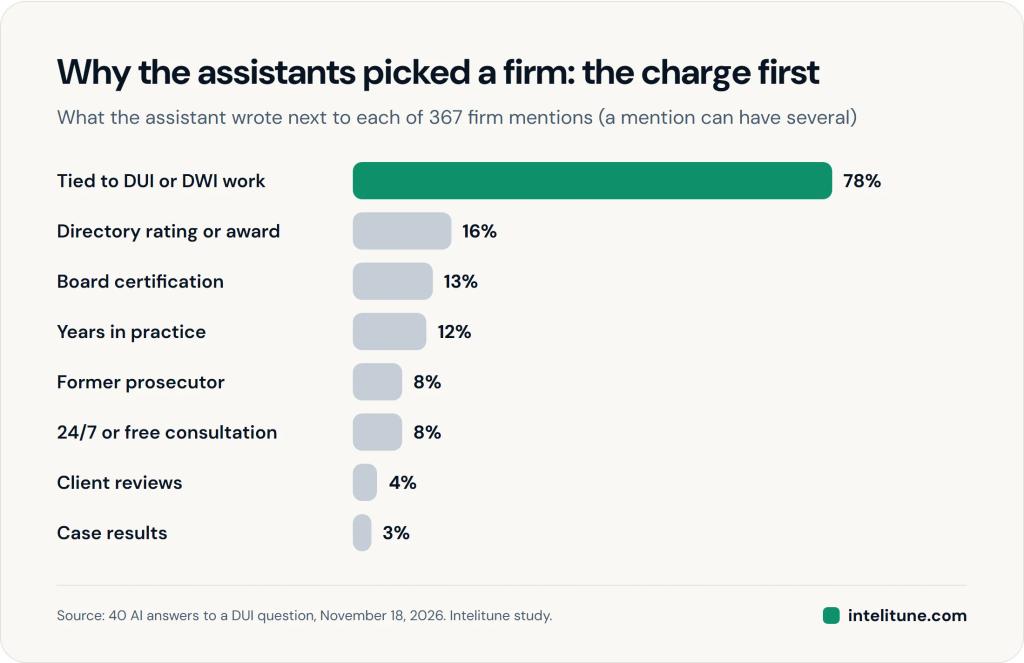
- 78% tied the firm to DUI or DWI work. The question said DUI, and the answers matched the charge.
- 16% mentioned a directory rating or award, like Super Lawyers or Avvo.
- 13% mentioned board certification.
- 12% mentioned years in practice, and 8% a former prosecutor.
- Only 4% mentioned reviews.
This is what ChatGPT answers look like up close. Its first Houston pick came with a reason: his site states he is "Board Certified in Criminal Law." A fact, a source, a reason. That is the pattern.
When an AI assistant recommends a lawyer, it repeats what the web can prove about that lawyer. Your job is to make the proof easy to find and the same everywhere.
One more thing can quietly take you out of these answers: your own website blocking them. Only 2 of the 130 sites blocked an AI search crawler in robots.txt. But 19 of the 163 firm sites we tried blocked our test browser outright, most of them with the same "Sorry, you have been blocked" page from a hosting firewall. We can't tell from outside whether those firewalls also turn away the assistants' own fetchers. It matters: OpenAI says sites that block its search crawler won't be shown in ChatGPT search answers. Ask your web host.
The assistants also repeat mistakes. One firm was recommended for Dallas, though it practices in San Antonio. One lawyer had a different first name in two different answers. In Phoenix, Claude told our person they had 7 days to request a license hearing; Gemini and Google AI Mode said 15. When the facts about you are inconsistent, the assistants fill the gaps themselves.
Being named is only half the job. For what happens after the mention, from the shortlist to a signed client, read how law firms get recommended when clients ask ChatGPT.
Charge and court pages that answer the first questions
The question said DUI, and 78% of the firm mentions tied the firm to DUI or DWI work. A page for each charge is how you match the exact problem a person brings.
The assistants didn't recommend "good criminal lawyers." They recommended DUI lawyers, for a DUI question. Someone charged with assault or a drug offense will get a different list, built from the pages that match their charge.
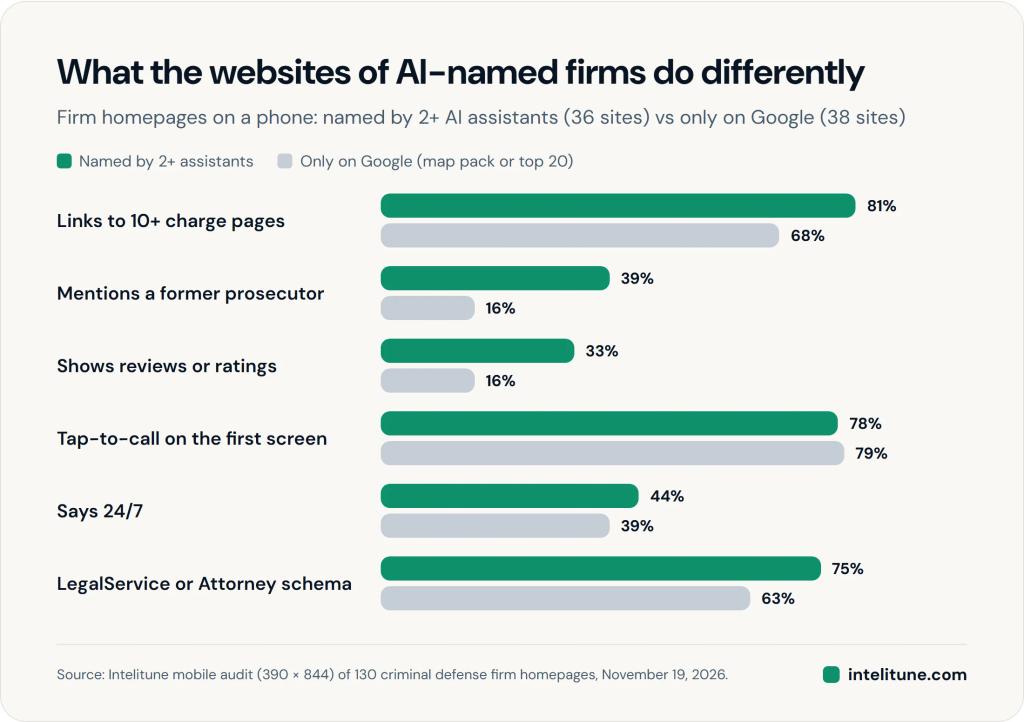
Our audit points the same way. Among firms named by two or more assistants, 81% linked to 10 or more charge pages from their homepage. Among firms named by one assistant, 70%. Among firms that only showed up on Google, 68%. The AI-named firms were also more likely to mention a former prosecutor (39% against 16%) and to show reviews on the homepage (33% against 16%). Those are the same kinds of proof the assistants quoted.
A good charge page answers the first questions in the first screen of text, then goes deeper:
What a charge page should include
- The charge in plain words, with the statute number.
- What happens in the first 24 to 72 hours: release, bail or bond, the first court date.
- Deadlines that can't wait, like a license hearing request, stated with the exact number of days and the source.
- The courts in your area that hear this charge, by name.
- Possible penalties, with a clear note that every case is different.
- Common defenses, explained without promises.
- Who handles it: the named attorney, bar number, any certification.
- A call button and a short form, with your hours.
- Five or six real questions people ask, answered in two or three sentences each.
- The date the page was last reviewed by a lawyer.
Point 3 matters more than it looks. Remember the Phoenix deadline that three AI answers couldn't agree on? A firm page that states it clearly, with the statute, is the kind of source an assistant can quote.
Pages built this way, answer first, are what answer engines can lift into a reply. A page that makes a person scroll past a sales pitch to find the deadline gives them nothing to quote.
Mobile calls: the conversion that matters
A criminal defense lead is usually a phone call, made from a phone. Yet 27 of the 130 firm sites we opened had no tap-to-call link on the first phone screen.
The map can't carry the calls on its own, either. In our searches, 4 of the 25 map pack spots were ads, and in 3 cities there was no map pack at all. Your own site has to do the work.
On the 130 sites we opened on a phone:
- 79% had a tap-to-call link on the first screen. 45% kept it pinned while you scroll.
- 47% said they answer 24/7. 76% offered a free consultation.
- 45% ran a chat widget.
- 21% offered Spanish.
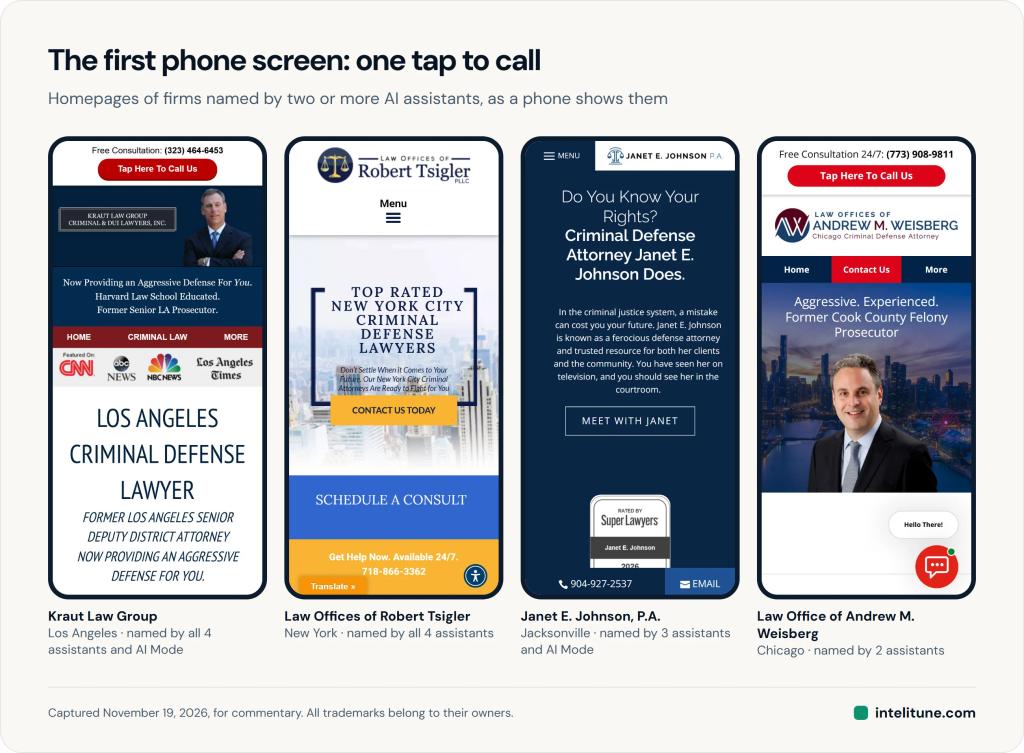
One surprise: the call button didn't separate the firms the assistants named from the rest. 78% of firms named by two or more assistants had one, and 79% of Google-only firms. It doesn't get you named. It turns being found into a call, and a firm without one loses callers it already earned.
The best ones look plain. A phone number at the top or pinned to the bottom, one clear button, a line that says when you can call. Nothing to figure out at 3 a.m.
Do this: open your homepage on your own phone. If you can't call the firm with one tap without scrolling, fix that first. Then track every tap as a key event in GA4, so you know which pages bring calls.
Paid ads vs organic for criminal defense
Ads rent the top of the page by the click. Organic and AI visibility are earned once and keep working. Firms that keep their cost per case down usually run both, with organic doing most of the work.
Look at what a click costs. Across our ten cities, the average cost per click for "DUI lawyer [city]" ran from $6.05 in New York to $185.96 in Los Angeles. The national term "criminal defense lawyer" averaged $66.71 a click, on 165,000 searches a month.
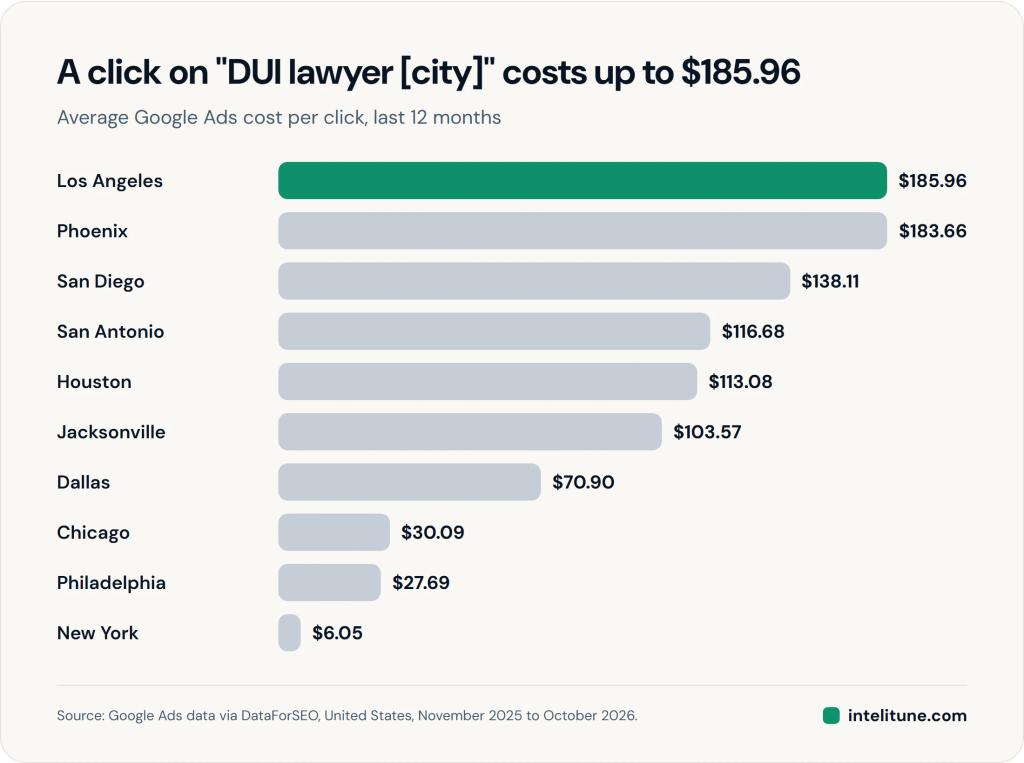
A click isn't a client. If one click in five turns into a real call and one call in five into a client, a $100 click means $2,500 in ads per signed case.
Here is how I'd split it:
- Run search ads only when someone answers every call within minutes, day and night, and you track which ads become signed clients, not only calls.
- Use Local Services Ads if you can respond fast. Google's help page says missed calls may negatively affect your responsiveness, which feeds how often you show.
- Never stop the organic work. It feeds the map pack, the AI Overviews and the assistants, and it doesn't switch off when the budget does.
The First-Call Stack: how firms get chosen first
Firms get the first call when they clear four layers in order: Found, Named, Matched and Tapped. Most firms work on one layer and wonder why the phone doesn't ring.
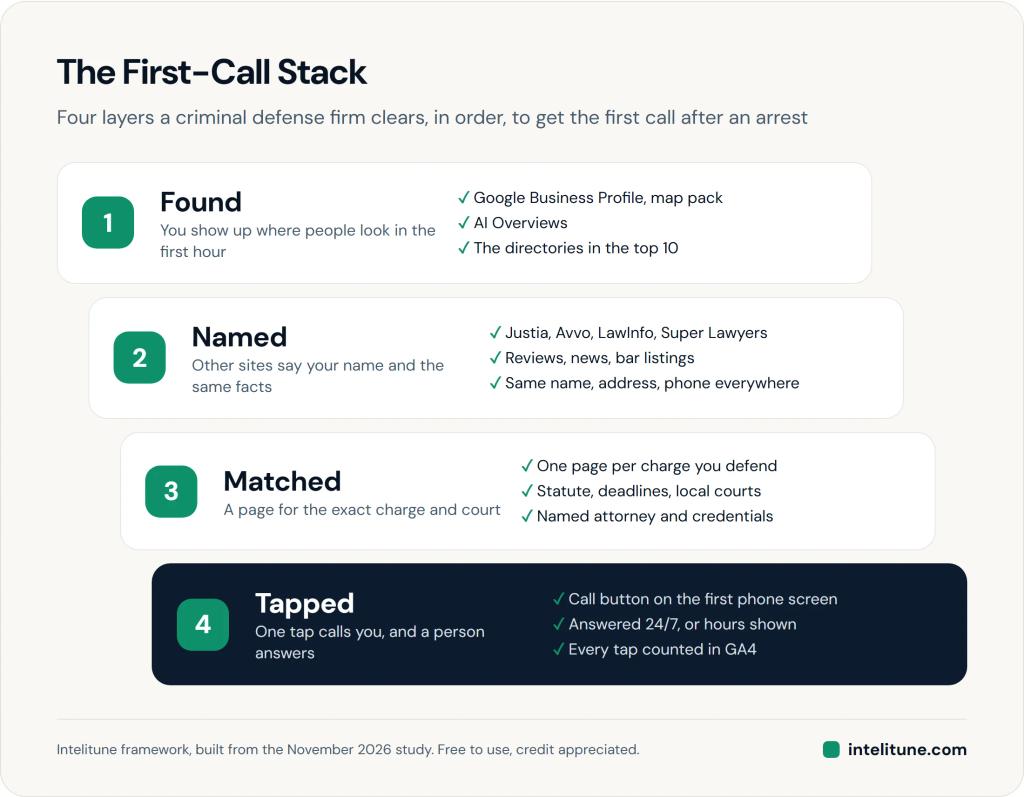
- Found. You show up where people look in the first hour: the map pack, the AI Overview, the directories that fill Google's top 10.
- Named. Other sites say your name and the same facts about you, so AI assistants are confident enough to recommend you.
- Matched. You have a page for the exact charge and court, so you're the answer to the question they actually asked.
- Tapped. One tap calls you from the first phone screen, and a person answers.
It is also the order we work in on law firm AI SEO engagements: found and named first, then matched pages, then every tap tracked.
Score your firm in five minutes. One point per yes.
- We are in the map pack for "criminal defense lawyer [our city]" on a phone.
- Our Google Business Profile has reviews from the last 30 days.
- Our Justia, Avvo and LawInfo profiles show the same name, address and phone as our site.
- ChatGPT, Claude, Gemini and Perplexity each name us for at least one real client question.
- We have a page for each charge we defend, with the statute and the local courts.
- Our charge pages state deadlines with the exact number of days and the source.
- Our homepage has a tap-to-call button on the first phone screen.
- The button stays visible as you scroll.
- Someone answers the phone 24/7, or the site says exactly when we do.
- We count every call tap and form as a key event in GA4.
8 to 10: you're built to be chosen first. 5 to 7: you're losing calls you never see. Under 5: start with points 7 and 10 this week.
Case study: 35 calls in 28 days without ads
An Australian criminal defence firm went from one landing page and referrals to 35 call taps and 13 forms in 28 days, with no paid ads. The work was charge pages, answers and tracking.
Can't show the name. Can show the screens.
The firm relied on referrals. No ads. The whole website was one landing page. Google sent about 800 clicks in three months, and Google's AI features showed the firm 59 times in the whole quarter.
In 90 days we rebuilt it:
- 24 pages, including one for each of the 18 kinds of charges the firm defends.
- 95 articles answering what people ask after a charge: police, bail, court, license, what happens next.
- Clear entity details and full lead tracking in GA4, so every call tap and form was counted.
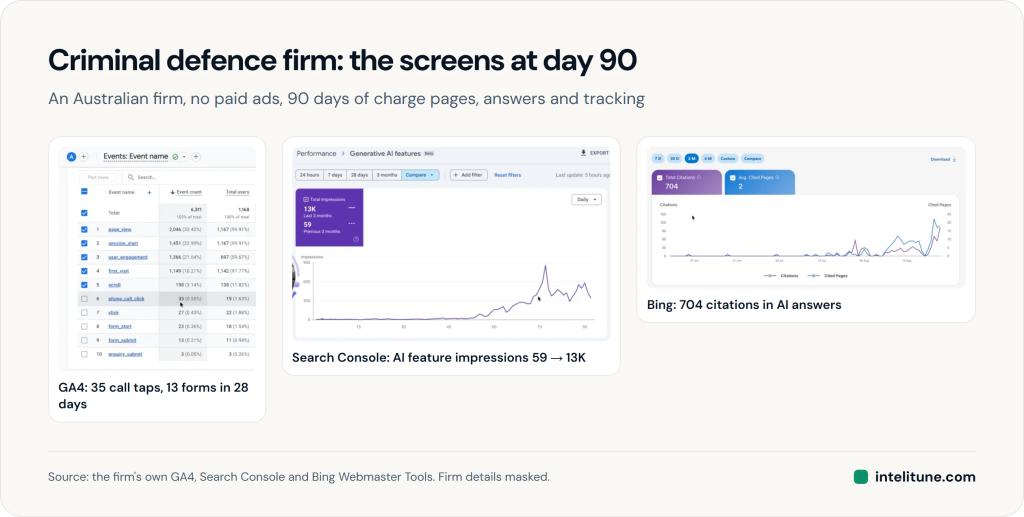
What moved, read in the firm's own accounts:
| Measure | Before | After | Source |
|---|---|---|---|
| Google Search clicks | 800 | 1.37K | Search Console, last 3 months vs prior 3 |
| Google AI feature impressions | 59 | 13K | Search Console, same comparison |
| Citations in Bing's AI answers | No baseline | 704 | Bing Webmaster Tools, last 3 months |
| Taps to call | No baseline | 35 (19 users) | GA4, last 28 days |
| Form submissions | No baseline | 13 | GA4, last 28 days |
The 704 citations come from Bing Webmaster Tools, which counts how often Copilot answers and Bing's AI summaries used the firm's pages.
One line surprised the firm. Average Google position barely moved, from 8.6 to 8.9. Clicks still rose about 71%. The site didn't climb. It got wider: it now had a page to show for each charge people searched.
That is the First-Call Stack in practice. Matched pages got the firm found and named. Tracking proved the taps.
The full criminal defence law firm case study has every screen and the screen recording.
Ethics rules on results and testimonials
Everything above has to stay inside your state's advertising rules. In criminal defense marketing, that mostly means three things: no misleading results claims, no false "specialist" titles, and no fake or bought reviews.
Most states build their rules on the American Bar Association's Model Rules. ABA Model Rule 7.1 bans false or misleading communication about a lawyer's services. Its comment warns that even true past results can mislead if they suggest a new client will get the same outcome.
ABA Model Rule 7.2 limits what you can pay for a recommendation and when you can call yourself a certified specialist.
On a criminal defense site that means:
- Case results go with the facts that explain them and a clear note that every case is different. "Charges dismissed" with no context is the risky version. In our audit, 56 of the 85 homepages that mentioned results like dismissals or not-guilty verdicts had no line saying results vary.
- "Specialist" or "expert" only if a body your state recognizes certified you, and you name it.
- Reviews come from real clients, unpaid. The FTC rule banning fake reviews has applied since October 21, 2024, and it covers AI-written ones too.
- Your state's version wins. Check your state bar's rules before you publish a results page.
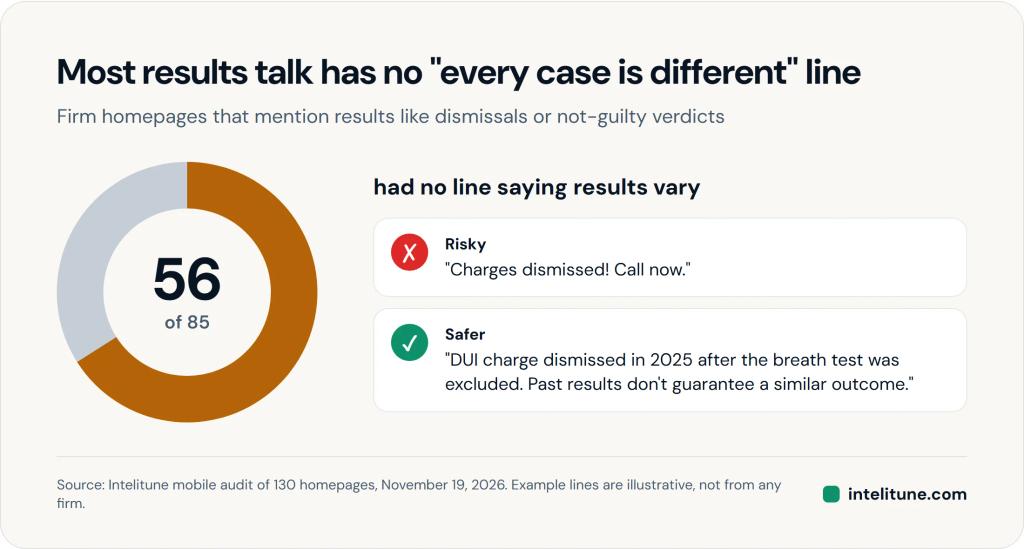
The same limits matter for AI. An assistant repeats what the web says about you. A results claim that breaks a bar rule on your site can end up in someone's answer with your name on it.
How we ran the study
Every number in this article comes from data we collected on November 18 and 19, 2026. Here is exactly how, and what it can't tell you.
- AI answers. One question, word for word: "I was arrested for DUI last night in [City], [State]. Which criminal defense lawyers or law firms should I call? Please give me specific names." We ran it once per city in ChatGPT (gpt-5.5), Claude (Sonnet 5), Gemini (3.6 Flash) and Perplexity (Sonar Pro), with web search on, and in Google AI Mode. All through the DataForSEO API on November 18, 2026, between 19:16 and 19:24 UTC.
- Firms. We listed every firm or lawyer an answer named as someone to call, in order. Directories and referral services were counted separately, not as firms. The same firm under two names in one city counted once.
- Reasons. For each firm mention we read the text from the firm's name to the next firm's name and recorded which reasons appeared (rules in the dataset notes). We checked a sample by eye.
- Google. Mobile results for "criminal defense lawyer [city]" in each city, top 20 results, map pack and AI Overview. Results were labeled as a directory, a firm's own site or other. In three cities the AI Overview loaded after the page, so we saw that it was there but not its content.
- Websites. We opened the 163 firm websites we could identify at 390 × 844 pixels with an iPhone browser signature, on November 19, 2026, and measured the homepage only. 130 were measured. We left out 19 that blocked our browser, 8 that loaded blank, broken or with a server error (every screenshot was checked by eye), and 6 that didn't load at all.
- Costs. Google Ads data for the US via DataForSEO, average of the last 12 months.
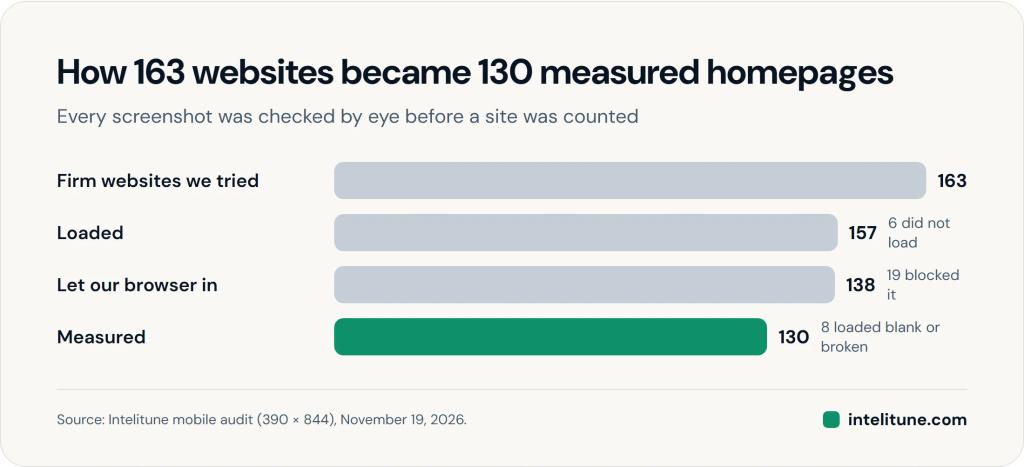
Limits. AI answers change from run to run, so a second run would name some different firms; the pattern, not any one name, is the finding. Gemini got the city only from the question. One mobile search per city is a snapshot, not a ranking. And we measured websites, not how well each firm practices law. Naming a firm here is not a recommendation.
Frequently Asked Questions
Can ChatGPT recommend a criminal defense lawyer?
Yes. In our test of 40 answers across 10 US cities, ChatGPT, Claude, Gemini and Perplexity all named specific firms when asked who to call after a DUI arrest, and none refused. But they rarely agreed: 72% of the firms were named by only one assistant. Being recommended means being named consistently across engines, not once.
How do criminal defense lawyers get clients today?
Mostly by phone, within hours of an arrest. People search on mobile, see directories, a map pack or an AI Overview, or ask an AI assistant directly, then call the first credible name. Referrals still matter, but a firm also needs a Business Profile with reviews, consistent directory profiles, charge pages and a tap-to-call button.
Should a criminal lawyer run Google Ads?
Only if someone answers every call within minutes and you track which ads become signed clients. Clicks are expensive: we saw average costs from $6.05 to $185.96 per click for "DUI lawyer" in ten US cities. Ads can fill gaps, but organic and AI visibility keep bringing calls after the budget stops.
Do criminal lawyers need SEO if they run Google Ads?
Yes. Ads only cover the paid slots, and the free results, map pack and AI answers are where most people choose. In our test, none of the 50 firms named first by an AI answer was in the map pack, so ads and map rankings alone won't put you in the assistants' shortlists.
How fast can a criminal defense firm see calls from SEO?
It depends on the starting point, but it can be weeks, not years. An Australian criminal defence firm that started with one landing page and no ads logged 35 call taps and 13 forms in the last 28 days of a 90-day engagement, after adding a page for each of 18 charges and 95 answer articles.
What should a criminal defense charge page include?
The charge in plain words with the statute, what happens in the first 24 to 72 hours, any deadline with the exact number of days and its source, the local courts, possible penalties with a note that every case differs, common defenses, the named attorney, a call button, and real questions answered briefly.
Resources & Further Reading
The following authoritative sources were used to inform and validate this article:
- Pew Research Center: Google users are less likely to click on links when an AI summary appears – 900 US adults, July 22, 2025
- Google Search Central: AI features and your website – AI Overviews and AI Mode
- Google Business Profile Help: Tips to improve your local ranking on Google – relevance, distance and prominence
- Google Local Services Help: About ad rankings – responsiveness and missed calls
- OpenAI: Overview of OpenAI crawlers – OAI-SearchBot and ChatGPT search
- American Bar Association: Model Rule 7.1, communications concerning a lawyer's services – and its comment on past results
- American Bar Association: Model Rule 7.2, advertising – payments for recommendations and specialist claims
- Federal Trade Commission: final rule banning fake reviews and testimonials – August 14, 2024; in force October 21, 2024