
 ChatGPT SEO
 Perplexity SEO
 Gemini SEO
 Claude SEO
 Microsoft Copilot SEO
 Meta AI SEO



What nine industry studies and our eight case studies show about whether AI visitors convert better, and for whom.
- It depends on what you sell. Siege Media's 78-site study (January to May 2026) put AI visitors at a median 1.26x organic, and ecommerce sites at 1.01x.
- Stores see parity or worse. A peer-reviewed study of 973 online stores found organic search visitors about 13% more likely to buy than ChatGPT visitors.
- Lead-gen firms see the biggest gap. In our investment fraud law firm case, ChatGPT visitors converted at 20.45% against about 1.81% for organic search, August to November 2026.
- Small samples make big multiples. The two single-site studies reported 9.0x and 23x. Orbit Media's 97 lead-gen sites came in at 3x.
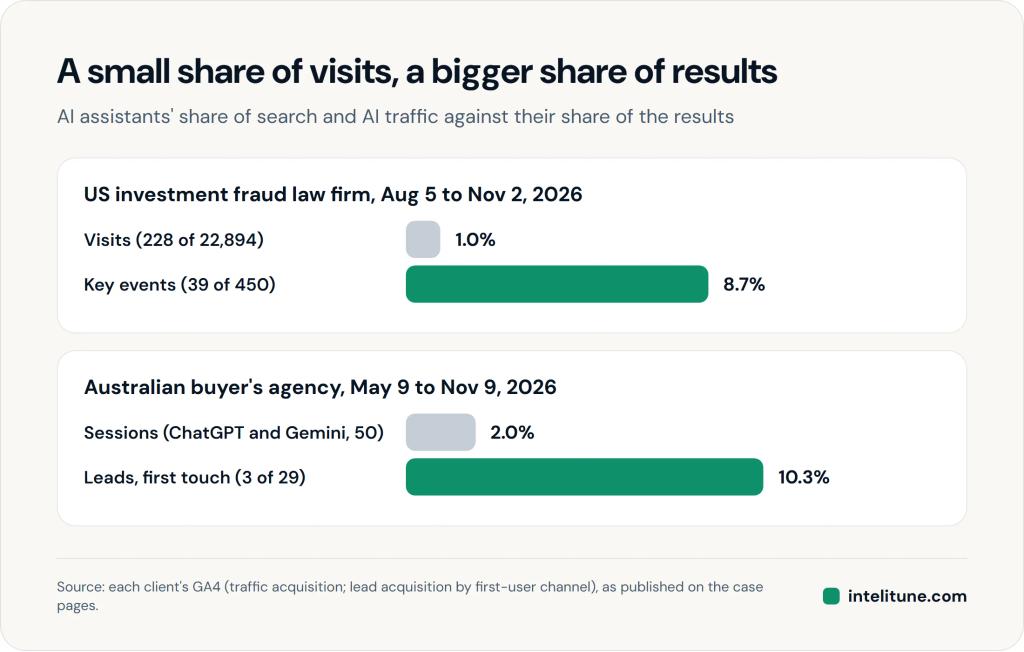
- Count conversions, not just the rate. AI assistants brought that law firm 1.0% of its search and AI visits and 8.7% of the key events.
- Check what GA4 counts. Clicks from Google's AI Overviews and AI Mode land in Organic Search, not in the AI Assistant channel.
132 visits from ChatGPT. 32 key events. For a US investment fraud law firm, between August 5 and November 2, 2026, that was a 20.45% ChatGPT conversion rate, measured as GA4's key event rate. The same firm's organic search visitors converted at about 1.81%.
It's the best number in our case files. It's also the kind of number you should trust least.
So we put it next to nine industry studies and the rest of our eight published engagements. The question: whether AI visitors convert better, and for whom.
Short answer: AI visitors convert better when the sale starts with a conversation. For firms that sell through a call or a form, the larger studies put them at about 1.3 to 3 times organic search. Our two lead-gen cases came in at 3.8x and 11.3x. For online stores, mostly not: the largest store study, 973 sites, found them less likely to buy.
What we compared: nine published studies, each read at its source, and the figures on our eight case pages. Where the studies disclosed a sample, they cover more than 2,500 sites. Every number below carries its window. Intelitune sells AI SEO, so we have a stake in a yes. That's why the places where the answer is no get the same space.
If you're building a business case, AI visitors' conversion rates are one input. The full chain, from citation to revenue, is how you measure AI SEO ROI.
The answer splits on what you sell: a conversation or a checkout
AI visitors convert better for businesses whose sale starts with a conversation, such as finance, local services, real estate and B2B lead gen. For online stores and B2B software, the larger samples put them close to parity.
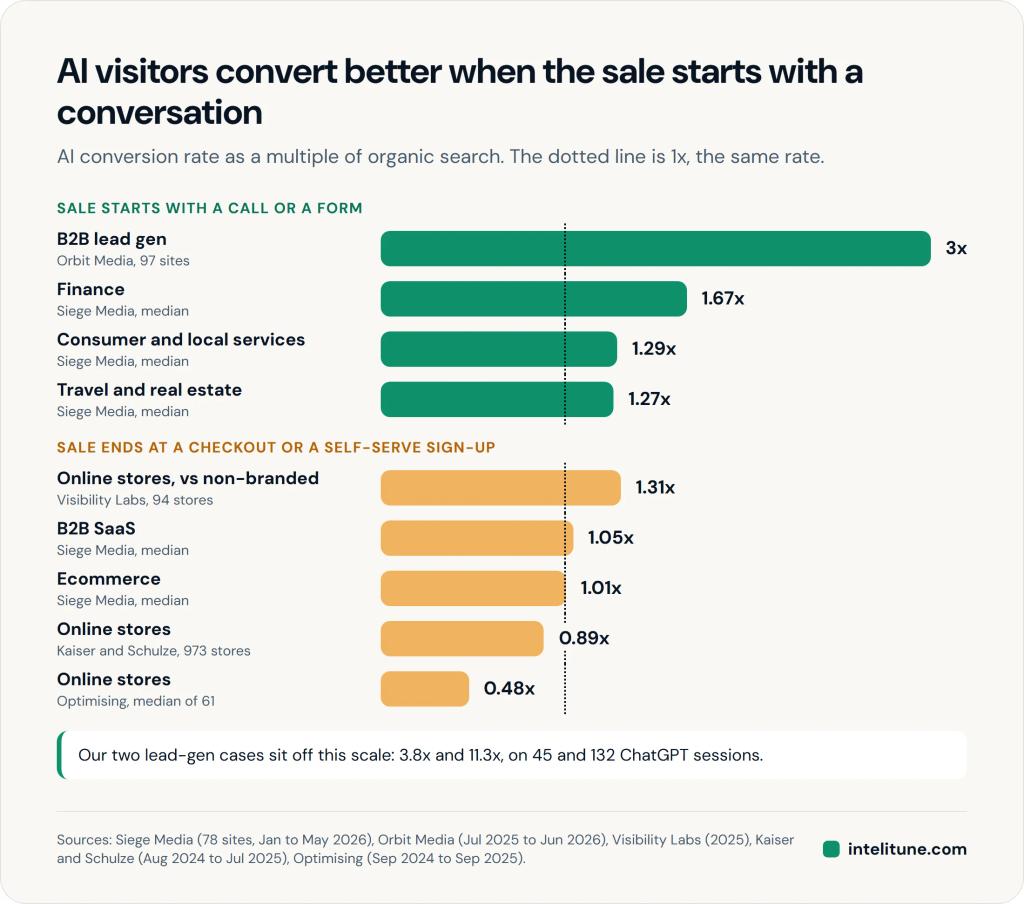
Siege Media's study of 78 sites, January 1 to May 31, 2026, gives the cleanest split. It compared GA4 session key event rates site by site and reported the median AI-to-organic ratio by industry:
- Finance: 1.67x
- Consumer and local services: 1.29x
- Travel and real estate: 1.27x
- B2B SaaS: 1.05x
- Ecommerce: 1.01x
Orbit Media's study of 97 B2B lead-gen sites ran from July 2025 to June 2026. AI visitors were 3x as likely as other organic visitors to become leads. ChatGPT turned 2.1% of its visitors into leads. Google Search turned 0.5%.
Stores sit on the other side. A peer-reviewed study of 973 online stores by Kaiser and Schulze in Marketing Science covered August 2024 to July 2025. It found organic search visitors about 13% more likely to buy than visitors from ChatGPT.
Our read: the split isn't AI against Google. It's the kind of decision. A person who needs a lawyer, an adviser or a buyer's agent asks an assistant for a shortlist, then calls. A shopper asks it to research, then compares prices.
Do this: Before you read any benchmark, decide which side you're on. If your sale ends at a checkout, judge AI traffic against the store studies, not the lead-gen ones.
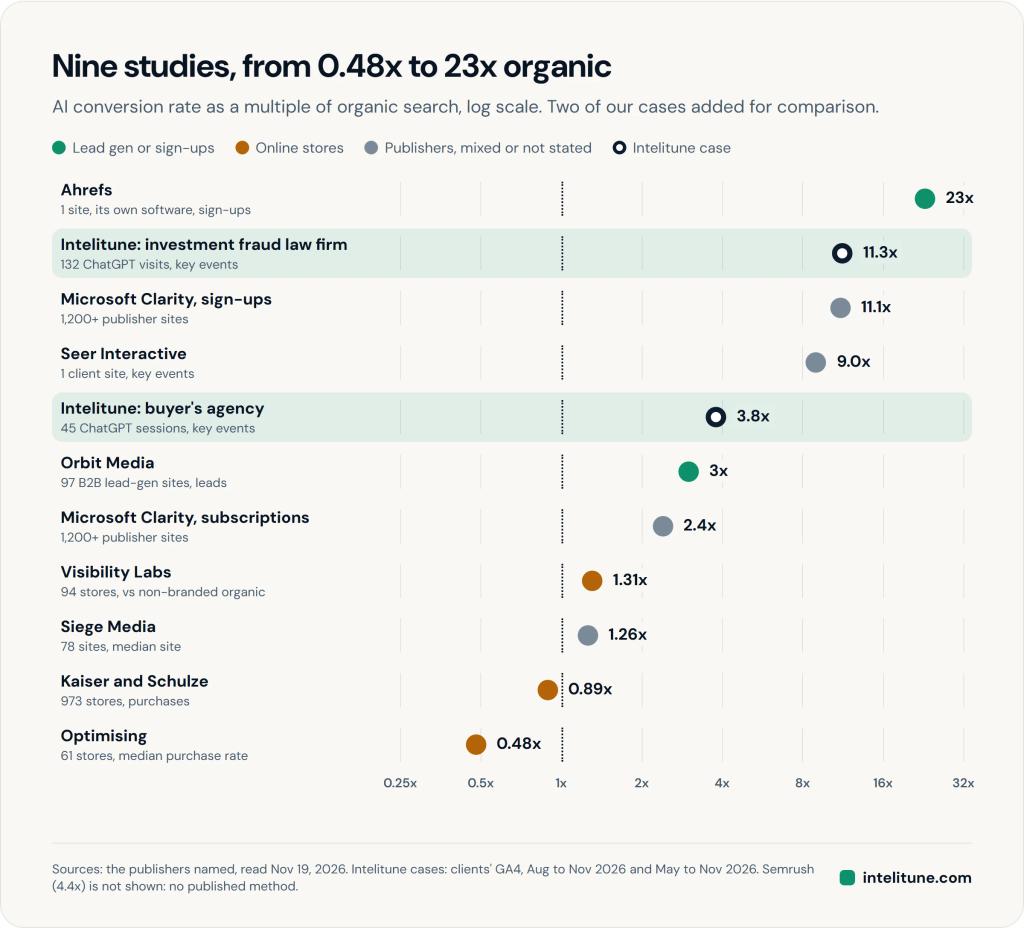
Nine studies put AI visitors anywhere from 0.48 to 23 times organic
Published studies of AI traffic conversion rates disagree by a factor of almost 50. The spread follows two things: how many sites a study used, and what kind of sites they were.
| Study (published) | Sample | Sites | Conversion | AI vs organic |
|---|---|---|---|---|
| Ahrefs (Jun 2025) | 1 site, 30 days | Its own software | Sign-ups | 23x |
| Seer Interactive (Jun 2025) | 1 client, 7 months | Not stated | Key events | 9.0x (15.9% vs 1.76%) |
| Microsoft Clarity (Nov 2025) | 1,200+ sites, 1 month | Publishers | Sign-ups, subscriptions | 11.1x, 2.4x |
| Semrush (Jul 2025) | Not published | Not published | "Value" from conversion rate | 4.4x |
| Orbit Media (Jul 2026) | 97 sites, 12 months | B2B lead gen | Leads | 3x (7x per-site median) |
| Visibility Labs (2026) | 94 sites, all of 2025 | Online stores | Purchases | 1.31x vs non-branded organic |
| Siege Media (Jun 2026) | 78 sites, 5 months | Mixed | Key event rate, median | 1.26x |
| Kaiser and Schulze (2025) | 973 sites, 12 months | Online stores | Purchases | about 0.89x |
| Optimising (Nov 2025) | 115 businesses, 61 stores | Online stores | Purchase rate, median | 0.48x |
Two of the three highest numbers come from single sites. Ahrefs measured its own software over 30 days. Seer Interactive measured one client. Clarity's sign-up figure is high partly because search visitors on news sites almost never sign up: 0.15%.
The lowest numbers come from stores. Optimising found a median AI purchase rate of 2.9% against 6.0% for organic, across Australian stores from September 2024 to September 2025.
Semrush's 4.4x is the figure quoted most often in this debate. Its July 2025 article doesn't publish the sample, the window or the conversion definition, so it isn't on the chart.
Seven of the nine come from agencies or SEO tool vendors. So does this article. Weigh each one by its sample, not its headline.
Do this: When someone quotes you a multiple, ask three questions. How many sites? What kind of sites? What counted as a conversion?
In our two lead-gen cases, the ChatGPT conversion rate ran 3.8 and 11.3 times organic
Two of our eight engagements recorded both sides of the comparison in GA4. Both are lead-gen businesses, and in both, ChatGPT visitors converted at several times the organic rate.
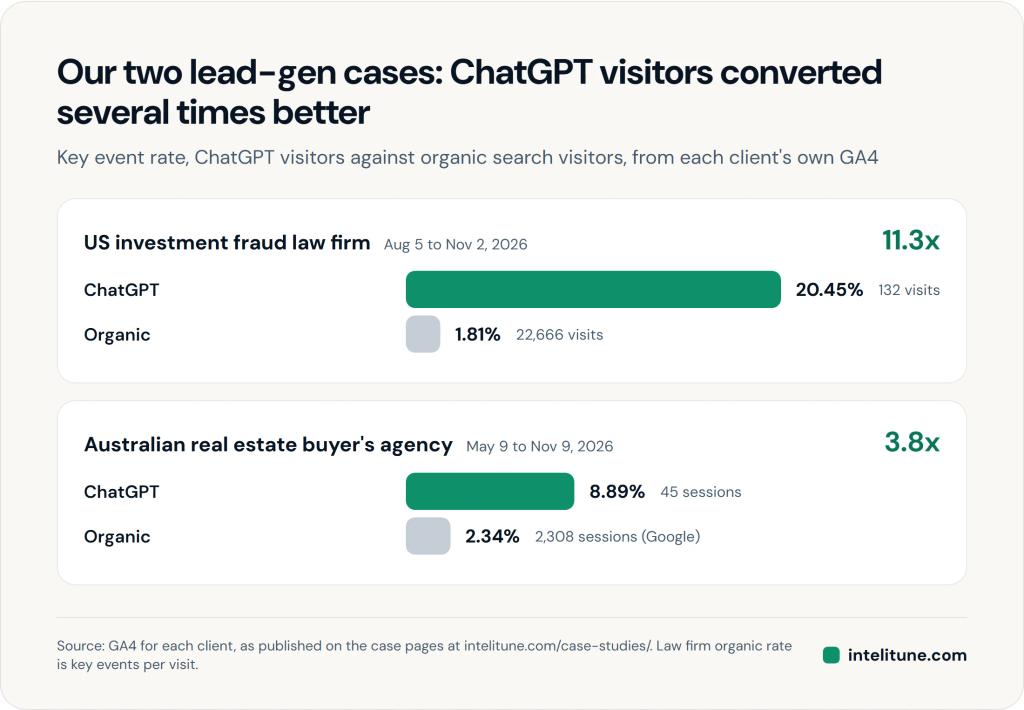
- A US investment fraud law firm, August 5 to November 2, 2026: ChatGPT sent 132 visits with 32 key events, a 20.45% key event rate. Organic search ran at about 1.81%. That's 11.3x.
- An Australian real estate buyer’s agency, May 9 to November 9, 2026: ChatGPT sent 45 sessions with 4 key events, 8.89% per session. Google organic ran at 2.34%. That's 3.8x.
One detail matters in the law firm case. The organic figure counts key events per visit (411 over 22,666). The ChatGPT figure is GA4's session key event rate. Counted the organic way, ChatGPT's 32 key events over 132 visits is 24.2%, so the gap holds either way.
The other six of our eight engagements can't answer the question cleanly, and we'd rather say so than stretch them:
- Two stores report revenue, not a conversion rate for AI visitors. They're in the store section below.
- A B2B professional services firm drew 1,402 ChatGPT sessions, 58.13% of them engaged, but its 890 form submissions aren't split by channel.
- A new research peptide supplier had 55 ChatGPT sessions in its first month. Conversion tracking wasn't live yet.
- A digital marketing agency logged 87 AI visits, 46 of them engaged.
- A criminal defence firm's case shows AI citations, not AI visits.
Engagement leans the same way where we can compare it. In the peptide supplier's first month, ChatGPT visitors stayed 1m 10s on average against 47s for Google organic, with a 74.55% engagement rate against 67.61%. Engagement isn't a conversion, though.
Do this: Pull two numbers from your own GA4 for the last 90 days. One is the key event rate for chatgpt.com sessions: your ChatGPT conversion rate. The other is the same rate for google / organic. If either side has under 100 sessions, write the result down and don't act on it yet.
Small samples make big multiples, ours included
Our two multiples rest on 132 and 45 ChatGPT sessions. The likely range around each rate is wide. In both cases, even the low end of the range beats organic.
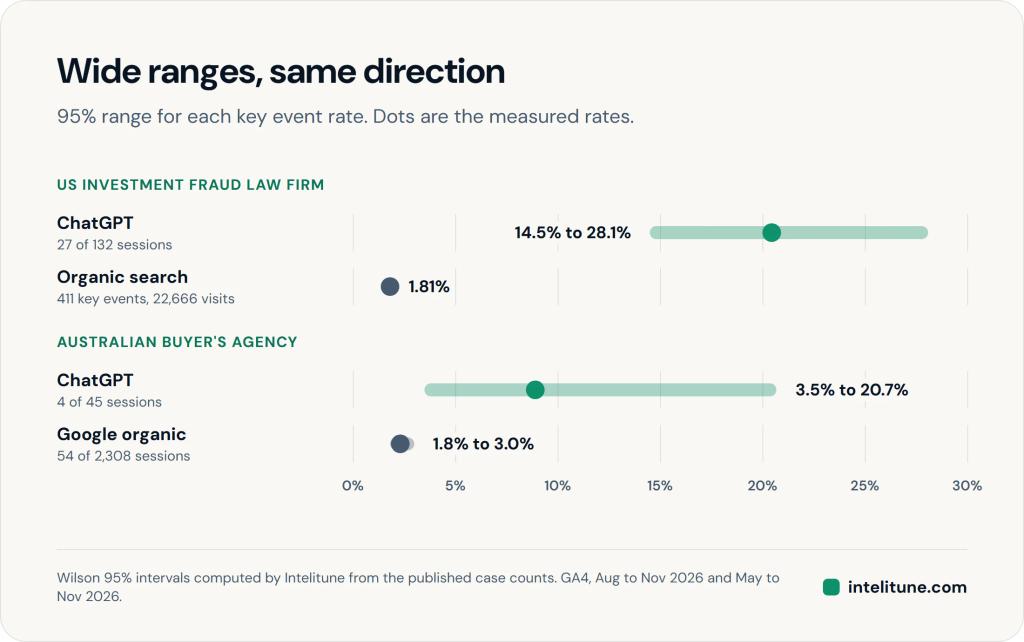
We ran a standard 95% confidence range (the Wilson interval) on each rate:
- Law firm: 27 of 132 ChatGPT sessions had a key event. The range runs from 14.5% to 28.1%. The low end is still 8.0x organic.
- Buyer's agency: 4 of 45 ChatGPT sessions had a key event. The range runs from 3.5% to 20.7%. Google organic, on 2,308 sessions, sits between 1.8% and 3.0%. The two ranges don't overlap, but only just.
So the direction holds. The size doesn't. 11.3x could as easily be 8x.
Volume pulls the rate down, too. When the law firm's AI assistant visits rose from 102 to 228 in a quarter, the key event rate across all assistants fell from 16.67% to 14.47%. Our read: the first AI visitors a site gets tend to be the most motivated ones.
The nine studies follow the same pattern. The single-site reports land at 9x and 23x. Orbit's 97 sites, pooled, land at 3x. Siege's median site lands at 1.26x.
Do this: Report AI conversion as a range until each side has a few hundred sessions. A line like "14.5% to 28.1%, 132 sessions" keeps one lucky month out of the budget meeting.
AI visitors convert better when the answer did the shortlisting
An AI answer does the research step before the click. The visitors who still click are further along: they've read a shortlist, and your name was on it.
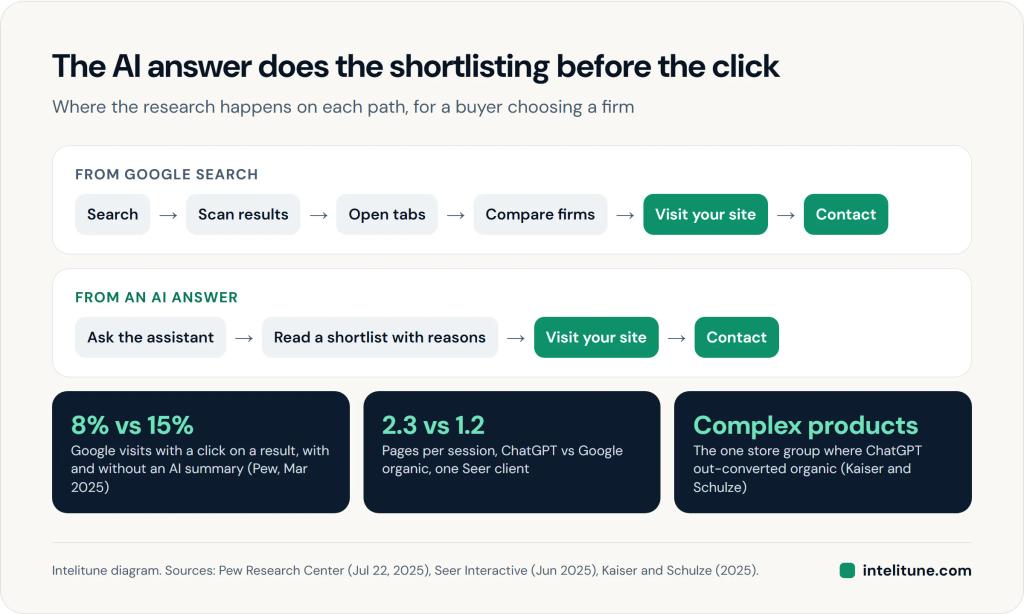
Pew Research Center tracked the Google searches of 900 US adults in March 2025. With an AI summary on the page, they clicked a traditional result on 8% of visits, against 15% without one. They clicked a link inside the summary on 1%.
Fewer clicks, then. But the clicks that remain come after the reader has the answer. Google says clicks from its AI features are "higher quality (meaning, users are more likely to spend more time on the site)".
The store study points the same way from another angle. Across all 973 stores, ChatGPT visitors converted below organic. On sites selling complex products, they converted above it. A considered purchase behaves like a service sale.
Seer Interactive's client saw ChatGPT visitors view 2.3 pages per session, against about 1.2 for Google organic. Our read: for a service firm, the assistant's shortlist replaces the old "three tabs open" stage.
That's why we treat ChatGPT visitors as late-stage traffic when we plan the pages they land on.
Do this: Make the pages AI answers link to ready for a decision, not for research. Put who you help, how pricing works and one way to contact you on the first screen.
Stores see parity, and some AI sales never reach the site
For online stores, AI visitors convert at about the organic rate or below it. And part of AI shopping now ends inside the assistant, where your site's conversion rate can't see it.
The store studies don't agree on the sign, but none shows a lead-gen-sized gap. Visibility Labs found ChatGPT visitors at 1.81% against 1.39%, 31% higher, across 94 stores in 2025. That advantage was measured against non-branded organic only. Optimising and Kaiser and Schulze found AI below organic.
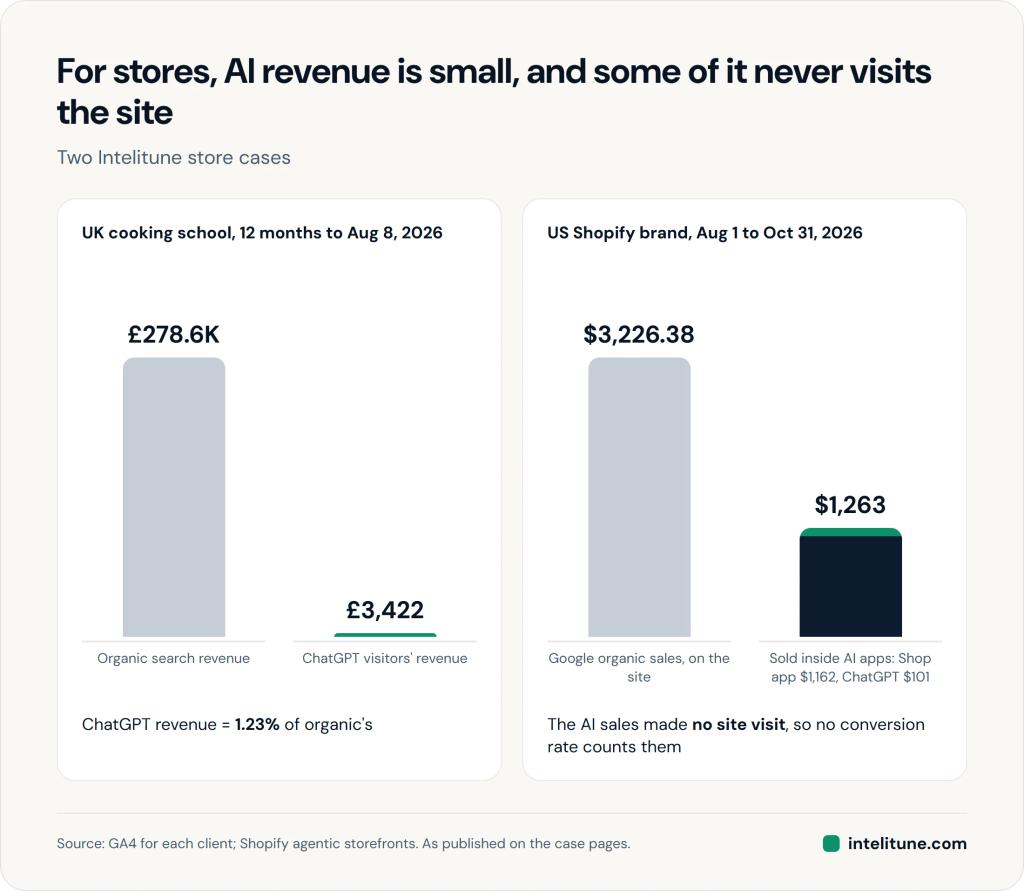
Our two store cases add revenue, not rates:
- A UK cooking school that sells classes online: in the 12 months to August 8, 2026, GA4 tied ChatGPT visitors to £3,422. Organic search brought £278,611.98. ChatGPT came to 1.23% of organic's revenue.
- A US Shopify brand: from August 1 to October 31, 2026, Shopify's agentic storefronts sold $1,263 inside AI apps. That was $101 through ChatGPT and $1,162 through the Shop app. Google organic sales were $3,226.38 over the same quarter.
Those agentic sales never created a visit to the store's website. No visitor conversion rate counts them. OpenAI launched Instant Checkout in ChatGPT on September 29, 2025, with Etsy and Shopify sellers among the first. Expect this share to grow.
Our read: for a store, "do AI visitors convert?" is turning into "does the assistant sell my product at all?"
Do this: If you sell on Shopify, put agentic storefront sales next to GA4's AI referral revenue every month. Add the two. Don't compare them.
Each assistant converts differently, and the leader changes by study
There is no single AI visitor. In our law firm case, ChatGPT visitors converted at 20.45% and Perplexity's 7 visitors not at all. Other studies put a different assistant on top.
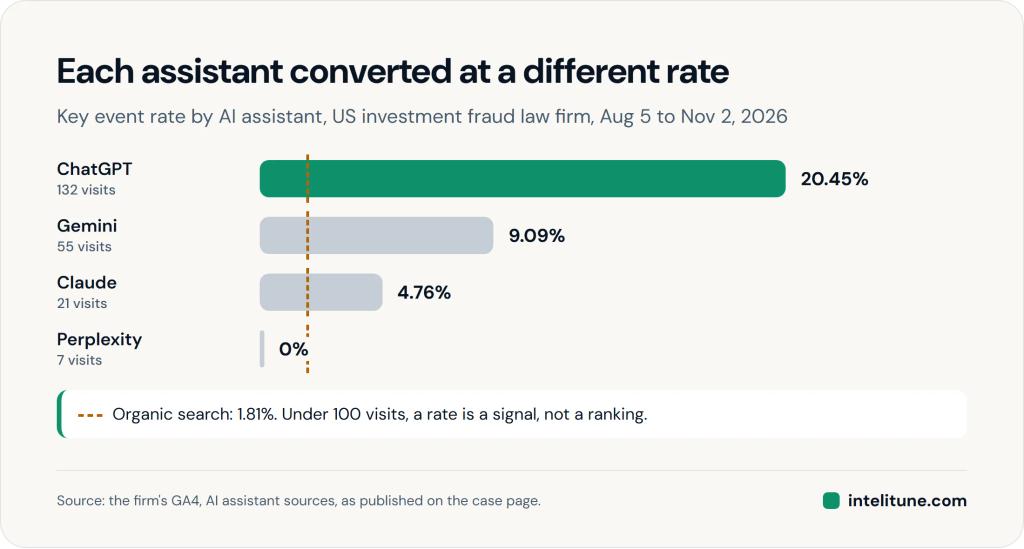
| AI assistant | Visits | Key events | Key event rate |
|---|---|---|---|
| ChatGPT | 132 | 32 | 20.45% |
| Gemini | 55 | 6 | 9.09% |
| Claude | 21 | 1 | 4.76% |
| Perplexity | 7 | 0 | 0% |
| All AI assistants | 228 | 39 | 14.47% |
Seer Interactive's client ranked them differently: ChatGPT 15.9%, Perplexity 10.5%, Claude 5%, Gemini 3%. Gemini came second in our case and last in theirs. Which pages it sends people to depends on how Gemini decides what to ground an answer in, and that changes by query.
Optimising found Perplexity and Gemini visitors converting 3 to 6 times better than ChatGPT's, on far smaller volumes. The pages Perplexity cites sit as numbered sources beside its answer, so a visitor has picked one source out of several before clicking.
Microsoft Clarity found Copilot visitors had the highest subscription rate on publisher sites: 17 times direct traffic and 15 times search. Bing Webmaster Tools now reports Copilot citations, so you can see how often Copilot uses your pages before a single visit arrives.
Claude sent the law firm 21 visits and one key event, 4.76%. That's above the firm's organic rate, on a sample far too small to lean on. It's the honest status of Claude answers as a lead source for most firms today.
Our read: the leader changes because outside ChatGPT the volumes are tiny. Seven visits can't rank anything.
Do this: Report ChatGPT on its own line. Group the other assistants until each one has 100 or more sessions.
Count conversions, not just the rate
AI visitors are still around 1% of traffic or less. A high rate on a small base adds a modest number of leads, which can still be worth a lot.
The size of the channel, in the studies that reported it:
- Orbit Media: AI was 0.5% of visits to B2B sites, about one visit in 200.
- Microsoft Clarity: under 1% of traffic on publisher sites.
- Kaiser and Schulze: ChatGPT was under 0.2% of store sessions.
In our law firm case, AI assistants brought 1.0% of the firm's search and AI visits (228 of 22,894). They brought 8.7% of the key events (39 of 450).
In the buyer's agency case, an AI assistant was the first touch for 3 of 29 search and AI leads, 10.3%. ChatGPT and Gemini sent 50 sessions in those six months, against 2,511 from organic search.
Our read: for a firm where one client is worth thousands, three leads in six months can pay for the work. For a store with a $40 basket, the same share is noise. Weigh it against what AI answers take away, too. That's the net math of AI traffic.
Do this: Multiply your AI key events by the value of one conversion. If the answer doesn't matter to the business yet, keep tracking it and spend the effort elsewhere.
Five measurement choices explain most of the disagreement
Most of the gap between studies comes from five choices. What counts as a conversion, what AI is compared with, how sites are averaged, which visits count as AI, and how many sessions are enough.
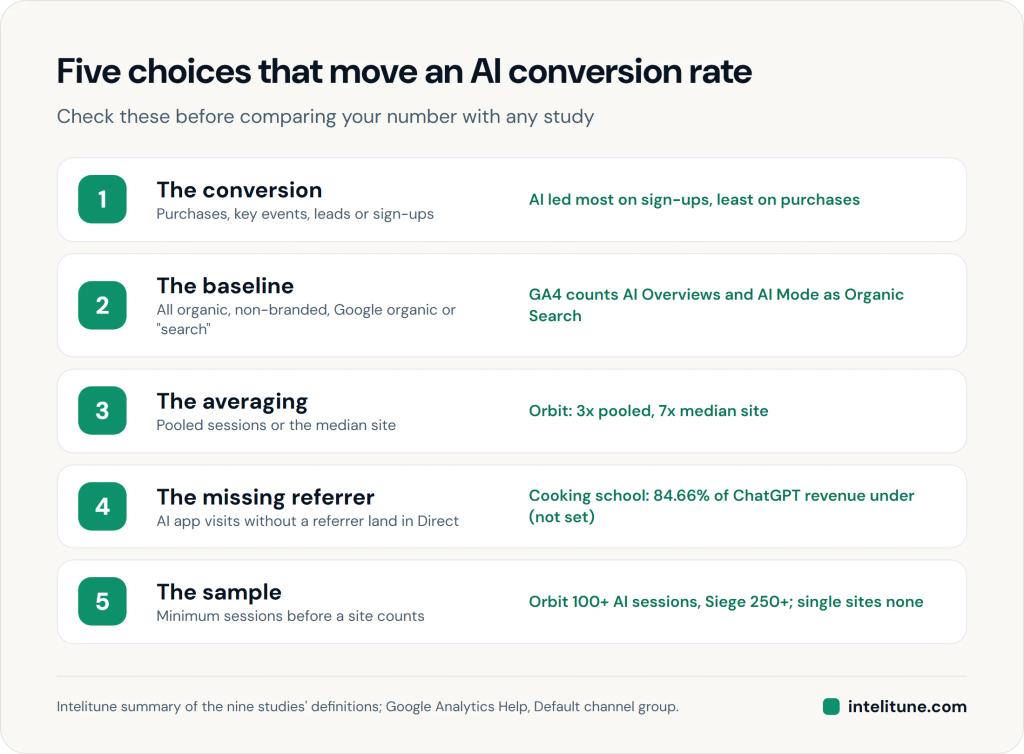
- The conversion. Purchases (Kaiser and Schulze, Optimising), any key event (Seer, Siege), leads (Orbit) or sign-ups (Ahrefs, Clarity). A newsletter sign-up and a purchase aren't the same event. In these studies the AI advantage was largest on sign-ups and smallest on purchases.
- The baseline. All organic, non-branded organic, Google organic or "search". Google's GA4 channel definitions put clicks from AI Overviews and AI Mode inside Organic Search. So "organic" already has some AI in it.
- The averaging. Orbit's pooled 3x becomes 7x when you take the median site instead. Neither is wrong. They answer different questions.
- The missing referrer. AI apps often open links without saying where the visit came from, and GA4 files those visits under Direct. Even tagged visits arrive messy: in our cooking school case, 84.66% of ChatGPT revenue sat under chatgpt.com / (not set). This is why your analytics cannot see the new source in full.
- The sample. Orbit only counted sites with 100 or more AI sessions. Siege required 250 AI and 1,000 organic sessions. Single-site studies set no floor.
Do this: Before you compare your rate with any study, match its definitions: the same conversion, the same baseline, a similar sample.
Measure AI conversions in your own GA4 in four steps
GA4 now has a default AI Assistant channel. It covers referrals from assistants such as ChatGPT, Gemini, Copilot, Deepseek and Grok, and keeps Google's AI Overviews and AI Mode in Organic Search.
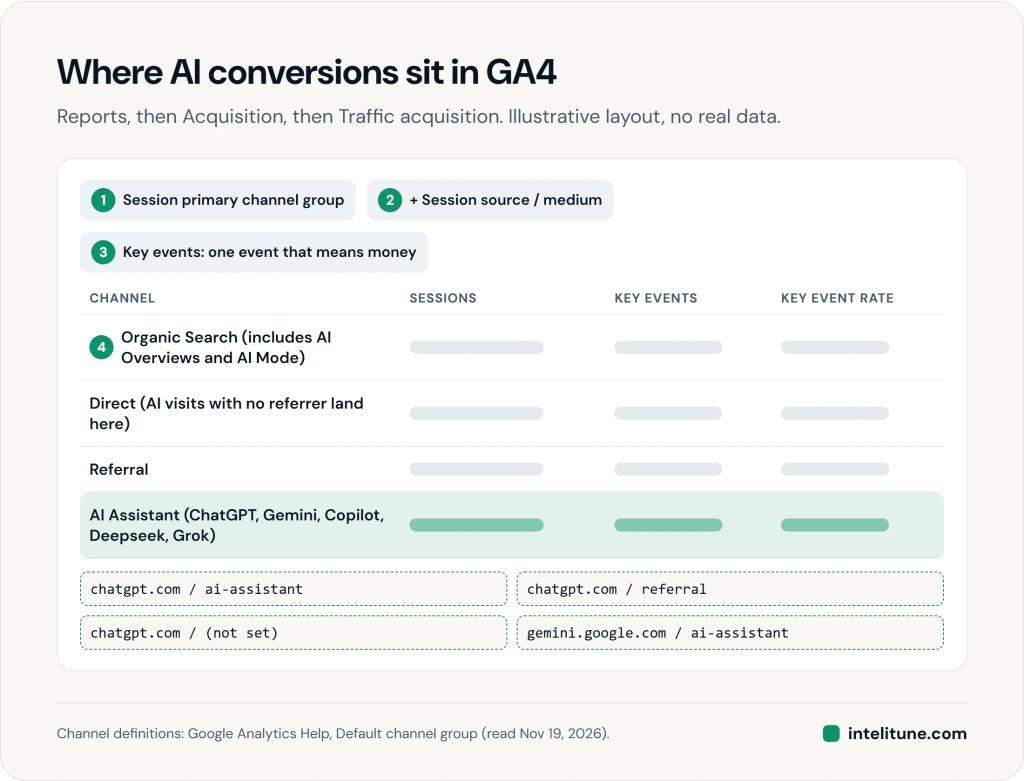
- Find the channel. Open Reports, then Acquisition, then Traffic acquisition. Set the primary dimension to Session primary channel group. The AI Assistant row is your starting count.
- Split by source. Add Session source / medium as a secondary dimension, and look for chatgpt.com rows under any medium, including (not set). For dates before the channel existed, build a custom channel group that matches sources such as chatgpt, perplexity, gemini, claude and copilot.
- Pick one conversion that means money. A form submission, a call tap or a purchase. Read the session key event rate for that event only, not for every event the site fires.
- Compare like with like. Put google / organic beside it for the same 90 days, and write the session counts next to both rates.
We set this up in the AI visibility diagnostic before any work starts, so the before and after are measured the same way.
Do this: Save the four steps as one exploration in GA4 and read it on the same day each month.
The Conversation Test: what AI traffic is worth to your business
Three questions tell you what AI visitors are worth to you. Does your sale start with a conversation? Do you have enough AI sessions to read a rate? And what is one conversion worth?
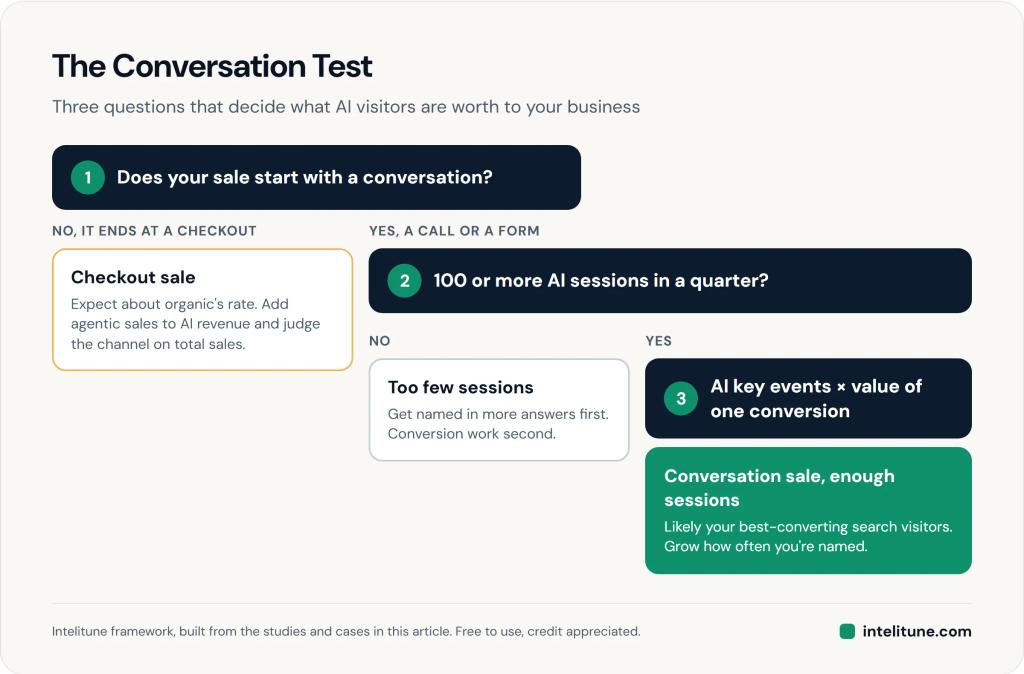
The answers sort most businesses into one of three positions:
- Conversation sale, enough sessions, high-value conversion. AI visitors are likely your best-converting search visitors. The constraint is how often you're named. That's why we report our work in AI-attributed sessions and revenue, not in rankings alone.
- Conversation sale, too few sessions. The rate can't guide you yet. Being named in more answers comes first, conversion work second.
- Checkout sale. Expect about organic's rate. Watch AI revenue and agentic sales together, and judge the channel on total sales.
The checklist
- Decide whether your sale starts with a conversation or ends at a checkout.
- Ask any quoted multiple for its sample, its site type and its conversion definition.
- Pull ChatGPT and google / organic key event rates for the last 90 days.
- Report AI conversion as a range until each side has a few hundred sessions.
- Make the pages AI answers link to ready for a decision.
- Add agentic storefront sales to AI referral revenue if you sell on Shopify.
- Report ChatGPT alone and group the other assistants.
- Multiply AI key events by the value of one conversion.
- Match a study's definitions before comparing your rate with it.
- Save the GA4 exploration and read it monthly.
Do this: Answer the three questions with your own last 90 days of GA4 data, and write down which position you're in.
How we built this comparison
We read nine studies at their source and used only figures already published on our eight case pages. Nothing here is new client data.
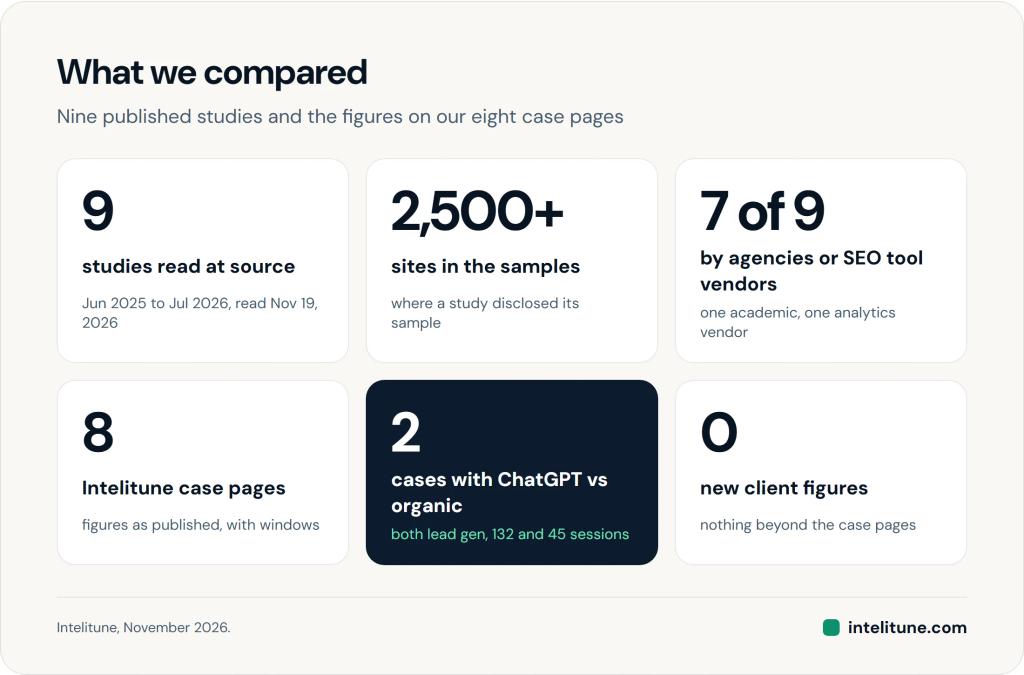
Studies. We looked for studies published from June 2025 to November 2026 that compared AI-referred visitors' conversion with organic search, and read each on its publisher's page on November 19, 2026. Kaiser and Schulze were read through the authors' summary and press coverage of the paper. We kept every study that published an AI and an organic figure, and listed Semrush without a chart point because its method isn't published.
Multiples. AI rate divided by the organic rate the study compared it with. Where a study stated its own multiple (Ahrefs, Orbit, Siege, Visibility Labs) we used that. Kaiser and Schulze reported organic search about 13% more likely to convert, which we show as about 0.89x.
Cases. Figures as published on each case page, with its window and report. The ranges are 95% Wilson intervals, computed from the counts behind each rate.
What this comparison can't tell you
- Nine studies with nine definitions can't be averaged into one number, so we didn't.
- Our two lead-gen rates rest on 132 and 45 ChatGPT sessions. Two firms aren't a sector.
- Every AI count here is a floor. Visits without a referrer don't show up as AI.
- None of this is a forecast for your site. Your own GA4, read with its sample size, is the only answer that counts.
Frequently Asked Questions
What is a good ChatGPT conversion rate?
There isn't a universal one, so compare ChatGPT with Google organic on your own site. In the studies we read, ChatGPT rates ran from 1.81% for stores to 15.9% for one agency client. Across Orbit Media's 97 B2B lead-gen sites, ChatGPT turned 2.1% of visitors into leads. Beat your own Google organic rate on 100 or more sessions, and you have a signal.
Will AI visitors convert better on my site?
Nobody can promise that, including us. The evidence says it's more likely if buyers contact you before they pay, and less likely if they check out on their own. The answer that counts is your own GA4 over at least 90 days, read with its session counts, because a few lucky weeks can make any channel look brilliant.
Do AI visitors spend more per order?
Not in the store studies we read. Optimising found a lower average order from AI visitors, $146.70 against $160.65 for organic, across Australian stores. Visibility Labs also reported smaller ChatGPT orders. Siege Media found AI traffic earned more per session than traditional traffic on fewer than half of the sites with reliable revenue tracking.
Why would AI visitors convert worse than Google visitors?
Mostly because of what they came to do. Shoppers often use an assistant to research and compare, then buy later or somewhere else. Google organic also includes branded searches from people who already chose you, which lifts its rate. That's why Visibility Labs measured its ChatGPT advantage against non-branded organic search only.
How many AI sessions do you need before trusting the rate?
We treat anything under 100 sessions per side as a signal, not a result. The larger studies set their own floors, from 100 to 250 AI sessions per site. With 45 ChatGPT sessions, our buyer's agency case's 8.89% could plausibly sit anywhere from 3.5% to 20.7%.
Can I see AI visitors who arrive without a referrer?
Not as AI traffic. When an AI app opens a link without passing a referrer, GA4 files the visit under Direct, and no setting recovers its source later. So treat every AI figure as a floor. A rise in Direct visits alongside growing AI citations is a hint, not proof, and we never count it as AI.
Resources & Further Reading
The following authoritative sources were used to inform and validate this article:
- Microsoft Clarity: AI Traffic Converts at 3x the Rate of Other Channels (Study) – November 6, 2025. 1,200+ publisher and news sites; sign-up and subscription rates by channel.
- Kaiser and Schulze: ChatGPT Referrals to E-Commerce Websites (Marketing Science) – Peer reviewed. 973 online stores, August 2024 to July 2025.
- Pew Research Center: Google users are less likely to click on links when an AI summary appears – July 22, 2025. Browsing data from 900 US adults, March 2025.
- Google Search Central: AI features and your website – How clicks from AI Overviews and AI Mode are reported.
- Google Analytics Help: Default channel group – Definitions of the AI Assistant and Organic Search channels.
- OpenAI: Buy it in ChatGPT, Instant Checkout and the Agentic Commerce Protocol – September 29, 2025.