





Key Takeaways
A plain-English guide to AI SEO in 2026: what it means, how AI search works, and how to get your brand cited by ChatGPT, Gemini, and AI Overviews.
- AI SEO means optimizing to be found and cited by AI engines, not just ranked in ten blue links.
- Close to half of US Google searches now show an AI Overview, and less than a third of searches send a click to the open web.
- Getting cited depends on clear answers, structured data, strong entity signals, and being mentioned across trusted third-party sources.
- The biggest mistake is treating “AI SEO” as “using AI tools to write content.” Those are two different things.
- Businesses that adapt early win a compounding advantage, because AI systems keep citing sources they already trust.
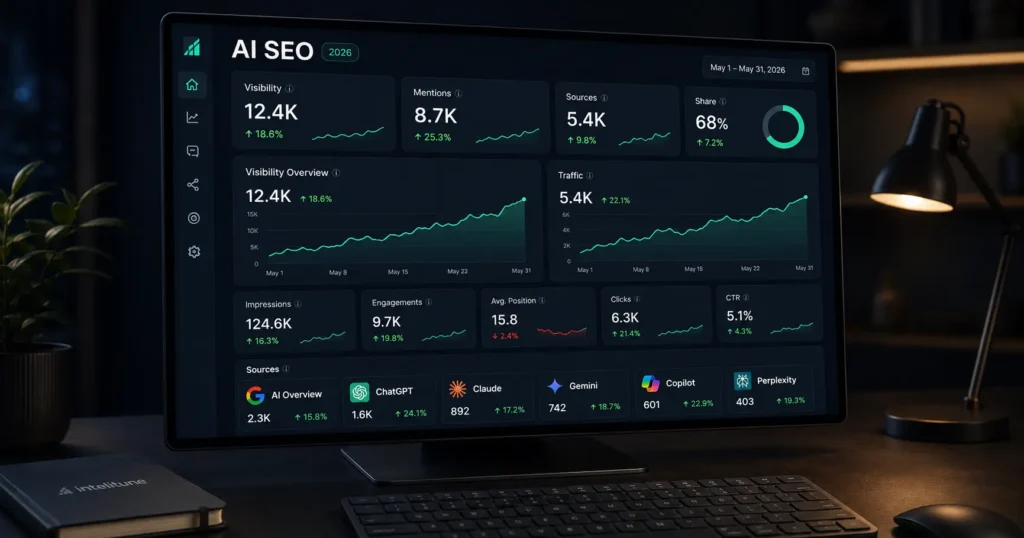
Search stopped being a list of ten blue links. In 2026, most people get their answer straight from an AI: a Google AI Overview at the top of the page, a ChatGPT reply, or a Perplexity summary with sources attached. AI SEO is the discipline of making sure your brand is the source those systems pull from.
If your customers ask an AI engine about your category and your name never comes up, you are invisible to the fastest growing part of search. That is the problem this guide solves. Below, you will learn what AI SEO actually means in 2026, how AI search decides who to cite, where AEO and GEO fit, and the exact moves that get a business found and recommended. It is written for founders, marketers, and business owners who can feel their traffic shifting and want a clear plan instead of buzzwords.
What does AI SEO actually mean?
AI SEO is the practice of optimizing your website, content, and brand so artificial intelligence search systems can understand you, trust you, and cite you in their answers. It is search optimization for a world where a machine reads your page and speaks the answer on your behalf.
There is an important distinction most articles blur. “AI SEO” is used two ways. The first is using AI tools, such as writing assistants and keyword software, to do traditional SEO faster. The second, and the one that decides visibility, is optimizing so AI engines surface your brand. This guide is about the second meaning. You can see how muddled the wider AI search coverage has become, which is exactly why clarity here is a competitive edge. When we build AI SEO services for clients, the goal is not more blog output. It is becoming the answer an AI gives.
Think of it as a shift in the customer. Your old audience was a human scanning results. Your new audience includes the model itself, deciding which few sources to quote. Optimize for the human alone and you can still lose, because the model never picked you to begin with.
Quick verdict: AI SEO is not a rebrand of old SEO. It is optimizing to be the source AI engines cite when they answer for buyers. Get your entity signals, structure, and trust right and you get recommended at the moment people ask. Ignore it and you stay invisible in the answers that now replace the click.
How is AI SEO different from traditional SEO?
Traditional SEO earns a ranking position and a click. AI SEO earns a citation inside a generated answer, whether or not a click follows. The overlap is real, but the target moved.
Classic SEO optimized for keywords, backlinks, and blue-link position. AI SEO optimizes for clarity, structured answers, entity recognition, and trust signals a language model can parse. Ahrefs’ click study found that queries showing an AI Overview lose a meaningful share of clicks even when the page still ranks, which tells you position one is no longer the finish line. At Intelitune, we have watched clients hold their rankings and still lose traffic, purely because the answer now sits above the results.
| Factor | Traditional SEO | AI SEO |
| Goal | Rank and get the click | Get cited and recommended |
| Audience | Human searcher | The AI model plus the searcher |
| Signals | Keywords, backlinks, position | Entities, structure, trust, citations |
| Output | Blue-link ranking | Answer inside ChatGPT, Gemini, AI Overviews |
| Success metric | Traffic and rank | Share of AI answers and mentions |
The two are not rivals. Strong classic SEO still feeds AI systems the crawlable, credible content they read. AI SEO adds the layer that decides whether they quote you. In practice, the winners do both well, then compound the advantage as engines keep returning to sources they already trust.
How does AI search actually work?
AI search works by retrieving trusted sources, then generating an answer from them. Systems built on large language models do not “rank” pages the old way. They pull passages that best answer a query, synthesize a response, and often cite a handful of sources.
Most engines use retrieval-augmented generation, or RAG. The model searches a live index, grabs the most relevant and credible passages, and writes an answer grounded in them. Under the hood, your content is converted into embeddings, numerical representations of meaning, so the system matches a query by concept, not just by exact keyword. That is why being clearly quotable matters more than hitting a keyword density. If a single paragraph states a fact cleanly, with the context a machine can lift, that paragraph becomes the passage it cites.
Different engines behave differently. AI Overviews and AI Mode lean on Google’s index and Knowledge Graph. ChatGPT and Perplexity browse the live web and surface links. Getting cited in ChatGPT rewards content that reads like a direct, self-contained answer, while Perplexity leans hard on visible sources. The common thread across all of them is retrieval: you cannot be generated into an answer if you were never retrieved as a source.
Here is what that looks like in practice. Say a reader asks which approach fits a small team. An engine scans its index, finds three pages that answer directly, and quotes the one that states the answer in a single clean sentence with a supporting number. The other two pages may be longer and even more accurate, but they buried the answer, so the model skipped them. Clarity, not length, wins the citation, and that single insight reshapes how you write every page.
Where do AEO and GEO fit into AI SEO?
AEO and GEO are the two core sub-disciplines of AI SEO. Answer Engine Optimization (AEO) focuses on winning the direct answer. Generative Engine Optimization (GEO) focuses on getting cited and recommended inside generated responses.
AEO is about structure: answer-first paragraphs, question-based headings, FAQ blocks, and schema that make your content easy for an engine to extract. GEO is about influence and trust: statistics, quotable claims, original data, and brand mentions across the web that make a model choose you over a competitor. The academic groundwork here is solid, and generative engine optimization research from Princeton showed that adding citations, statistics, and authoritative sourcing measurably increased how often content was surfaced in AI answers.
You do not choose between them. A complete program pairs both, which is why our generative engine optimization work always sits alongside answer-first structuring. AEO gets you into the answer. GEO gets you named as the recommendation. Miss either one and the gap shows: strong structure with no authority gets extracted rarely, and strong authority with messy structure gets skipped for a cleaner source.
Why does AI SEO matter in 2026?
AI SEO matters because the click is disappearing. According to zero-click search data from SparkToro, less than a third of Google searches now end in a click to the open web. The rest are answered on the results page or inside an AI tool.
The numbers compound the point. Close to half of US Google searches now trigger an AI Overview. Google AI Mode has rolled out to US users, turning search into a conversation with follow-up questions. ChatGPT sits at roughly 800 million weekly users, and a growing share of buyers ask it for recommendations before they ever open Google. When the answer is generated and no link is clicked, the only way to be seen is to be the cited source.
Picture the moment that matters. A buyer types, “best option for my situation,” into ChatGPT, and it returns three companies with a sentence on each. If you are one of the three, you just earned pre-qualified trust at the exact point of intent. If you are not, you lost the deal before you knew it existed, and no amount of blue-link ranking recovers it. That is why we start most engagements by checking exactly that: you cannot fix a gap you cannot see, and most brands have never checked what AI actually says about them.
See how AI describes your brand today. Most companies never look. Run a free AI visibility audit and get your citation gaps in minutes.
How do you actually do AI SEO?
You do AI SEO by making your brand the clearest, most trusted, most quotable source in your category. The work breaks into a repeatable framework.
First, build the entity foundation. Make sure Google and AI systems know who you are through consistent business information, an authoritative About page, Organization and Person schema, and presence in trusted references like Wikipedia and Wikidata.
Second, write answer-first content: lead each section with a direct answer, use question-based headings, and add FAQ blocks a model can lift verbatim. Third, add structured data so machines can parse your facts without guessing. Fourth, earn credibility through original statistics, named expert quotes, and mentions on sites AI engines already trust, including Reddit, industry press, and review platforms.
Fifth, cover the platforms that matter to your buyers. Optimizing for Perplexity’s sources is different from optimizing for Google Gemini, and both differ from ranking in classic Google. A serious program treats each engine as its own surface with its own citation behavior. The sequence matters: fix entity and trust signals first, structure content second, then tune per platform. Do it in the wrong order and you polish pages an engine still does not understand.
Consistency is the multiplier most teams underrate. AI systems build confidence in a source through repeated, aligned signals over time, so a steady publishing cadence and a tight, non-contradictory message beat a single big push. Contradict yourself across pages, or go quiet for months, and the model hedges by citing someone steadier. Treat AI SEO as an ongoing program rather than a one-time project, and each new asset reinforces the last instead of competing with it.
What are the most common AI SEO mistakes?
The most common mistake is confusing “using AI to write” with “optimizing for AI search.” Publishing more machine-written articles does nothing if none of them are structured to be cited, and a flood of thin content can actively lower the trust signals you need.
The second mistake is ignoring crawlability for AI bots. If GPTBot, ClaudeBot, or Google’s crawlers cannot access your content, you are invisible by default, and Google’s AI features documentation is explicit that your pages must be accessible to appear. The third is writing for keywords instead of answers, which leaves engines with nothing clean to lift. The fourth is thin entity signals: no clear About page, inconsistent brand information, no schema, so the model never confidently knows who you are. The fifth is treating every engine the same. Getting cited by Claude rewards depth and nuance, while an AI Overview rewards a crisp, extractable definition. Skip the differences and you underperform on every surface at once.
A sixth mistake is chasing volume over authority. Ten shallow posts on a topic send a weaker signal than one definitive resource that other sites reference. AI engines reward the source that owns the answer, not the one that mentions it most. The fix is to consolidate: build fewer, deeper pages, make each the clearest explanation available, and earn the mentions that tell a model this is the reference worth quoting.
How do you measure AI SEO success?
You measure AI SEO by tracking how often AI engines mention, cite, and recommend your brand, not just by rankings and sessions. The metric that matters most is AI share of voice: across a set of real buyer prompts, how often does your brand appear versus competitors, and in what position within the answer.
Beyond that, track direct citations in ChatGPT, Perplexity, and AI Overviews, referral traffic from AI tools in your analytics, and branded search lift as more people encounter you inside answers. Proof is what makes this real, which is why our AI SEO case studies report citation and visibility gains rather than vanity metrics. Results also vary by sector, so we benchmark against direct competitors and map coverage across our industry solutions instead of chasing a single national number. If you cannot see your share of the answer, you cannot grow it, and what gets measured here is what gets funded.
Turning AI visibility into your next advantage
AI SEO is not a rebrand of old tactics. It is the response to a genuine shift, from a search engine that sends clicks to an answer engine that makes recommendations. The businesses that get cited early build a lead that is hard to reverse, because AI systems keep returning to the sources they already trust.
Start by finding out where you stand. Run an honest audit of how AI engines describe your brand today, fix the entity and structure gaps, and commit to being the clearest answer in your category. Do that consistently, and you stop competing for a click and start owning the recommendation.
Frequently Asked Questions
Is AI SEO the same as regular SEO?
No. Regular SEO optimizes to rank in blue-link results and earn clicks. AI SEO optimizes so AI engines like ChatGPT, Gemini, and Google AI Overviews find, cite, and recommend your brand inside their generated answers. The two overlap, since strong classic SEO feeds AI systems, but their goals and success metrics differ.
Do I still need traditional SEO in 2026?
Yes. Traditional SEO provides the crawlable, credible content AI engines read before they cite you. AI SEO adds the layer that wins the citation. Skipping classic SEO leaves AI systems with weak signals, while skipping AI SEO leaves you invisible in the answers that now replace many clicks.
How is AI SEO different from AEO and GEO?
AI SEO is the umbrella. Answer Engine Optimization (AEO) wins the direct answer through structure and schema. Generative Engine Optimization (GEO) earns citations and recommendations inside generated responses through trust, data, and brand mentions. AEO and GEO are the two pillars that make AI SEO work.
How long does AI SEO take to work?
It varies by starting authority and competition. Entity and structure fixes can influence AI answers within weeks, while building the trust and mentions that drive consistent citations usually takes a few months. AI systems reward sources they repeatedly encounter, so momentum compounds over time.
Can AI SEO generate real leads, not just visibility?
Yes. When an AI engine recommends your brand at the moment a buyer asks for options, you receive pre-qualified intent. Businesses cited in AI answers often report higher-quality traffic and better conversion, because the reader arrives already trusting the source the AI chose to endorse.
Authoritative Resources
- Search Engine Land covers what AI SEO means and how the discipline is evolving.
- Google Search Central is the official documentation on AI features and how pages appear in them.
- SparkToro published the 2026 study showing less than a third of Google searches send a click.
- Ahrefs ran the data study on how AI Overviews reduce click-through rates.
- Princeton (arXiv) introduced Generative Engine Optimization and measured what boosts AI citations.
- Wikipedia provides the reference explainer on the large language models that power AI search.

Arqam Bashir
Founder & Head of AI SEO
Arqam Bashir is the Founder & Head of AI SEO at Intelitune, helping brands grow visibility across ChatGPT, Google AI Overviews, Gemini, Perplexity, and Search through AI SEO, AEO, GEO, technical SEO, and entity optimization.
- Previous
- Next
- Real client results
What you can expect to gain
- AI Visibility Diagnostic