
 ChatGPT SEO
 Perplexity SEO
 Gemini SEO
 Claude SEO
 Microsoft Copilot SEO
 Meta AI SEO




Why AI knowing your name does not get you recommended, the 99% vs 3% gap behind it, and the entity work that closes it.
- In a 2026 study of 112 startups, ChatGPT knew the brand 99.4% of the time but named it in-category only 3.32% of the time.
- Perplexity showed the same split: 94.3% recognition, 8.29% recommendation.
- Models recommend the clearest, best-corroborated answer, not the most familiar name.
- The fix is entity work: Organization and Person schema, sameAs, consistent facts across the web.
- Being named beside your category matters more than being mentioned once.
- Measure category share of voice, not brand recognition.
You typed your company name into ChatGPT. It knew who you are, in detail, so you relaxed. Then a buyer asked it for the best provider in your category, and it named three competitors and skipped you. Nothing was broken. The model simply does not treat knowing you and recommending you as the same thing.
This guide shows why that gap exists and why it is wider than almost any team realizes. It also gives the exact entity and corroboration work that closes it. If AI knows your brand but your pipeline does not feel it, this is the reason.
What recognition and recommendation really mean
Recognition is whether a model can describe your brand. Recommendation is whether it names you when a buyer asks for the best option. They are different results, won by different work.
Recognition is close to automatic once you exist on the web. Recommendation is earned. It is the heart of generative engine optimization: being the answer a model assembles, not just a name it has stored. One is a memory. The other is a judgment the model makes in the moment, from the evidence in front of it.
Quick verdict: AI knowing you is table stakes. AI recommending you in-category is the deal. The gap between them runs on entity clarity, consistent facts, and third-party corroboration, not on how often the model has heard your name. Close that gap and a smaller brand can be named beside leaders it could never outspend.
Recognition and recommendation are not the same test
Knowing your name and naming you are two different outcomes, and the distance between them is large.
| Engine | Knows the brand | Names it for the category | Sample |
|---|---|---|---|
| ChatGPT | 99.4% | 3.32% | 112 startups |
| Perplexity | 94.3% | 8.29% | 112 startups |
Sharma 2026, reported in the arXiv survey “Optimizing Visibility in Generative Engines” (2607.14035).
The brands in that study were known almost every time and recommended almost never. Most teams test the first number, see a confident answer, and stop. That false comfort is usually a sign your model cannot recognize your brand entity clearly enough to place you in a category.
My read: recognition feels like safety, and the category question is the one that wins deals.
How do AI engines decide who to recommend?
AI engines recommend the clearest, best-supported answer to the exact question, not the most familiar name. Familiarity is not the lever.
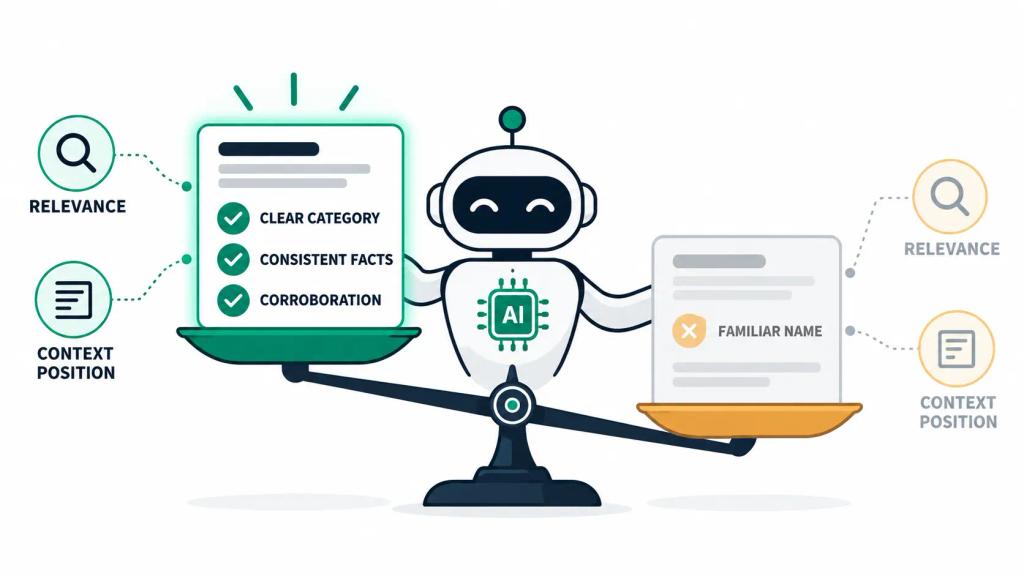
A 2026 analysis of 252,000 trials across six models found the primary drivers of a first citation. They were relevance and position in the model’s context. Keyword stuffing showed null or negative effect. The mechanics of how ChatGPT decides what to recommend reward the brand that defines what it does, for whom, and in which category.
So the brand that states its category plainly wins the slot. The one that assumes being known is enough loses it.
Define your entity before you write another word
A model recommends an entity it can resolve, not a name it has merely seen. That resolution starts with structured identity.
{
“@context”: “https://schema.org”,
“@type”: “Organization”,
“name”: “Your Brand”,
“url”: “https://yourbrand.com”,
“sameAs”: [
“https://www.linkedin.com/company/yourbrand”,
“https://www.crunchbase.com/organization/yourbrand”,
“https://www.wikidata.org/wiki/Qxxxxxxx”
],
“knowsAbout”: [“your category”, “your core service”]
}
Organization schema with sameAs and knowsAbout. Add Person schema for your named experts.
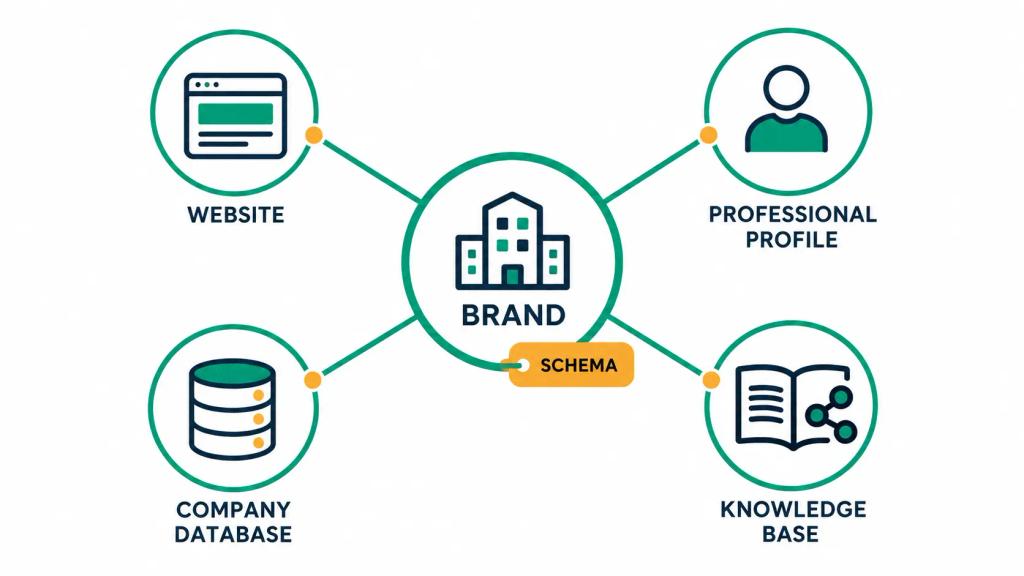
The sameAs links tie your site to profiles models already trust. The knowsAbout field states your category in machine-readable terms. This is the core of entity SEO: one consistent identity, repeated everywhere a model looks. Keep the same name, category, and facts across every one of those profiles.
Get named beside your category, not just mentioned
Being cited anywhere is not the goal. Being named in your category, beside its known players, is.
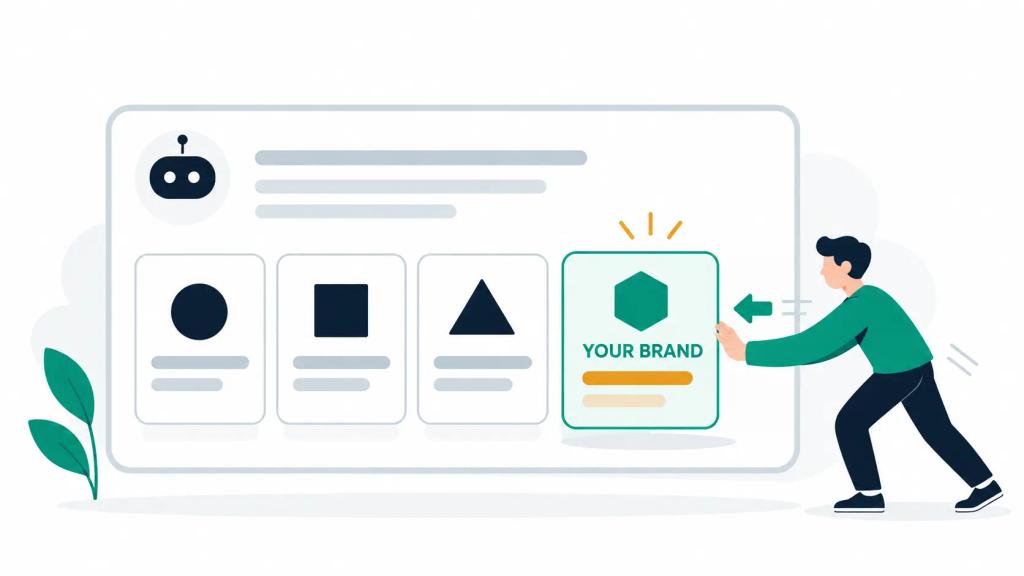
Chen and colleagues reported in 2025 that third-party and earned media appear overrepresented among the sources AI cites, an observational finding. Models also lean on category co-occurrence. You get recommended for a category by appearing beside its known names in trusted sources. That is also why competitors get cited while you are left off.
We saw this directly. One digital marketing agency was named inside Google AI Overviews and ranked #3 in its AI visibility benchmark, while its Google impressions rose 462% in three months. The mention was observed during the engagement, and AI answers vary by query, place and time.
Not sure how often AI recommends you versus a competitor? The complimentary AI Visibility Diagnostic shows the gap across the major answer engines.
Run the two-prompt test today
You cannot close a gap you have not measured. This takes 20 minutes, and you can run it without us.
Pick five category questions a buyer would ask. For each, first ask the engine what it knows about you, then ask it for the best providers. Do this in ChatGPT, Perplexity, Gemini, and Google AI. Record how often it knows you, and how often it names you. The gap between those two numbers is your real problem, and it maps directly to the work of getting recommended inside ChatGPT and its peers.
Write down both numbers for each question. That scoreboard is where every fix starts.
What this does not fix
Recommendation is not guaranteed, and no one can promise a date. A 2026 study found day-to-day source overlap of just 0.34 to 0.42 across engines, so answers shift. Entity and corroboration work compounds over weeks, not overnight. Most of this research uses English queries and anonymous sessions, so your market may differ.
And recommendation is not the only gap. If AI ignores you even when you rank well, that is a separate problem, covered in why AI never quotes your content. Strong search still underpins both.
A 30-day recommendation checklist
Use this as a fast starting point before you commit to a full program.
- Run the two-prompt test across ChatGPT, Perplexity, Gemini, and Google AI on five buyer questions.
- Record recognition rate and in-category recommendation rate separately.
- Add Organization and Person schema with sameAs and knowsAbout to key pages.
- Match your name, category, and core facts across your site, LinkedIn, Crunchbase, and Wikidata.
- List the brands AI names in your category, and the trusted sources that name them.
- Earn a place in those same sources through real reviews, press, and useful contributions.
- Track category share of voice monthly, not just brand mentions.
Where Intelitune fits
We do the entity and corroboration work this takes, then measure it against a documented baseline. Our AI SEO services are built to move you from recognized to recommended, not to chase vanity rankings. The agency above was named inside Google AI Overviews during that work, with Google impressions up 462% in three months.
Want to see how often AI recommends you versus your competitors, in your own category? The AI Visibility Diagnostic is a written read across the major answer engines, back in three business days. It is complimentary, with no sales call. If you only want a guaranteed mention, we are not the right agency.
Turning recognition into recommendation
Recognition was the easy win, and almost every brand already has it. Recommendation is the one that fills the pipeline, and it is still open. Most competitors are still checking whether AI knows their name and stopping there.
Start with a baseline of how often AI recommends you today. Fix the entity, consistency, and corroboration gaps, then keep earning a place beside your category’s known names. Do that and you stop being a brand AI can describe, and become the one it names.
Frequently Asked Questions
AI already knows my brand. Isn’t that enough?
No. Recognition and recommendation are separate results. In a 2026 study, ChatGPT knew brands 99.4% of the time but named them for a category question only 3.32% of the time. Being known does not get you on the shortlist a buyer actually asks for.
Is this the same as building backlinks?
Not quite. Links help, but the goal here is a resolvable entity and category association, not raw link volume. Models reward clear identity, consistent facts across trusted profiles, and being named beside your category. That is corroboration, which is broader than a backlink count.
How is this different from what my SEO agency does?
Most SEO still optimizes for rank and clicks. This optimizes for in-category recommendation, which rank does not predict. If your reports show positions and traffic but never how often AI names you versus competitors, they miss the result that now drives the shortlist.
How long until AI starts recommending us?
It depends on your starting point. Entity and consistency fixes can shift answers within weeks, while durable category recommendation usually builds over two to three months. Brands already earning reviews and press move faster. No one can promise a specific date, because recommendation is volatile.
Can you guarantee ChatGPT will recommend us?
No, and no honest provider can. Recommendation is low and volatile, with day-to-day source overlap near 0.34 to 0.42. We guarantee the entity work, the measurement, and a senior team, not a specific outcome. Anyone promising a guaranteed recommendation is selling what they cannot control.
Resources & Further Reading
The following authoritative sources were used to inform and validate this article:
- arXiv GEO survey is the source for the recognition-versus-recommendation and citation-driver findings.
- Princeton (arXiv) introduced Generative Engine Optimization and measured what boosts AI citations.
- Google Search Central is the official documentation on AI features and structured data.
- Schema.org defines the Organization type, sameAs, and knowsAbout used for entity signals.
- Wikidata is the open knowledge base models and search engines use to resolve brand entities.
- OpenAI documents how ChatGPT search browses the web and cites sources.